Fact sheet
- Common names
- Angelfish, freshwater angelfish, scalare
- Family
- Cichlidae (cichlids)
- Origin
- Amazon basin (Peru, Colombia, Brazil) and rivers of the Guianas
- Adult size
- About 6 in (15 cm) long, up to 8 in (20 cm) tall with fins
- Lifespan
- 10–12 years, sometimes more
- Minimum tank
- 30 gallons (114 L) for a pair, 55 gallons (208 L) for a group
- Temperature
- 76–82 °F (24–28 °C)
- pH
- 6.0–7.5
- Hardness
- GH 3–12 °dH, KH 2–8 °dH
- Diet
- Omnivore leaning carnivore (small invertebrates, fish fry)
- Temperament
- Semi-aggressive, territorial when pairing
- Care level
- Easy to moderate
01
Freshwater angelfish care at a glance
The angelfish is one of the most recognizable fish in the hobby: a laterally flattened, disc-shaped cichlid with long dorsal and anal fins that give it its tall, triangular silhouette. Captive breeding over many decades produced silver, zebra, marble, koi, black, platinum and veil-finned varieties, and nearly all angelfish sold in the US today are farm-raised rather than wild-caught. That makes them hardier and more tolerant of ordinary tap water than their reputation suggests.
What surprises new keepers is size and behavior. The quarter-sized juvenile in the store becomes a fish as tall as a hand within a year, and an adult angelfish is a cichlid with cichlid instincts: it claims territory, forms pairs and will eat any fish small enough to fit in its mouth. Plan the tank around the adult, not the juvenile, and cycle the tank fully before the first fish goes in.
- Tank: tall rather than long, at least 30 gallons for a pair, 55 gallons for a group
- Heater: adjustable, set to about 78–80 °F (26 °C)
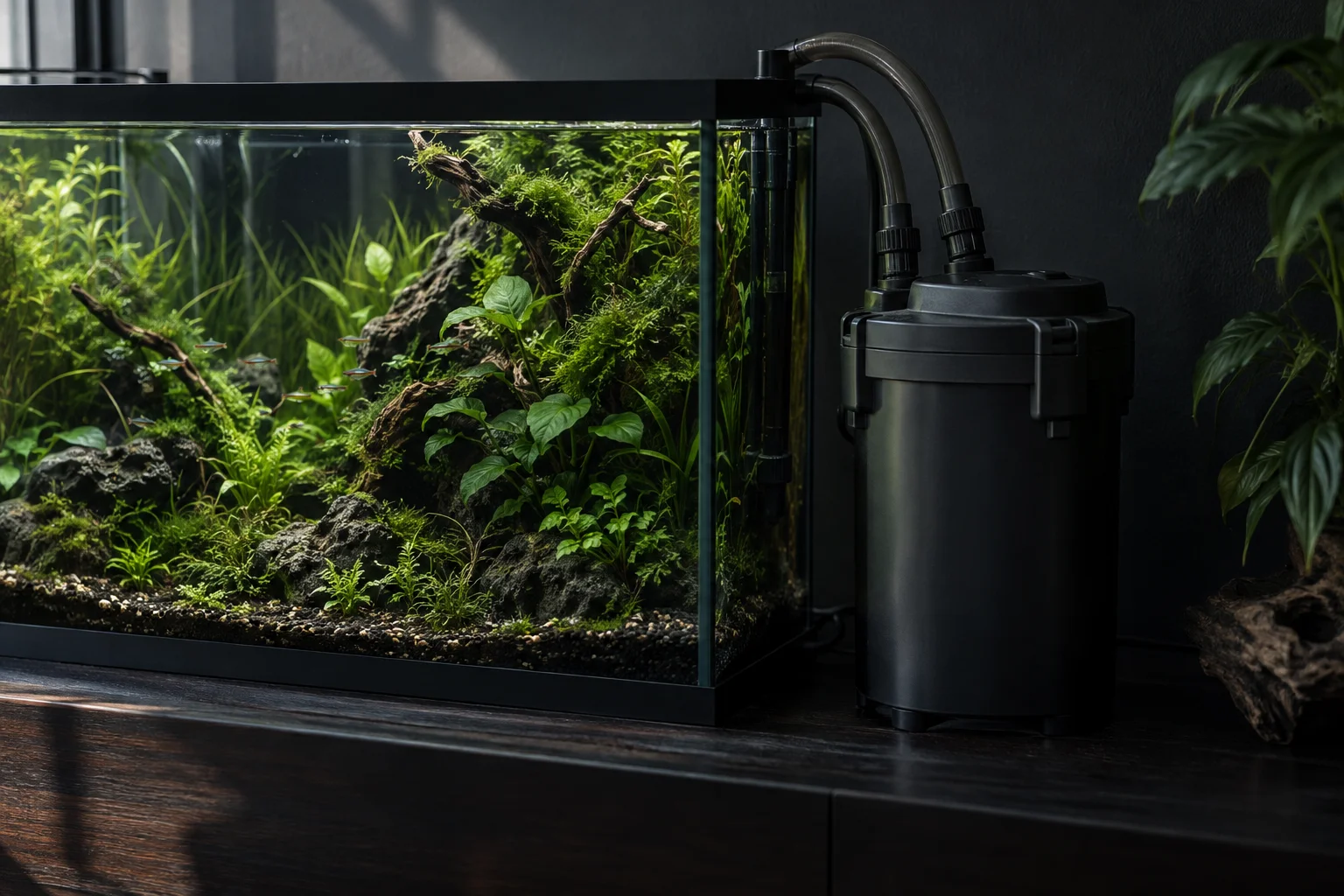
- Filter: good biological capacity with moderate, not strong, flow
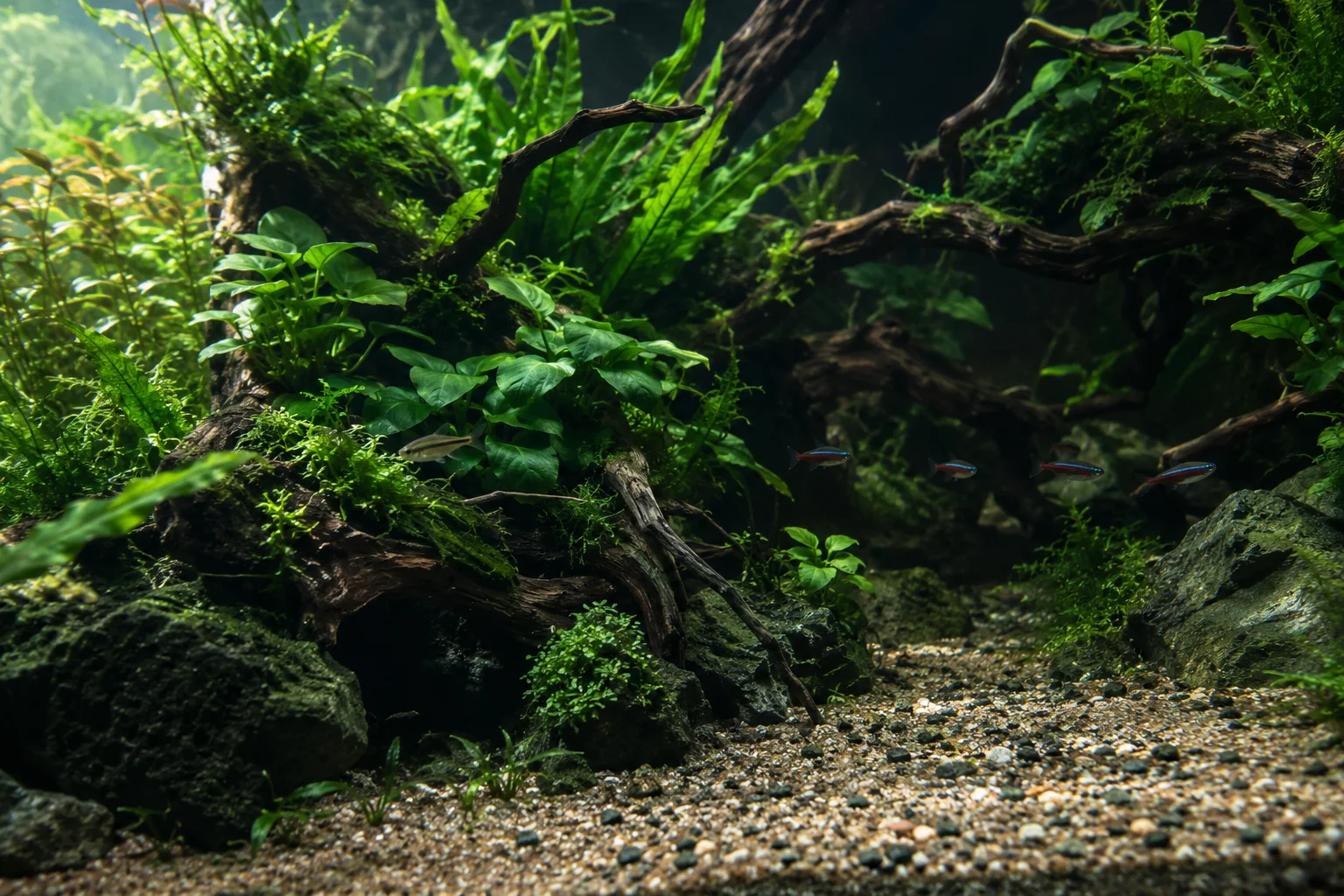
- Decor: tall plants, driftwood and open swimming space in the middle
- Group size: a single fish, a pair, or a group of 5–6 juveniles that will sort themselves out
02
Origin and natural habitat
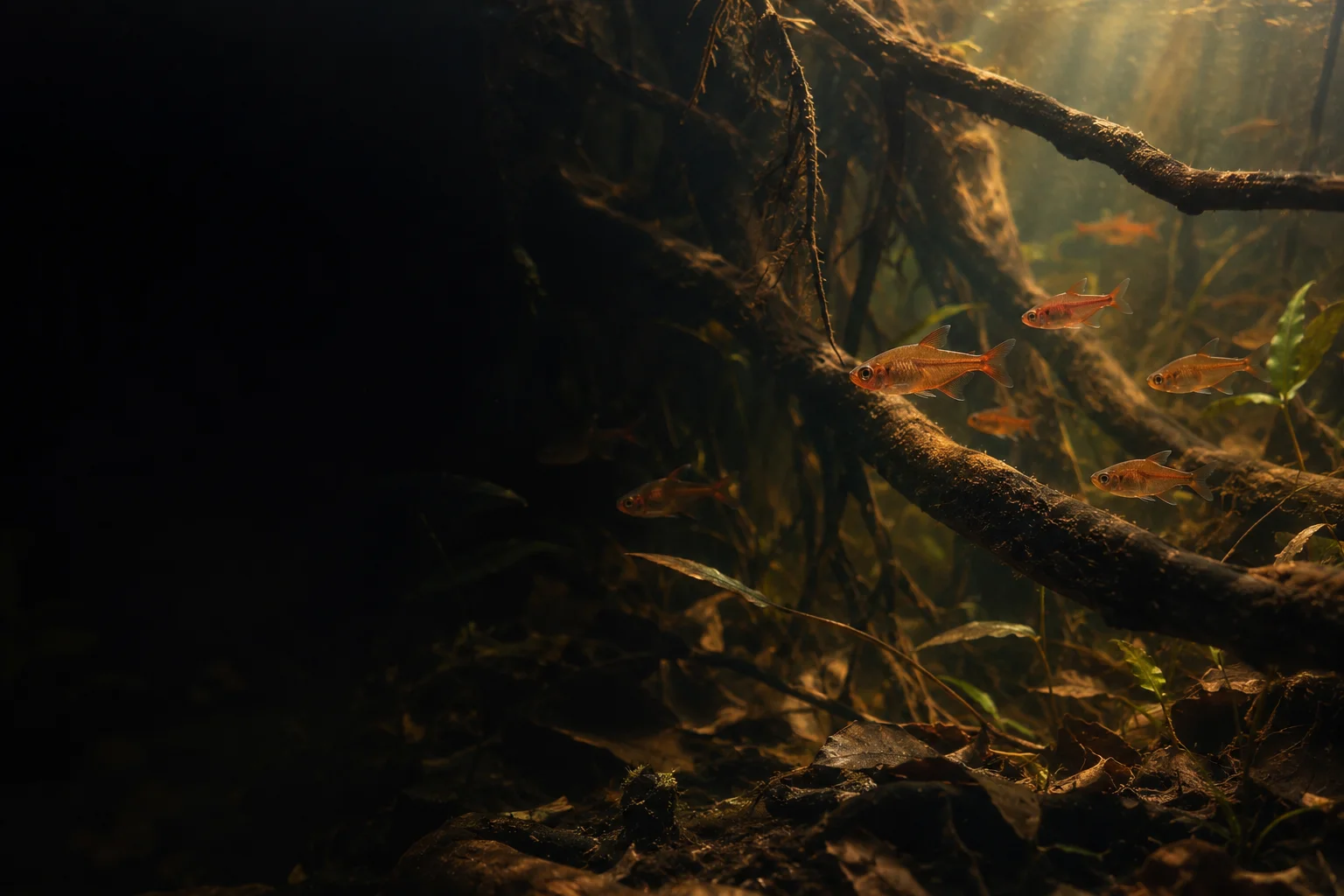
Wild Pterophyllum scalare live in the Amazon basin of Peru, Colombia and Brazil, and in some coastal rivers of the Guianas. They favor slow, quiet stretches: flooded forest margins, swampy backwaters and banks thick with submerged roots, branches and vegetation. The water there is warm, usually soft and slightly acidic, and often stained by tannins.
That habitat explains the body shape. A thin, tall fish slips between vertical roots and reed stems, hides in plain sight and ambushes small prey. In the aquarium, angelfish feel most secure with vertical structure (driftwood, tall stem plants or Amazon swords) and calm water. Two related species, P. altum and P. leopoldi, are kept by specialists but are much less common.
03
Adult size and lifespan
Adult angelfish reach about 6 inches (15 cm) in body length and up to 8 inches (20 cm) or more from the tip of the dorsal fin to the tip of the anal fin. Veil-finned strains look even taller. Growth is fast with good food and clean water: most juveniles reach adult size within 12–18 months.
With stable conditions, angelfish commonly live 10–12 years, and longer lifespans are reported. That is a long commitment for a fish often bought on impulse, so choose this species when you are ready for a medium to large tank for the next decade.
04
Angelfish tank size
Height matters as much as volume. A tank at least 18–20 inches (45–50 cm) tall lets an adult turn without bending its fins. A 29- or 30-gallon tall tank (110–114 L) works for one pair or a single angelfish with a small community. For a group of 4–6, or for angelfish with schooling tank mates, a 55-gallon (208 L) tank is the realistic starting point; our guide to the best 55-gallon aquarium compares complete kits.
If you start with a group of juveniles, expect a pair to form at some point. A breeding pair claims a third to half of a medium tank and can bully the others, so a 55-gallon or larger tank gives the rest of the fish somewhere to go. A 10- or 20-gallon tank is only suitable for very young fish on their way to a bigger home.
Do not buy a juvenile angelfish for a short 20-gallon tank "for now". Many owners never upgrade, and an adult angelfish in a shallow tank ends up stressed, with damaged fins.
05
Water parameters
Farm-raised angelfish adapt well to most treated US tap water, including moderately hard water with a pH near 7.5. Wild-caught fish and breeding pairs prefer softer, slightly acidic water. In both cases, stability is more important than a perfect number: avoid big pH or temperature swings during water changes, and test regularly with a reliable kit (see our best aquarium test kit picks). Our guide to aquarium water parameters explains each value.
Change 20–30% of the water every week and keep nitrate low. Angelfish are sensitive to accumulated waste, and long fins are often the first place stress shows.
| Parameter | Target range |
|---|---|
| Temperature | 76–82 °F (24–28 °C), 80–84 °F (27–29 °C) for breeding |
| pH | 6.0–7.5 |
| GH (general hardness) | 3–12 °dH (50–200 ppm) |
| KH (carbonate hardness) | 2–8 °dH (35–140 ppm) |
| Ammonia / nitrite | 0 ppm |
| Nitrate | Below 20 ppm |
06
Diet and feeding
In the wild, angelfish pick small crustaceans, insect larvae, worms and fry from the water column and plants. In the aquarium they accept almost everything. Use a quality cichlid or tropical flake or small pellet as the staple, and add frozen or live foods several times a week: bloodworms, brine shrimp, mysis and daphnia. A pellet with some plant content helps balance the diet.
Feed once or twice a day, an amount eaten within about two minutes. Angelfish are greedy and will beg constantly; overfeeding fouls the water faster than it fattens the fish. Our guide on how often to feed aquarium fish covers portion sizes and fasting days.
07
Behavior and angelfish tank mates
Angelfish are calm, slow-moving and inquisitive most of the time, often recognizing the person who feeds them. They become territorial when pairing or guarding eggs, and they are opportunistic predators. The classic mistake is mixing them with neon tetras: juveniles ignore them, but adult angelfish often eat neon tetras at night.
Good companions are peaceful, medium-sized fish that will not nip long fins and are too big to swallow. Bottom dwellers such as corydoras and the bristlenose pleco are classic choices. The full list, with what to avoid and stocking examples, is in our guide to angelfish tank mates.
- Usually compatible: corydoras, bristlenose pleco, larger tetras (rummy nose, black skirt, lemon), pearl gourami, larger rasboras
- Risky: neon and other small tetras, cherry shrimp, dwarf cichlids in a small tank
- Avoid: tiger barbs and other fin nippers, large aggressive cichlids, goldfish (cold water)
08
Breeding angelfish
Angelfish are open-substrate spawners and pair for life in many cases. Since males and females look nearly identical, most breeders raise a group of 6 juveniles and let pairs form naturally. A pair cleans a vertical surface (a broad leaf, a slate, a filter intake or a breeding cone) and the female lays rows of a few hundred eggs that the male fertilizes.
At around 80 °F (27 °C), eggs hatch in about 2–3 days and the fry become free-swimming roughly 5 days later. First foods are baby brine shrimp or fine powdered fry food. Young pairs often eat their first clutches; this is normal and usually stops after a few spawns. Many breeders remove the eggs to a separate container with an air stone and an anti-fungal treatment used per the label.
09
Common angelfish diseases
Most problems come from poor water quality, sudden temperature changes or new fish added without quarantine. Quarantine every newcomer for 2–4 weeks and acclimate new fish slowly. For any serious or spreading condition, consult an aquatic veterinarian.
| Problem | Typical signs | Where to start |
|---|---|---|
| Ich | White salt-like spots, scratching | Raise temperature gradually and treat, see ich in fish |
| Gill flukes | Fast breathing, flared gills, rubbing | See gill flukes, treat with a fluke medication per label |
| Fin rot | Frayed, shortening fins | Water quality first, then fin rot treatment |
| Hole in the head | Small pits on the head and lateral line | Improve water quality and diet, ask a vet |
| Angelfish virus | Lethargy, slime, rapid deaths in new stock | Isolate new fish, buy from reputable breeders |
10
Recommended gear
A tall tank is the main investment. For filtration, a canister or a large hang-on-back with a spray bar keeps flow gentle while handling the bioload; compare models in our best canister filter guide. An adjustable heater sized at roughly 3–5 W per gallon keeps temperature steady, see the best aquarium heater list.
Add a liquid test kit, a gravel vacuum for weekly maintenance and a water conditioner that handles chlorine and chloramine. Live plants such as Amazon swords, java fern and anubias suit angelfish well. If you are still deciding between show fish, our list of centerpiece fish compares the angelfish with other options.
Frequently asked questions
Frequently asked questions
What is the right angelfish tank size?
Plan at least a 30-gallon tall tank (114 L) for one pair and 55 gallons (208 L) for a group of 4–6 angelfish. Height is key: aim for 18–20 inches (45–50 cm) of water depth so adults can turn comfortably. Smaller tanks only suit juveniles for a few months.
Can angelfish live with neon tetras?
Often not for long. Young angelfish ignore neon tetras, but adults are predators and frequently eat small tetras, usually at night. If you want tetras with angelfish, choose larger species such as rummy nose, lemon or black skirt tetras, add them before the angelfish grows, and keep a big group.
How many angelfish should be kept together?
Keep one angelfish, one pair, or a group of five or more in a 55-gallon tank or larger. Two or three angelfish together often leads to one fish bullying the others. In a group, aggression spreads out, though a breeding pair may eventually need to be separated.
How long do freshwater angelfish live?
Freshwater angelfish typically live 10–12 years with clean, stable water and a varied diet, and some live longer. Short lifespans usually trace back to small tanks, poor water quality or disease brought in by new fish without quarantine.
Is angelfish care hard for beginners?
Not especially, if the tank is big and tall enough. Farm-raised angelfish tolerate a range of water conditions and eat most foods. The real challenges are planning for their adult size, picking tank mates they will not eat, and keeping nitrate low with weekly water changes.
Sources and references
Written and reviewed by the handsoffmyhobby editorial team according to our editorial policy.