Fact sheet
- Family
- Alismataceae
- Origin
- Tropical South America
- Height
- 12–20 in (30–50 cm), occasionally taller
- Light
- Medium (tolerates low)
- CO2
- Optional
- Growth rate
- Moderate to fast once rooted
- Difficulty
- Easy
- Placement
- Background or centerpiece, tanks of 30 gallons (110 L) and up
- Temperature
- 72–82 °F (22–28 °C)
- pH
- 6.5–7.5 (tolerates about 6.0–8.0)
01
Amazon sword at a glance
The name Amazon sword covers several Echinodorus plants, but in US stores it almost always means Echinodorus grisebachii 'Bleheri', long sold as E. bleheri or E. amazonicus. It forms a rosette of long, lance-shaped leaves from a short rhizome and a dense mat of roots. Under good conditions a single plant can fill a 12-inch (30 cm) wide patch of the background.
It suits community tanks with tetras, angelfish, corydoras and other South American fish, and it is one of the few large plants that grows well without injected CO2. It also appears in our list of the best aquarium plants for beginners, as long as you respect its size and its appetite for root nutrients.
- Fast visual impact: one plant becomes a focal point
- Grows under medium light without CO2
- Absorbs nitrate and ammonia, helping water quality
- Needs space and root fertilizer, two things beginners often forget
02
Amazon sword types
Several sword plants are sold side by side. The table helps you pick the right one for your tank size.
| Plant | Typical height | Notes |
|---|---|---|
| Amazon sword (E. grisebachii 'Bleheri') | 12–20 in (30–50 cm) | The classic, bright green, easiest to find |
| Echinodorus 'Ozelot' | 8–16 in (20–40 cm) | Green leaves with red-brown spots, compact |
| Echinodorus 'Red Flame' / 'Rubin' | 12–20 in (30–50 cm) | Red to burgundy leaves, likes more light |
| Melon sword (E. osiris type) | 12–20 in (30–50 cm) | Wider leaves, reddish new growth |
| Pygmy chain sword (Helanthium tenellum) | 2–4 in (5–10 cm) | Foreground carpet, formerly Echinodorus tenellus |
03
How to plant an Amazon sword
Swords root deeply, so the substrate matters more than for epiphytes like anubias. Use at least 2–3 inches (5–7 cm) of fine gravel, sand over a nutrient layer or an aquarium soil. If you are still choosing, our guide to the best aquarium substrate compares the main options.
- Remove the pot and rock wool, and trim roots to about 2 inches (5 cm) to encourage fresh growth.
- Remove damaged or very large farm-grown leaves; they will likely melt anyway.
- Dig a hole at the back or center of the tank, at least 6 in (15 cm) from other large plants.
- Set the plant so the crown (where leaves meet roots) sits just above the substrate surface.
- Push one or two root tabs into the substrate a couple of inches from the base.
- Leave it in place: swords sulk when they are moved repeatedly.
04
Amazon sword care: light, fertilizer and water
Medium light gives compact, healthy leaves. Under weak light the plant survives but stretches and drops lower leaves; under very strong light without enough nutrients, algae settle on older leaves. Most modern LED fixtures sold with 30–55 gallon tanks are sufficient, and our best aquarium light guide explains what to look for if yours is not.
Fertilizer is where Amazon sword care succeeds or fails. The plant draws most of its nutrition through the roots, so inert gravel runs out quickly. Push root tabs (Seachem Flourish Tabs, API Root Tabs or similar) near the base every 2–3 months, following the label, and add a liquid fertilizer if the tank holds other plants. Our page on aquarium fertilizer explains the difference between root and water column feeding.
CO2 is not required. If you already run a CO2 system, swords grow faster and larger, so prune more often. Water chemistry is flexible: soft to moderately hard water and 72–82 °F suit them. Regular water changes and stable nitrate help; see how to lower nitrates if levels climb.
Prune the oldest outer leaves at the base when they yellow or collect algae. This redirects energy to new growth and keeps light reaching plants below.
05
Propagation
A healthy Amazon sword sends out long stalks that, underwater, produce small plantlets instead of flowers. Let a plantlet grow 4–5 leaves and its own roots, then cut it free and plant it, or pin the stalk to the substrate so it roots in place first. Large, old plants can also be divided by cutting the rhizome into sections, each with leaves and roots.
06
Common Amazon sword problems
Most problems come from the switch to underwater life or from a lack of root nutrients.
| Symptom | Likely cause | What to do |
|---|---|---|
| Leaves melt in the first weeks | Plant was grown emersed on a farm | Trim melting leaves, keep roots fed; new leaves follow |
| Older leaves turn yellow | Nitrogen or iron shortage, exhausted root tabs | Add root tabs, check liquid fertilizer |
| Pinholes in leaves | Potassium shortage | Use a fertilizer containing potassium |
| Brown or black algae on old leaves | Excess light for nutrient levels, old leaves | Remove affected leaves, see brown algae |
| Leaves reach the surface and shade the tank | Plant has outgrown the tank | Prune tall leaves or move it to a bigger tank |
07
Tank ideas with Amazon sword
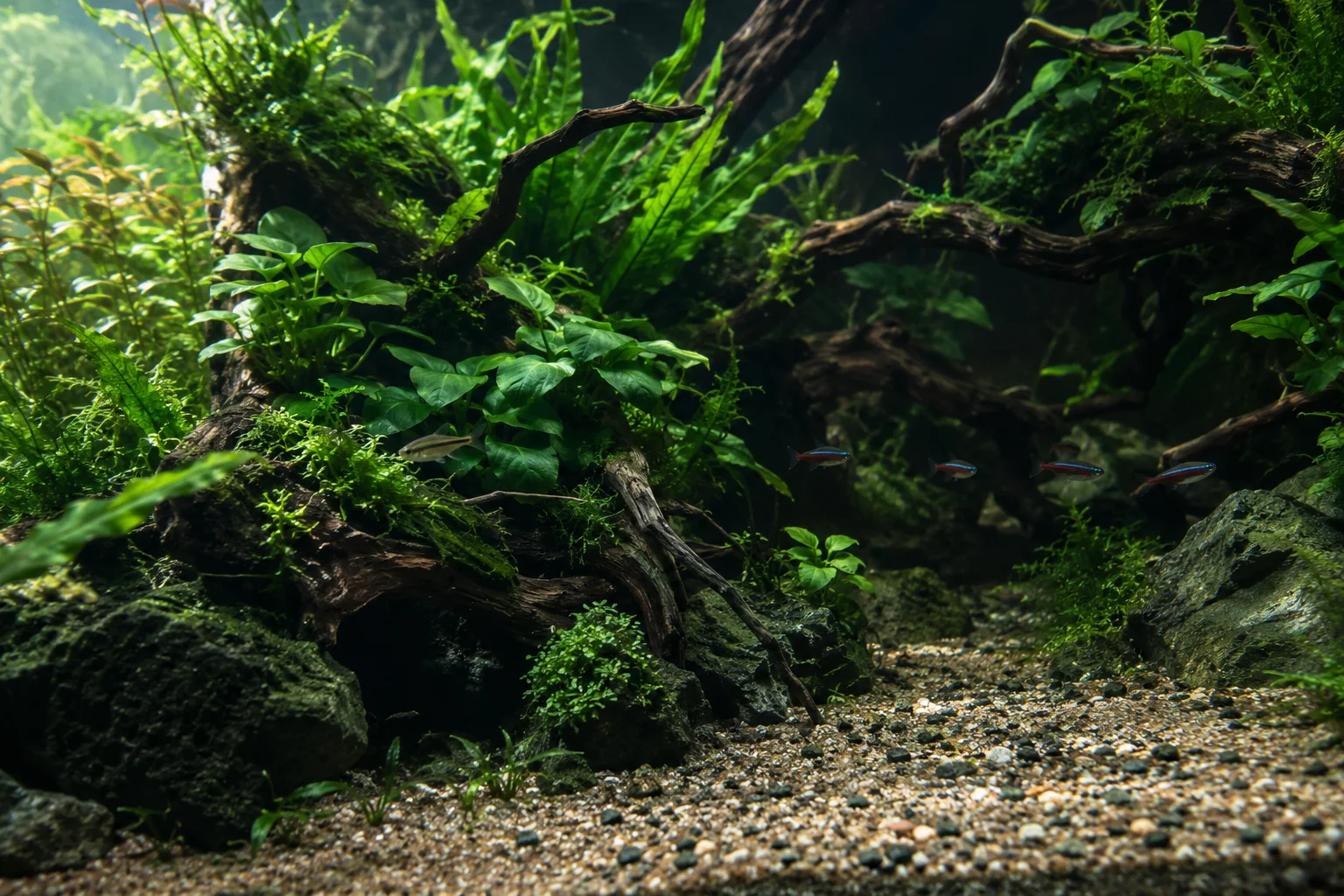
Amazon swords anchor a Dutch aquascape background or a lush South American biotope with angelfish and tetras. In a 55-gallon tank, three swords at the back with Java fern on driftwood in front and a carpet of pygmy chain sword make a balanced, low-tech layout. Avoid them in tanks under 20 gallons, where one plant fills everything, and with fish that eat soft plants such as silver dollars.
Frequently asked questions
Frequently asked questions
Why is my Amazon sword melting?
Most Amazon swords are grown emersed, with leaves in the air. Underwater, those leaves often yellow and dissolve during the first weeks while the plant builds new submerged leaves. Trim the melting leaves, keep the roots fed with a root tab, and avoid moving the plant. If the crown stays firm, it will recover.
What is the best Amazon sword fertilizer?
Root tabs are the best Amazon sword fertilizer, because the plant feeds mainly through its roots. Push one or two tabs into the substrate near the base every 2–3 months, as directed on the label. In tanks with many plants, add a complete liquid fertilizer as well to cover potassium and trace elements.
How big does an Amazon sword get?
Usually 12–20 inches (30–50 cm) tall and nearly as wide, sometimes taller in deep tanks with strong light and CO2. That is why a tank of about 30 gallons or more is recommended. In smaller tanks, choose a compact sword such as 'Ozelot' or a foreground species.
Does Amazon sword need CO2?
No. It grows well in low-tech tanks with medium light and good root fertilization. CO2 makes it grow faster and bigger, which can be a disadvantage in a medium tank because you will prune more often. Stable light and nutrients matter more than CO2 for this plant.
Can Amazon sword grow in sand?
Yes, as long as the sand is deep enough (2–3 inches) and you add root tabs, since plain sand contains no nutrients. Very fine, compact sand can limit root growth, so a slightly coarser sand or a nutrient layer underneath gives better results.
Sources and references
Written and reviewed by the handsoffmyhobby editorial team according to our editorial policy.