01
What counts as a low light aquarium?
Light for plants is best measured as PAR (photosynthetically active radiation) at the substrate. As a rough guide, about 15–30 PAR is low light, 30–50 is medium and anything above 50 is high light, the level where carpets and red stem plants thrive with CO2. Watts and lumens are poor indicators, because LED efficiency and tank depth vary so much.
Without a PAR meter, assume low light if you have the basic LED that came with a kit tank, a tank deeper than about 20 inches (50 cm), or a light that covers only part of the tank. In those conditions, shade-tolerant plants grow slowly but healthily, while light-hungry species stretch, lose their lower leaves and fade.
Low light also means low demand. Plants growing slowly need little CO2 and fertilizer, which is why low light tanks are the easiest planted tanks to keep balanced.
02
Why some plants thrive in low light
Most low light aquarium plants come from shaded habitats: forest streams, riverbanks under a canopy, or rocks splashed by water in the rainforest. Java fern, anubias, Bucephalandra and Bolbitis are epiphytes that grow attached to roots and stones, while many crypts live on shaded stream beds in Southeast Asia. They evolved to grow slowly on little light, with thick or leathery leaves that last for months.
That slow growth is the main trade-off. A low-light tank fills in over months rather than weeks, and old leaves can collect algae because they stay on the plant for a long time.
03
The 15 best low light aquarium plants compared
The table includes species with their own care guide on handsoffmyhobby and others covered only here. All grow without CO2 at 72–82 °F (22–28 °C) and pH 6–7.5 unless noted.
| Plant | Placement | Growth | Notes |
|---|---|---|---|
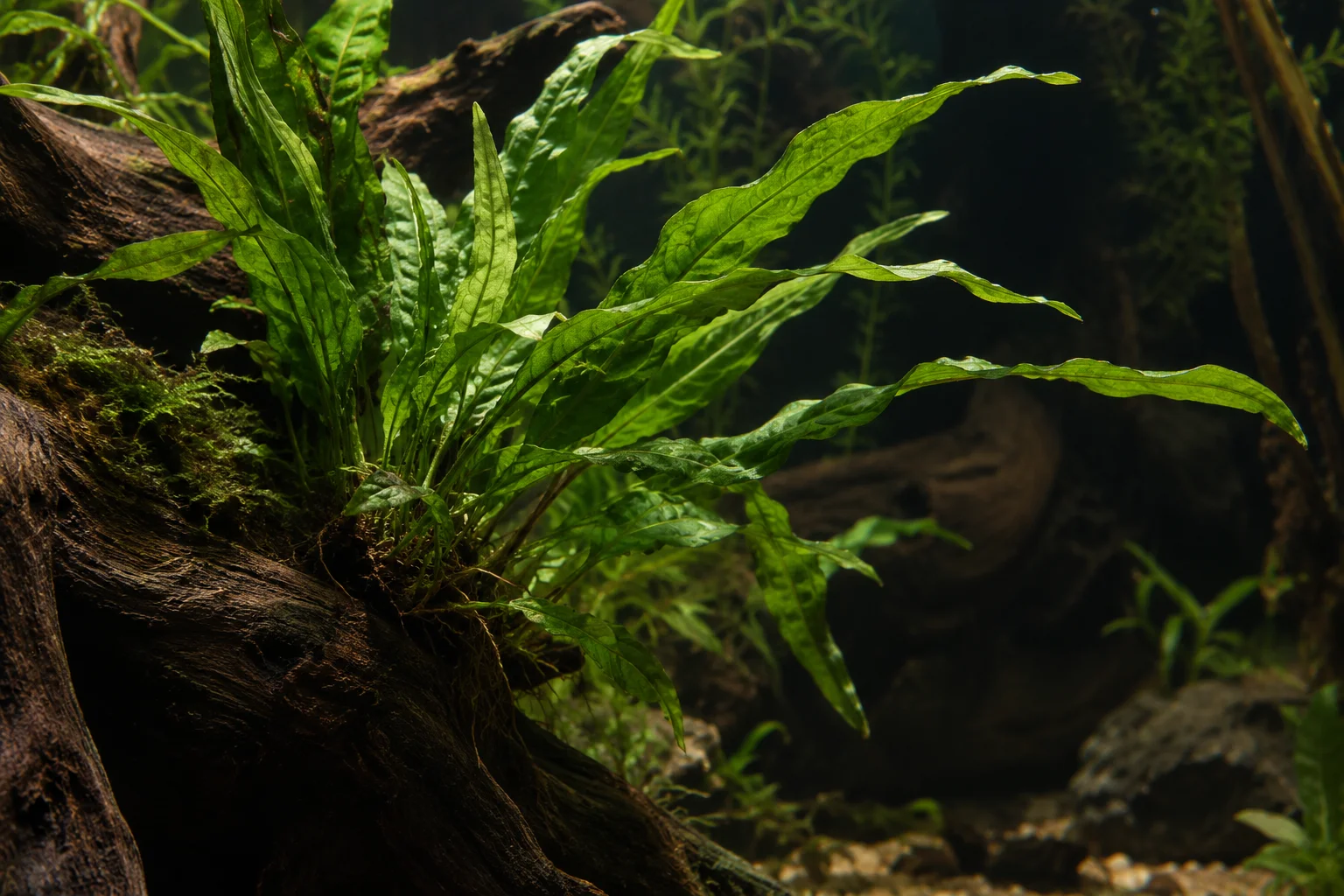
| Java fern (Microsorum pteropus) | Midground, on wood or rock | Slow | Never bury the rhizome; 'Windelov' and 'Trident' are also low light |
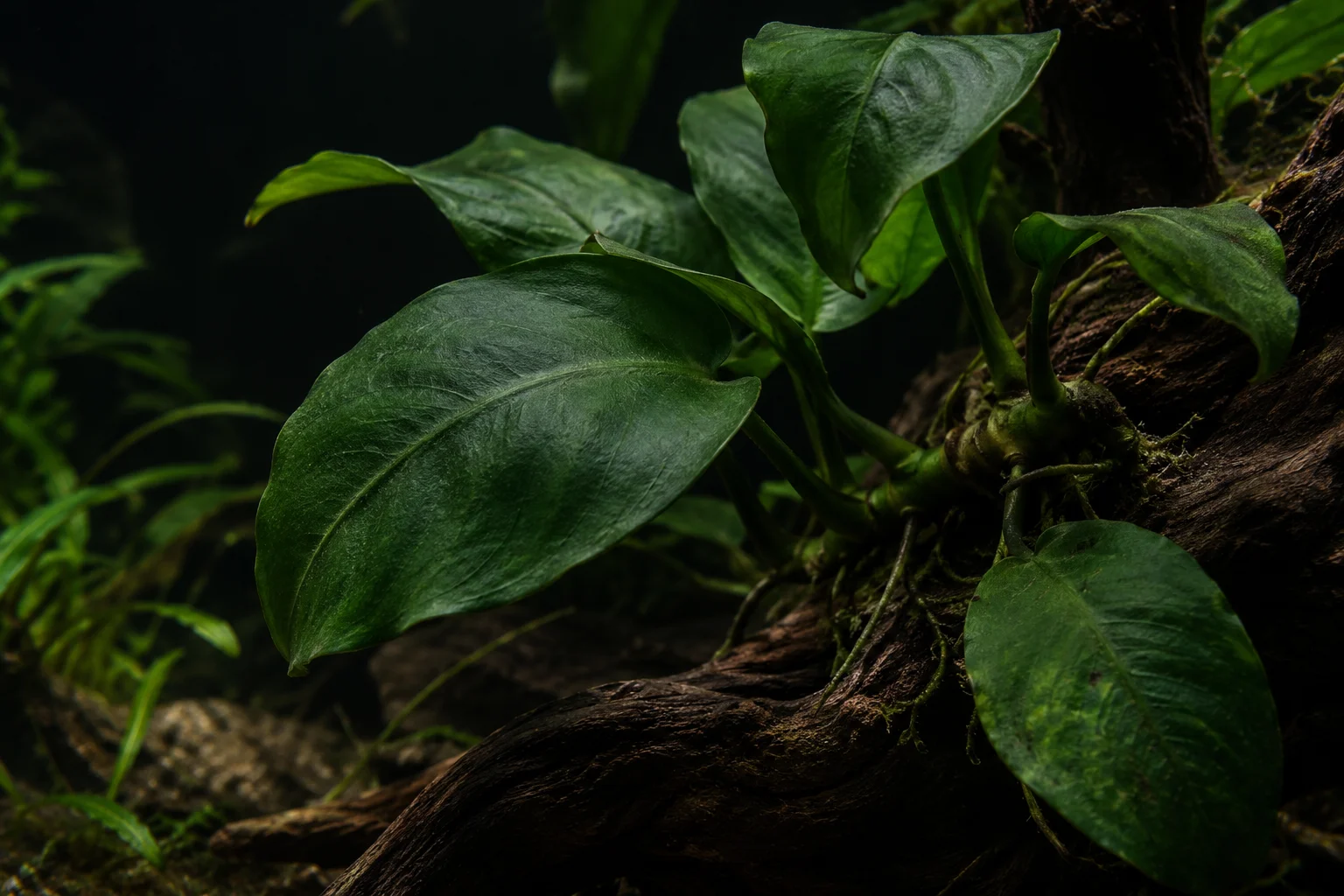
| Anubias barteri var. nana | Foreground, on decor | Very slow | Prone to green spot algae under strong light |
| Anubias barteri | Midground to background | Very slow | Larger leaves; safe with herbivorous fish |
| Java moss (Taxiphyllum barbieri) | Anywhere | Moderate | Shrimp favorite; trim to keep it clean |
| Christmas moss (Vesicularia montagnei) | On wood, walls | Slow | Neater, triangular fronds |
| Subwassertang (Lomariopsis lineata) | On wood or rock | Slow | Liverwort-like fern gametophyte, no roots |
| Bucephalandra species | Foreground, on rock | Very slow | Many cultivars; keep the rhizome uncovered |
| Bolbitis heudelotii (African water fern) | Midground, on wood | Slow | Prefers some water flow |
| Cryptocoryne wendtii | Foreground to midground | Slow | Root feeder; may melt after planting |
| Cryptocoryne beckettii | Midground | Slow | Root feeder; similar care to C. wendtii |
| Marsilea hirsuta | Foreground | Slow | Low-tech carpet option, needs time and root tabs |
| Vallisneria (Vallisneria spiralis) | Background | Moderate | Low to medium light; spreads by runners |
| Hornwort (Ceratophyllum demersum) | Floating or planted | Fast | Strong nutrient sponge, may shed needles |
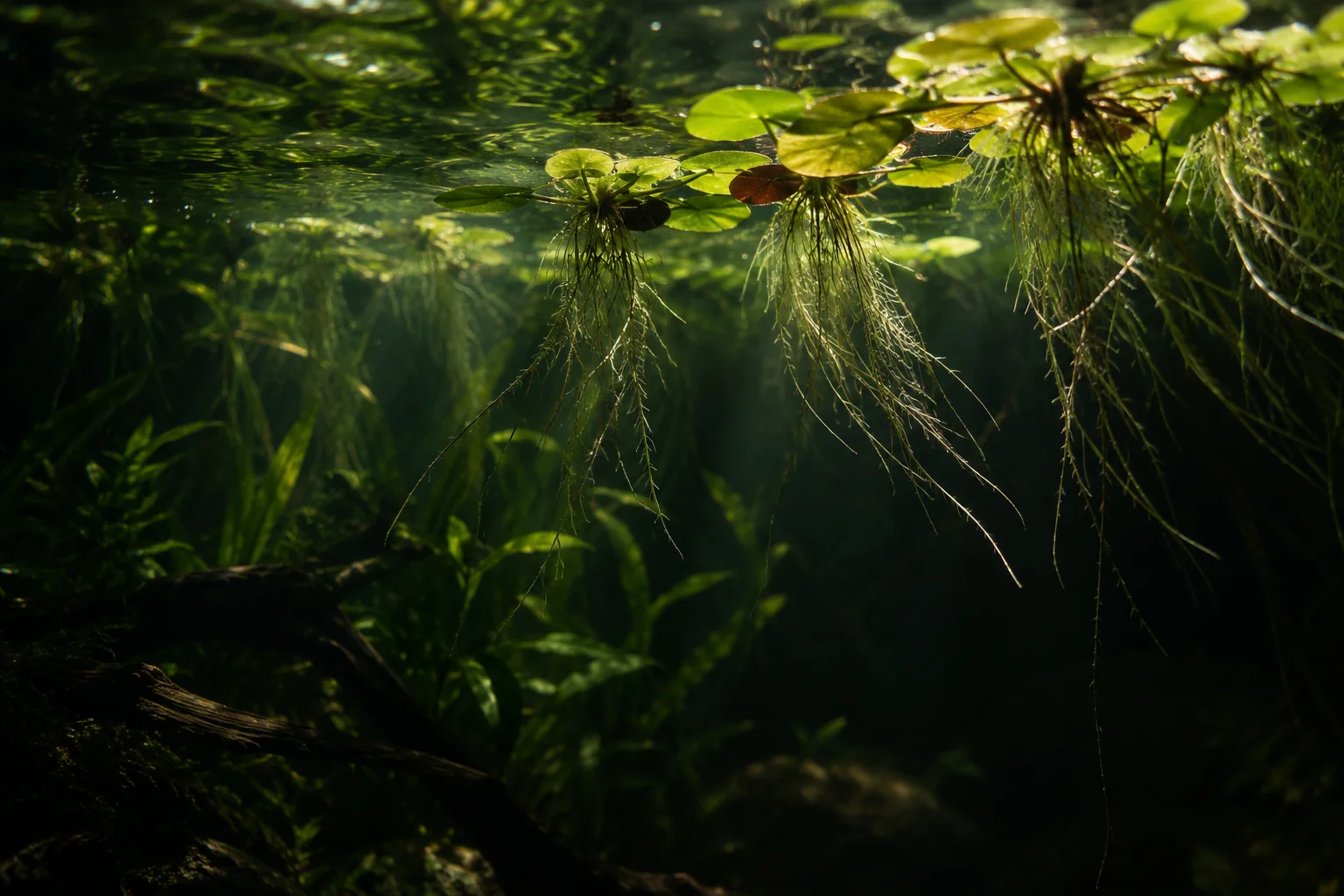
| Amazon frogbit (Limnobium laevigatum) | Surface | Fast | Close to the lamp; thin regularly to avoid shading |
| Marimo moss ball (Aegagropila linnaei) | Foreground, loose | Very slow | Prefers cooler water, under about 77 °F (25 °C) |
Java fern care guide: planting, propagation and common problems
The reference low light plant. Grows on wood in the dimmest tanks and is ignored by almost all fish.
PlantsAnubias care guide: types, planting, light and propagation
Slow, tough and happy in shade. Place it under taller plants or wood where little light reaches.
PlantsFloating aquarium plants: the 10 best floaters and how to keep them
Floaters sit right under the lamp, so they grow fast even in a low-light tank. Use them for shade and nitrate control.
PlantsBest aquarium plants for beginners: 15 easy live plants
The wider beginner list, including medium-light swords and stem plants for when you upgrade your light.
04
How to place and plant them
Most of the best low light plants are epiphytes. Tie or glue them to driftwood and rock with cotton thread, fishing line or gel superglue, and leave the rhizome exposed. This lets you build height without needing a deep, rich substrate, and makes rearranging easy.
Use the light gradient in your tank. Put the most shade-tolerant plants (anubias, mosses, Subwassertang) under overhanging wood or in the corners, and keep the brightest central spot for crypts, vallisneria and anything that grows a little faster. Root feeders still need nutrients: push root tabs near crypts and vallisneria every 2–3 months, as described in our aquarium fertilizer guide.
- Keep floating plants to about a third of the surface so they do not starve the plants below
- Rinse mosses and check new plants for snails before adding them
- Plant densely from the start, mixing a few fast growers like hornwort with the slow species
- Leave crypts alone after melting: the roots regrow leaves within a few weeks
05
Lighting, fertilizer and carbon in a low-tech tank
Run the light 6–8 hours a day on a timer. A longer photoperiod does not make slow plants grow faster, but it does give algae more time. If you replace the stock light, look for a fixture with a dimmer so you can stay in the low to medium range; our best aquarium light review flags the models that suit low-tech tanks.
Dose an all-in-one liquid fertilizer once a week, starting at half the label dose and adjusting to plant growth and nitrate readings. Liquid carbon products based on glutaraldehyde (such as Seachem Flourish Excel) can give slow plants a modest boost, but follow the label carefully: some plants, notably vallisneria and some mosses, react badly to higher doses. Injected CO2 is unnecessary here; our aquarium CO2 guide explains when it starts to make sense.
06
Sample low light layouts by tank size
These layouts suit the stock lights of most kit tanks and rely mostly on epiphytes, which means very little substrate work.
- 10 gallon (38 L): a driftwood branch with 2 Java ferns and a clump of Christmas moss, 2 Anubias nana and 1–2 Bucephalandra on stones, 3 Cryptocoryne wendtii and a few frogbit. A good home for cherry shrimp or a betta.
- 20 gallon (75 L): 6 vallisneria along the back, 4–5 crypts in the midground, 3 Java ferns and 2 Anubias barteri on wood, Subwassertang on a rock and hornwort in one corner.
- 55 gallon (208 L): a large driftwood centerpiece covered with Java fern, Bolbitis and moss, groups of 5–8 crypts at its base, Anubias barteri in the shaded areas, 10–15 vallisneria at the back and a corner of frogbit.
07
Plants to avoid in low light
Carpets such as dwarf hairgrass and Monte Carlo, red stem plants like Rotala macrandra and Alternanthera reineckii, and most fine-leaved stems will stretch, lose color and melt under low light. The Amazon sword survives in moderate light but grows leggy and slow in a truly dim tank.
If algae appears, check the photoperiod before anything else. Green spot algae on old anubias leaves is common and mostly cosmetic; black beard algae usually signals unstable carbon or poor flow. Snails from our best snails for algae list help keep leaves clean.
Frequently asked questions
Frequently asked questions
What aquarium plants grow with no CO2 and low light?
Java fern, anubias, Java moss, Christmas moss, Bucephalandra, Subwassertang, Bolbitis, Cryptocoryne wendtii, hornwort and marimo balls all grow with no CO2 under low light. Floating plants such as Amazon frogbit also do well because they sit close to the lamp. Expect slow growth and plant densely from the start.
Can aquarium plants grow without any light?
No. Every plant needs light to photosynthesize. Shade-tolerant species manage with very little, such as a stock LED or bright indirect daylight, but a tank kept dark will see even Java fern and anubias slowly decline. Plan for at least 6 hours of artificial light a day.
Is the light that came with my aquarium kit enough for plants?
For low light plants, usually yes. Most kit LEDs provide enough light for Java fern, anubias, mosses, crypts and floaters in tanks up to about 16–20 inches (40–50 cm) deep. They are generally not enough for carpets or red stem plants.
Why are my low light plants getting algae?
Slow plants keep their leaves for months, so algae has time to settle. The usual causes are a photoperiod longer than 8 hours, direct sunlight on the tank, excess nutrients from overfeeding, or too few plants overall. Shorten the light period, add fast growers and introduce algae-eating snails.
Sources and references
Written and reviewed by the handsoffmyhobby editorial team according to our editorial policy.