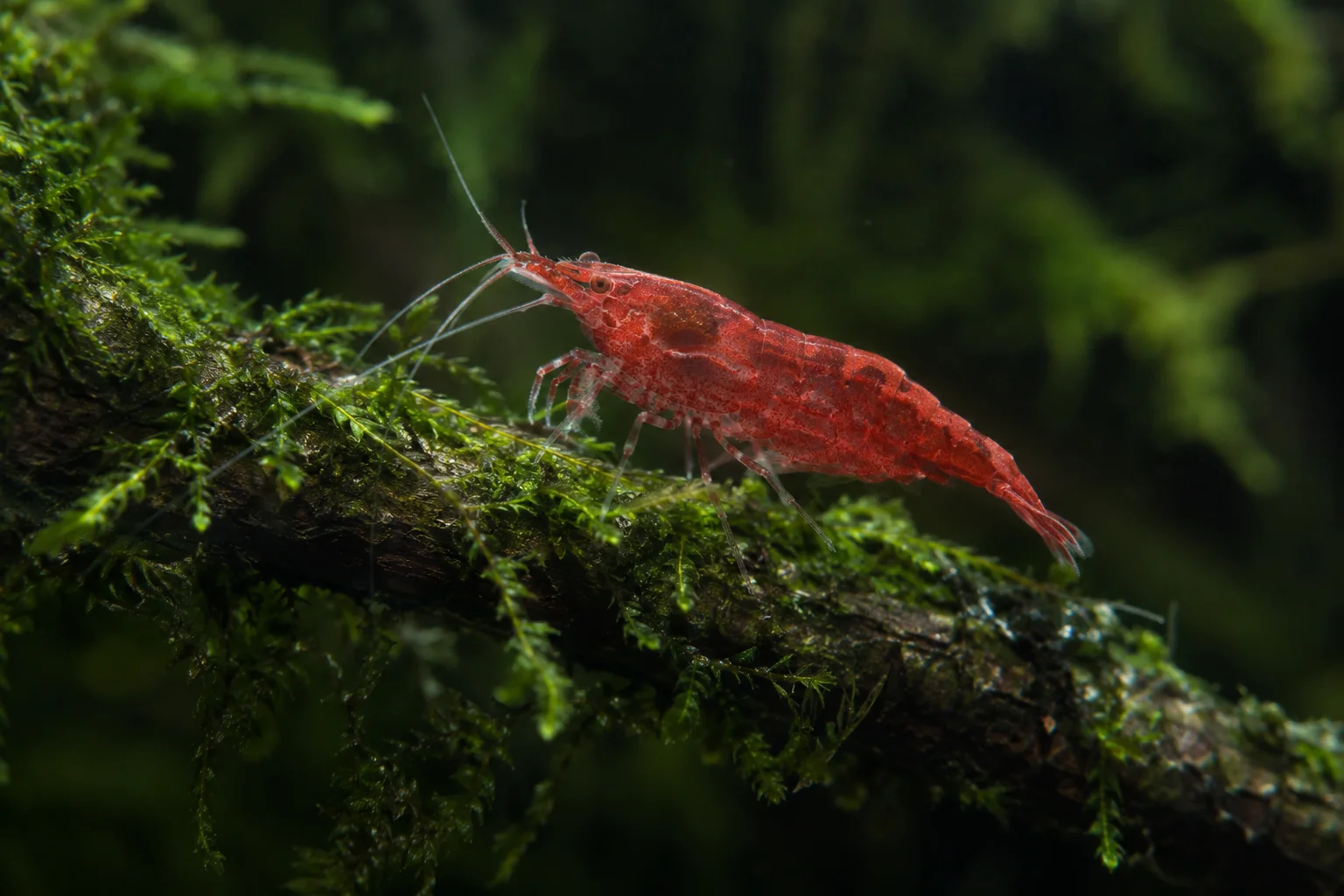
Fact sheet
- Common names
- Amano shrimp, Japanese algae-eating shrimp, Yamato shrimp
- Family
- Atyidae
- Origin
- Coastal rivers of Japan and Taiwan
- Adult size
- 1.2–2 in (3–5 cm), females larger
- Lifespan
- 2–3 years, often longer
- Minimum tank
- 10 gallons (38 L)
- Temperature
- 68–80 °F (20–27 °C)
- pH
- 6.5–7.8
- Hardness
- GH 6–15 °dH, KH 2–10 °dH
- Diet
- Omnivore: algae, biofilm, detritus, leftovers
- Temperament
- Peaceful, best in groups of 3–6+
- Care level
- Easy to keep, very hard to breed
01
Amano shrimp at a glance
The amano shrimp became famous through Takashi Amano, the Japanese aquascaper who popularized it in the 1980s and 1990s as a natural way to keep algae out of planted layouts. Decades later, it is still the go-to algae-eating shrimp for planted tanks and community aquariums.
Amanos are larger, bolder and longer-lived than cherry shrimp, and their size makes them safe with many small and medium community fish. The trade-off is that they almost never reproduce in a home aquarium, so every amano you own was either wild-caught or raised in a specialist hatchery.
- Tank: 10 gallons or more, planted and mature
- Group: 3–5 for a 10-gallon tank, about 1 per 2–3 gallons in larger tanks
- Lid: essential, amanos climb tubing and escape
- Filter: covered intake or sponge filter
- Food: algae, plus wafers or pellets when algae runs out
02
Origin and natural habitat
Caridina multidentata, long sold as Caridina japonica, lives in short, fast coastal rivers in Japan and Taiwan. Adults live in freshwater among rocks and plants, but the species is amphidromous: females release larvae that drift downstream to the sea, develop in salt water, then migrate back upriver as juveniles.
This life cycle explains two things about amanos in aquariums. They are strong, adaptable shrimp used to changing conditions, and they cannot complete their development in a freshwater tank.
03
Amano shrimp size and lifespan
Amano shrimp size is one of their main advantages. Adults usually reach 1.2–2 inches (3–5 cm), with females at the top of that range. Females show a continuous line of dashes along the side and a broader underside for carrying eggs; males are smaller with evenly spaced dots.
Expect 2–3 years of life in a stable tank, and many keepers report amanos living considerably longer. Their bodies are mostly translucent grey with a brown or bluish tint, and they take on some color from what they eat.
04
Tank size and setup
A 10-gallon (38 L) aquarium is a practical minimum for a small group. Amanos are active foragers that roam the whole tank, and a larger volume also produces more algae and biofilm for them to eat. A 20-gallon tank with 5–8 amanos is a classic planted setup; see our picks for the best 20-gallon aquarium.
Add them to a fully cycled, mature tank only: amanos are hardy once settled but sensitive to ammonia, nitrite and copper. Give them plants, wood and rock to climb and graze. A tight lid is non-negotiable, since amanos will climb heater cords and filter tubes, particularly in the first days or when water quality drops.
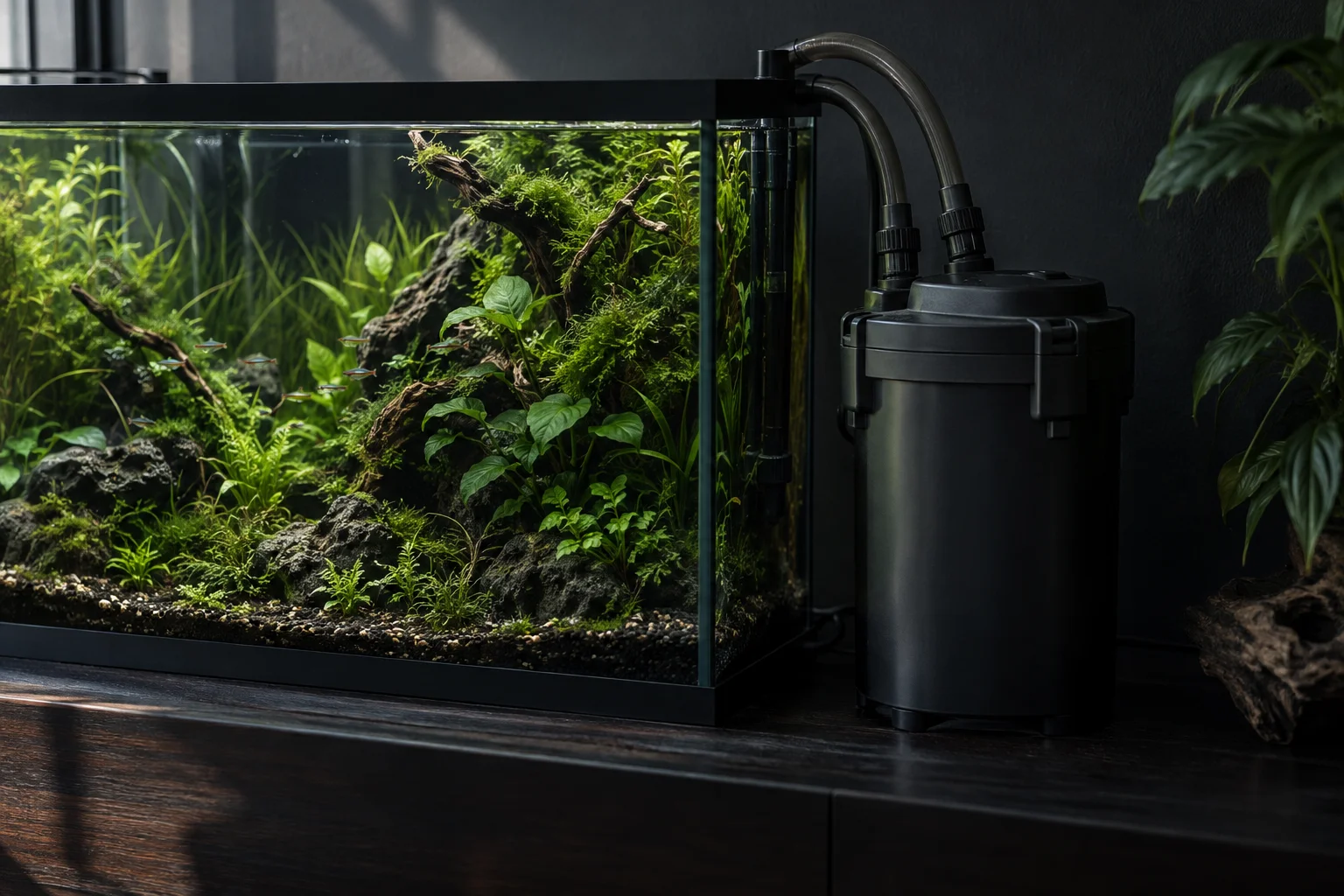
Any filter works if the intake is covered with a sponge. A sponge filter doubles as a grazing surface, and amanos are often seen picking it clean.
05
Water parameters
Amanos tolerate a wider range than most shrimp, which is one reason they suit community tanks. Treat tap water with a water conditioner that removes chloramine, keep the temperature steady and avoid large, sudden water changes that can trigger stressful molts. Our guide to aquarium water parameters explains how to read GH and KH results.
| Parameter | Target range |
|---|---|
| Temperature | 68–80 °F (20–27 °C) |
| pH | 6.5–7.8 |
| GH (general hardness) | 6–15 °dH (about 100–270 ppm) |
| KH (carbonate hardness) | 2–10 °dH (about 35–180 ppm) |
| Ammonia / nitrite | 0 ppm |
| Nitrate | Below 20 ppm |
Like all shrimp, amanos are killed by copper. Many ich and parasite medications contain it. Move shrimp out or choose an invertebrate-safe product before treating the tank.
06
Amano shrimp diet and algae eating
The amano shrimp diet is the reason most people buy them. They eat hair algae, thread algae, soft green film algae, biofilm, leftover fish food and decaying plant matter, working through moss and stem plants with their tiny claw fans. A group can clear soft filamentous algae from a planted tank within weeks.
Be realistic about what they can do. Amanos make little impression on hard green spot algae, and they are not a reliable cure for black beard algae, although some will nibble at it. They also cannot fix the cause of an algae problem, which is usually too much light or too many nutrients.
Once algae runs low, feed them: algae wafers, shrimp pellets, blanched zucchini or spinach a few times a week. In a community tank they will also grab sinking food meant for corydoras or plecos. An underfed amano may start nibbling soft plant leaves, so watch your plants as a hunger signal.
07
Behavior and tank mates
Amano shrimp are peaceful toward fish and other invertebrates, though they can be pushy at feeding time and will snatch food from slower tank mates, including cherry shrimp. They are active during the day and much more visible than smaller shrimp.
Their size protects them from many small fish. Tetras, rasboras, otocinclus, corydoras, dwarf gouramis and most bettas generally leave adult amanos alone. Large or predatory fish, such as big cichlids, adult angelfish, goldfish and most loaches, will eat them. See our guide to shrimp tank mates for a full compatibility list.
- Good companions: small tetras, rasboras, otocinclus, corydoras, nerite snails, cherry shrimp
- Case by case: bettas, dwarf gouramis, juvenile angelfish
- Avoid: large cichlids, goldfish, clown loaches, pufferfish
08
Breeding amano shrimp
Female amanos regularly carry eggs in aquariums, which surprises many owners. The eggs hatch into tiny larvae after about 4–6 weeks. In nature, these larvae drift to the sea. In a freshwater tank they die within a few days, so no amano population ever builds up on its own.
Captive breeding is possible but demanding: the larvae must be moved into brackish water that is gradually raised to full marine salinity, fed microalgae for several weeks until they metamorphose, then slowly acclimated back to freshwater. This is a project for experienced breeders, not something to plan for in a community tank.
09
Health problems and molting
Healthy amanos molt every few weeks and leave a clear, intact shell behind. Leave it in the tank so they can recycle the minerals. Repeated failed molts or a shrimp stuck in its old shell usually mean GH is too low or water parameters have swung suddenly.
New amanos are often stressed by transport. Drip-acclimate them over 1–2 hours using the method in our guide on how to acclimate fish. Losses in the first days are common with weakened stock. If several shrimp die later, test ammonia and nitrite at once and read our page on ammonia poisoning, which covers the same water problems.
| Problem | Typical signs | Where to start |
|---|---|---|
| Failed molt | Shrimp stuck in the old shell, white band behind the head | Check GH and KH, avoid big water changes |
| Water quality | Lethargy, frantic swimming, several deaths | Test ammonia and nitrite, partial water change |
| Copper exposure | Sudden deaths after a medication or fertilizer | Large water change, activated carbon |
| Escapes | Shrimp found dry outside the tank | Close gaps around tubing, keep water quality stable |
| Hunger | Shrimp pick at plant leaves | Feed wafers or blanched vegetables |
10
Recommended gear
Amanos need the same basics as other shrimp: a covered filter intake or a sponge filter, a dechlorinator, a tight lid and a liquid test kit that includes GH and KH. A stable aquarium heater helps if your room temperature varies a lot.
If algae is the problem you want them to solve, look at the light as well. A controllable LED from our best aquarium light guide, set to 6–8 hours a day, prevents algae more effectively than any clean-up crew.
Frequently asked questions
Frequently asked questions
How big do amano shrimp get?
Adult amano shrimp reach about 1.2–2 inches (3–5 cm). Females are larger and can reach the top of that range, while males usually stay around 1.2–1.6 inches (3–4 cm). That size makes them noticeably bigger than cherry shrimp and too large for most small community fish to eat.
What do amano shrimp eat?
Amano shrimp eat soft and hair algae, biofilm, detritus, leftover fish food and decaying plant matter. When algae runs out, feed algae wafers, shrimp pellets or blanched vegetables a few times a week. They do little against hard green spot algae and are not a reliable cure for black beard algae.
How many amano shrimp should I keep?
Keep at least 3, and preferably 5 or more, since they are more confident in groups. A common guideline is about one amano per 2–3 gallons in a planted tank: 3–5 in a 10-gallon tank and 6–10 in a 20-gallon tank. Too many in a tank with little algae means you will need to feed them.
Can amano shrimp live with cherry shrimp?
Yes. Amano and cherry shrimp do not interbreed and share the same water requirements. Amanos are larger and compete strongly for food, so spread food across the tank and offer enough for both. Adult amanos may occasionally eat a weak or dead shrimplet, but they do not hunt healthy baby shrimp.
Why don't my amano shrimp breed?
Amano shrimp larvae need salt water to develop. Females often carry eggs and release larvae in aquariums, but the larvae die within days in freshwater. Breeding them requires moving the larvae to brackish and then marine water, feeding them microalgae for weeks, and acclimating the young back to freshwater.
Sources and references
Written and reviewed by the handsoffmyhobby editorial team according to our editorial policy.