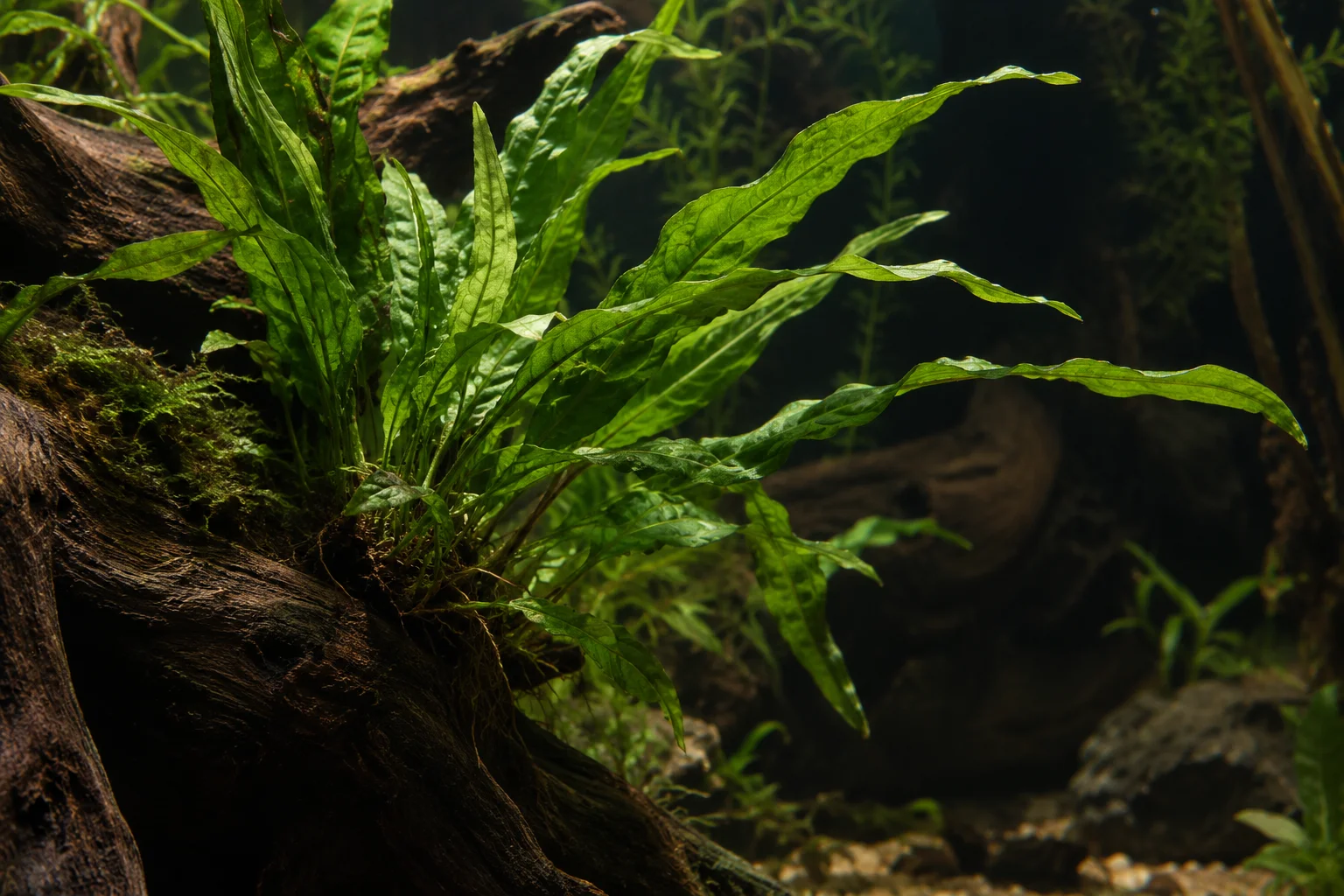
Fact sheet
- Common names
- Java fern, Microsorum
- Family
- Polypodiaceae (sometimes listed as Leptochilus pteropus)
- Origin
- Southeast Asia: Thailand, Malaysia, Indonesia, the Philippines, southern China and northeast India
- Height
- 6–14 in (15–35 cm), depending on variety
- Light
- Low to medium
- CO2
- Not required
- Growth rate
- Slow
- Placement
- Midground or background, attached to wood or rock
- Temperature
- 68–82 °F (20–28 °C)
- pH and hardness
- pH 6.0–7.5, GH about 3–15 dGH
- Difficulty
- Very easy
01
Java fern overview
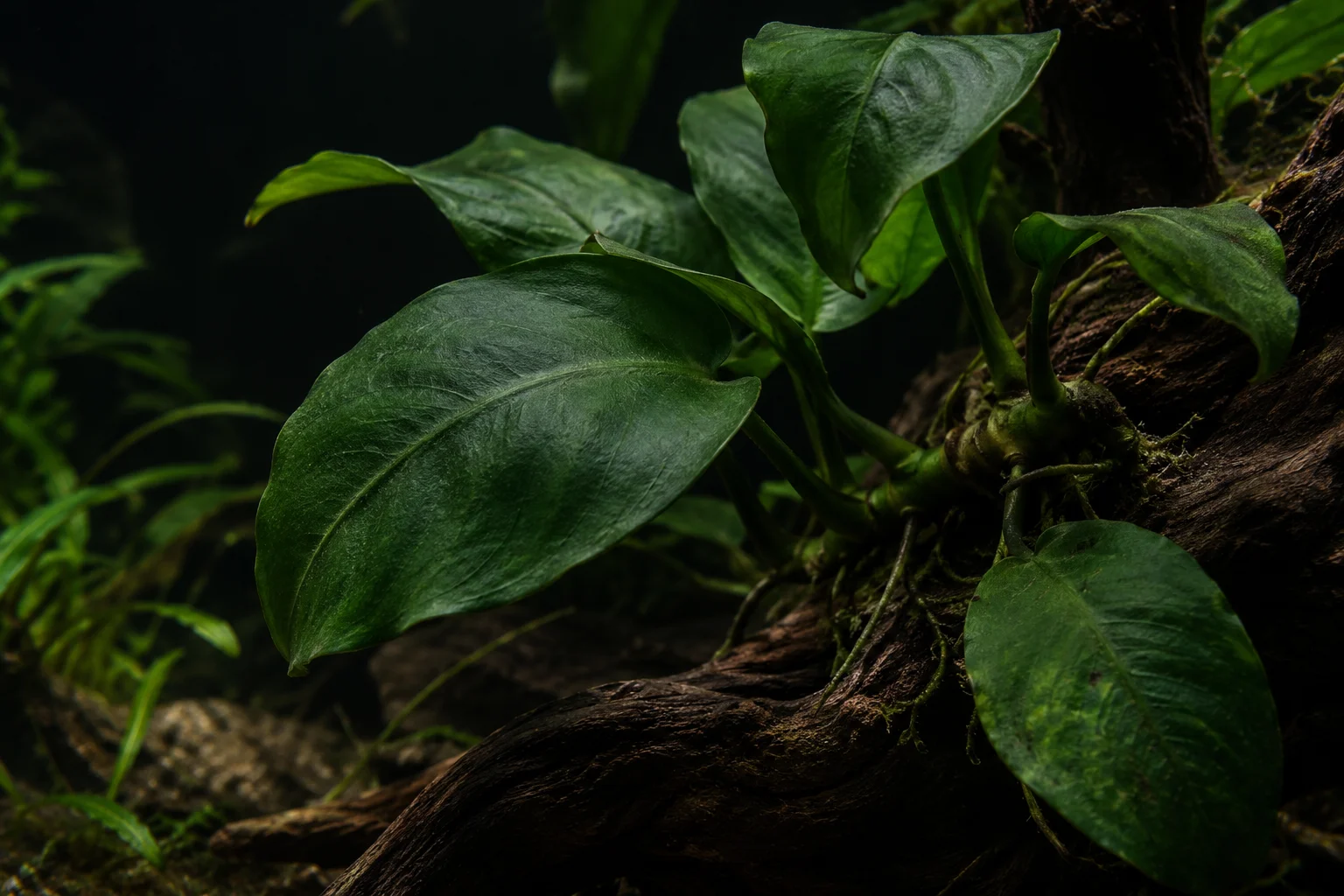
Java fern is a true fern from the streams and waterfalls of Southeast Asia, where it grows on rocks and tree roots, often partly out of the water. It is an epiphyte: instead of rooting in soil, it clings to hard surfaces with wiry brown roots and draws its nutrients from the water. That single fact explains most of Java fern care. Treat it like a plant that lives on decor, not in the substrate.
The plant grows from a horizontal stem called a rhizome, which sends up tough, dark green leaves. Those leathery leaves contain compounds that make them unappealing to most herbivorous fish, which is why Java fern survives in tanks with goldfish, cichlids and other plant-eaters. Botanists have recently proposed moving the species to the genus Leptochilus, so you may see Leptochilus pteropus on some labels; in stores it is still sold as Microsorum pteropus.
It is a natural partner for anubias, the other classic attached plant, and one of the safest picks on our list of the best aquarium plants for beginners.
02
Popular Java fern varieties
Several cultivars are widely sold. They share the same care; the main differences are leaf shape and size.
| Variety | Leaf shape | Typical height | Best use |
|---|---|---|---|
| Standard (Microsorum pteropus) | Broad, lance-shaped | 8–14 in (20–35 cm) | Midground to background, larger tanks |
| Narrow leaf | Long and slim | 6–12 in (15–30 cm) | Background, grassy look |
| Needle leaf | Very thin, needle-like | 4–6 in (10–15 cm) | Nano tanks, foreground accents |
| Trident | Narrow with 3–5 side lobes | 6–8 in (15–20 cm) | Midground, fine texture |
| Windelov (lace) | Branched, frilly tips | 6–8 in (15–20 cm) | Midground, small to medium tanks |
| Philippine | Broad with wavy edges | 8–12 in (20–30 cm) | Background, robust centerpiece |
03
How to plant Java fern
The golden rule: do not bury the rhizome. A buried rhizome is starved of oxygen and slowly rots, which is the most common reason Java fern dies in a new tank.
- Choose a spot on driftwood, lava rock or stone in the midground or background, where the plant will get moderate light and gentle flow.
- Hold the rhizome against the surface and tie it with cotton thread, black fishing line or a thin rubber band. Cotton thread dissolves after the roots have gripped.
- Alternatively, glue the rhizome with gel cyanoacrylate superglue, applied to the decor out of the water or on a dry surface.
- If you want it in the substrate area, wedge the rhizome between two stones or tuck the roots lightly under a pebble, leaving the rhizome itself exposed.
- Place the decor in the tank. Within a few weeks the roots will grip the surface and the thread can be removed if it has not dissolved.
Java fern bought in a plastic pot often has its rhizome buried in rock wool. Remove all of it carefully before attaching the plant: trapped rock wool holds debris and rots.
04
Java fern care: light, water and nutrients
Java fern tolerates a wide range of conditions, which is why it shows up in almost every kind of freshwater tank. Low to medium light is ideal; strong light can make the leaves turn translucent or brown and invites algae on the slow-growing leaves. A basic kit LED is enough, and our best aquarium light review explains which fixtures suit low-tech tanks.
Keep water between 68 and 82 °F (20–28 °C), with a pH of roughly 6.0–7.5. Soft to moderately hard water is fine. CO2 is not required, though it speeds up growth somewhat. Because the plant feeds through its leaves and roots in the water column, root tabs are pointless; a comprehensive liquid fertilizer once a week at or below the label dose is enough. Potassium shortage is a frequent cause of holes and brown patches, so choose a product that includes it (see our aquarium fertilizer guide).
Add Java fern to a new tank right away if you like: it tolerates the conditions during the nitrogen cycle better than most plants. Trim old, damaged or algae-covered leaves at the rhizome with sharp scissors.
05
Java fern propagation
Java fern propagation is effortless. Healthy plants produce small plantlets (adventitious plantlets) on the leaves, usually at the tips or along the leaf surface, each with its own tiny rhizome and roots. Older leaves often carry several at once.
- Plantlets: wait until a plantlet has 3–4 leaves and roots of about 1 in (2–3 cm), then pull it gently off the parent leaf or let it drop on its own. Tie it to a new piece of decor.
- Rhizome division: cut a long rhizome with clean scissors into sections, each with at least 3–4 leaves. Attach each section separately.
- Floating plantlets: if loose plantlets drift around the tank, collect them and tie them down; they root within a few weeks.
The rows of brown dots under some leaves are sori, the fern’s spore-producing structures. They are normal and not a disease or a pest.
06
Common Java fern problems
Most problems are slow to appear and slow to recover, because the plant grows slowly. Change one factor at a time and give it several weeks.
- Algae: older leaves are prone to black beard algae and brown diatom algae. Trim badly affected leaves and keep the light period to 6–8 hours.
- Grazers: Amano shrimp and nerite snails help keep the slow leaves clean without damaging them.
| Symptom | Likely cause | What to do |
|---|---|---|
| Black or brown patches spreading on leaves | Nutrient shortage (often potassium), buried rhizome, sudden change in conditions | Unbury the rhizome, dose a complete fertilizer, remove the worst leaves |
| Leaves turning translucent and melting | Too much light, buried rhizome, or shock after moving | Reduce light intensity, attach to decor, be patient |
| Mushy, dark rhizome | Rhizome buried or wrapped in rock wool | Cut away rotten sections, attach healthy parts to decor |
| Algae on older leaves | Slow growth plus high light or excess nutrients | Trim affected leaves, shorten photoperiod, add algae grazers |
| Brown dots in neat rows under leaves | Sori (spores), normal | Nothing: this is healthy reproduction |
07
Tank ideas with Java fern
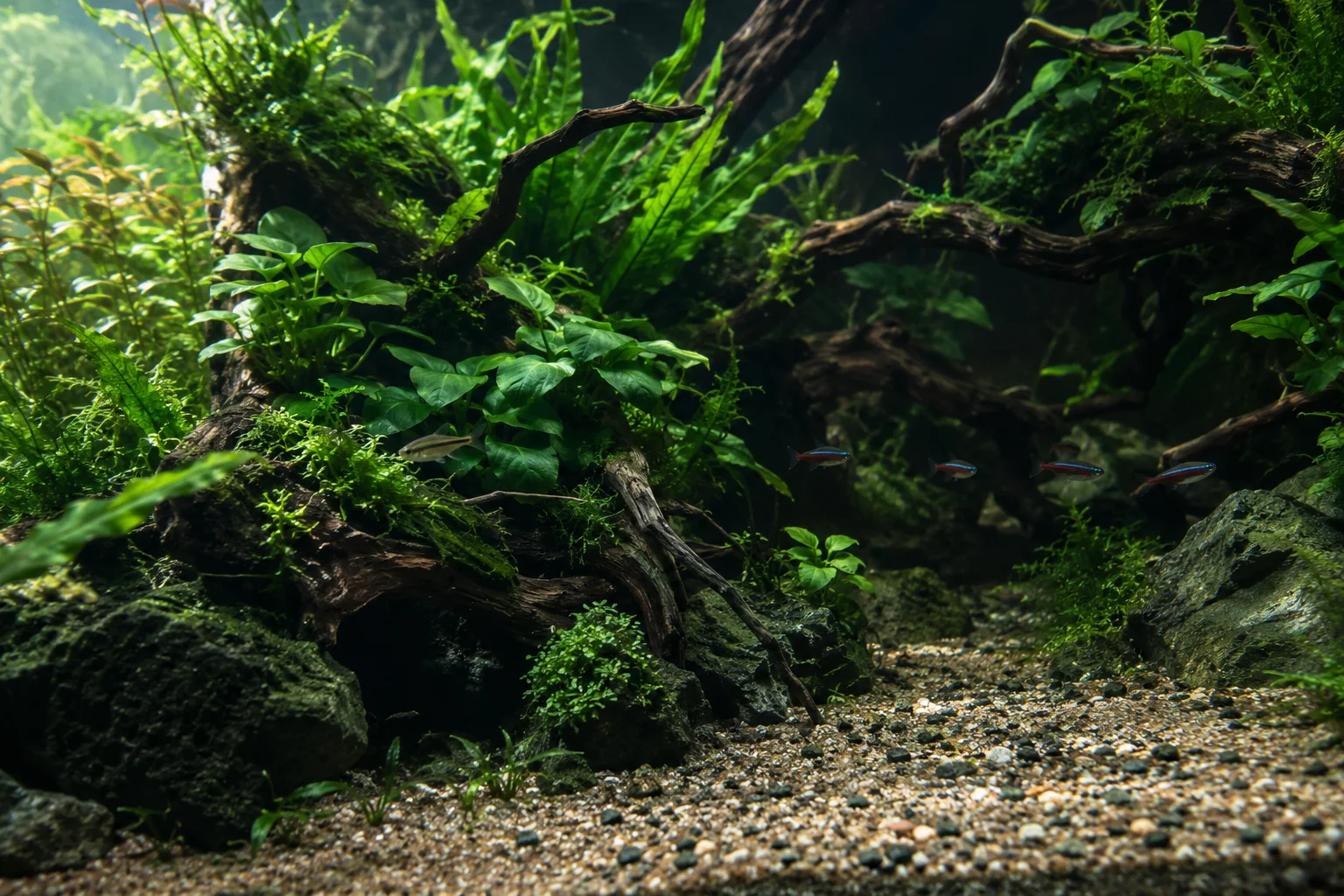
Java fern fits almost any freshwater layout. Tie it along a branch of driftwood for a natural stream look, mix it with anubias and moss on rock for a low-tech jungle, or use Windelov or needle leaf in a nano tank. It is one of the few plants that hold up in tanks with angelfish, larger cichlids and goldfish, and it is a key plant in any list of low light aquarium plants. For community fish that pair well in a low-tech planted tank, see our cichlid tank mates guide and the fish in our best beginner fish roundup.
Frequently asked questions
Frequently asked questions
Can you plant Java fern in substrate?
You can place it in the substrate area, but never bury the rhizome. A buried rhizome rots within weeks. Wedge it between stones, tuck only the roots under a pebble, or attach it to wood or rock. Over time the roots will grip the decor or even anchor lightly into the substrate on their own.
Does Java fern need CO2 or fertilizer?
Java fern does not need CO2 and grows well in low-tech tanks. It benefits from a weekly comprehensive liquid fertilizer at or below the label dose, especially one containing potassium. Root tabs are not useful because the plant feeds from the water, not the substrate.
Why does my Java fern have black spots?
Brown or black dots in neat rows on the underside are sori, the fern’s spores, and are normal. Irregular black or brown patches that spread and turn mushy usually point to a nutrient shortage, often potassium, or a buried rhizome. Unbury the rhizome, dose a complete fertilizer and remove badly damaged leaves.
How do you propagate Java fern?
Java fern propagation happens naturally through plantlets on the leaves. Detach them once they have 3–4 leaves and roots about 1 in (2–3 cm) long, then tie them to decor. You can also split a long rhizome into sections with at least 3–4 leaves each.
How fast does Java fern grow?
Slowly. In a typical low-tech tank, expect a new leaf every week or two on a healthy plant. Growth speeds up a little with better light, fertilizer and CO2. The slow rate is part of its appeal: it rarely needs trimming and keeps its shape for months.
Will fish eat Java fern?
Very few fish eat it. Its tough leaves contain compounds that make them unappealing, so it survives with goldfish, cichlids and silver dollars that destroy softer plants. Snails and shrimp graze algae and biofilm on the leaves without harming healthy tissue.
Sources and references
Written and reviewed by the handsoffmyhobby editorial team according to our editorial policy.