01
What makes a good angelfish community
The angelfish (Pterophyllum scalare) reaches about 6 inches (15 cm) long and 8 inches (20 cm) tall with fins. It is slow, curious and usually peaceful, but it is still a cichlid. Pairs defend a spawning site fiercely, and every adult hunts small fish at night.
Good angelfish compatible fish meet three rules. They are too big to fit in an adult angelfish’s mouth (roughly 1.5 inches, 4 cm, or deeper-bodied). They are calm and do not nip, because long ventral fins are an easy target. And they share soft to moderately hard water at 76–82 °F (24–28 °C) with a pH of 6.0–7.5.
- Tank: tall, 30 gallons (114 L) for one pair, 55 gallons (208 L) or more for a group of 4–6
- Decor: vertical plants such as Amazon swords and driftwood to break up territories
- Flow: gentle; angelfish struggle in strong current
- Group: buy 5–6 juveniles and let a pair form, or keep a single angelfish in a smaller community
02
Angelfish compatibility table
Ratings below assume adult angelfish in a properly sized, planted tank. Fish raised alongside angelfish from a small size are more often tolerated, but the risk with small species never fully disappears.
| Species | Rating | Minimum tank | Why |
|---|---|---|---|
| Corydoras (bronze, sterbai, panda) | Good | 30 gal (114 L) | Armored bottom dwellers; keep groups of 6+ |
| Bristlenose pleco | Good | 30 gal (114 L) | Peaceful algae eater, stays small for a pleco |
| Rummy nose tetra | Good | 30 gal (114 L) | Soft-water schooler, fast and peaceful; group of 8+ |
| Lemon tetra | Good | 30 gal (114 L) | Deeper-bodied than neons; usually safe from adults |
| Congo tetra | Good | 55 gal (208 L) | Large, peaceful schooler for bigger tanks |
| Pearl gourami | Good | 30 gal (114 L) | Calm, upper-water fish with similar needs |
| Kuhli loach | Good | 30 gal (114 L) | Hidden, nocturnal; group of 5+ on sand |
| Bolivian ram | Good | 30 gal (114 L) | Peaceful dwarf cichlid tolerant of the same temperatures |
| Otocinclus | Good | 30 gal (114 L) | Peaceful grazer for mature, planted tanks; group of 5+ |
| Platy | With caution | 30 gal (114 L) | Peaceful but prefers harder water; fry get eaten |
| Harlequin rasbora | With caution | 30 gal (114 L) | Peaceful but slim; may be eaten by large adults |
| Cardinal tetra | With caution | 30 gal (114 L) | Similar water, but small enough to be eaten |
| Black skirt tetra | With caution | 30 gal (114 L) | Right size, but may nip fins in small groups |
| German blue ram | With caution | 40 gal (151 L) | Needs 80–86 °F (27–30 °C) and claims territory |
| Discus | With caution | 75 gal (284 L) | Warmer water, disease risk and competition at feeding time |
| Amano shrimp | With caution | 30 gal (114 L) | Adults sometimes survive with cover; small ones get eaten |
| Neon tetra | Avoid | - | Often eaten by adult angelfish, especially at night |
| Cherry shrimp and other dwarf shrimp | Avoid | - | A snack for any angelfish |
| Guppies and endlers | Avoid | - | Small males get eaten or harassed; fry never survive |
| Betta | Avoid | - | Long fins and territorial clashes on both sides |
| Tiger barb, serpae tetra | Avoid | - | Fin nippers that target the angelfish’s long fins |
| Oscar, convict, Jack Dempsey | Avoid | - | Large, aggressive cichlids that bully or kill angelfish |
| Goldfish | Avoid | - | Coldwater fish with different needs |
Corydoras catfish care guide: tank, water, diet and popular species
Bronze, sterbai and other medium corydoras clean the bottom in groups and are too armored to bother.
Fish speciesBristlenose pleco care guide: size, tank, diet, lifespan and breeding
Stays around 4–5 inches, eats algae and spends its life on the glass and wood, away from the angelfish.
Fish speciesRummy nose tetra care guide: tank size, water, diet and tank mates
A tight, soft-water school that is large enough to be safe from adult angelfish in most tanks.
Fish speciesPearl gourami care guide: tank size, water, tank mates and breeding
A calm, elegant labyrinth fish of similar temperament that occupies the upper water.
Fish speciesKuhli loach care guide: size, tank, water and tank mates
Nocturnal, hidden bottom dweller that adult angelfish rarely notice.
Fish speciesGerman blue ram care guide: tank, water, tank mates and breeding
Possible in a warm, spacious tank, but its high temperature needs and own territory make it a careful choice.
Fish speciesDiscus fish care guide: water parameters, tank size and tank mates
A fellow Amazon cichlid that can share a big tank, with caution about warmth, disease and feeding competition.
Fish speciesOtocinclus care guide: tank, diet, water and tank mates
Small algae grazers for a mature planted angelfish tank, best kept in a group.
03
The best angelfish tank mates in detail
Bottom dwellers are the backbone of any angelfish community. Medium corydoras such as bronze or sterbai are too armored for an angelfish to swallow and spend their time sifting sand. A bristlenose pleco handles algae on wood and glass without growing into a 12-inch monster like the common pleco. Kuhli loaches add activity after dark.
Mid-water schooling fish must be big enough to be safe. Rummy nose tetras, lemon tetras and, in larger tanks, Congo tetras are the safest. Keep them in groups of eight or more so they school tightly and stay calm. A large school of fast tetras also makes the angelfish less shy.
Centerpiece companions need careful thought. A pearl gourami is calm and uses the top of the tank. The Bolivian ram is a peaceful dwarf cichlid that pairs well. The German blue ram and discus are possible only in warm, spacious tanks, and both work better with experience.
Raising small tetras together with juvenile angelfish sometimes works for years. Sometimes it ends overnight once the angelfish reaches full size. If you try it, accept that the risk is real.
04
Angelfish tank mates to avoid
The classic mistake is the neon tetra. Neons are sold as the default community fish and come from the same South American waters, so the pairing looks natural. But a neon is about 1.2 inches (3 cm) long, the size of prey for an adult angelfish, and many disappear one by one. The same applies to small rasboras, guppy males and every dwarf shrimp.
Fin nippers are the second danger. Tiger barbs and serpae tetras target the long, trailing fins of angelfish, and damaged fins can become infected with fin rot. Finally, large aggressive cichlids such as the oscar, convicts and Jack Dempseys are far too aggressive; if you want a bigger cichlid community, read our cichlid tank mates guide first.
05
Angelfish community stocking examples
These examples assume a cycled, planted tank with a filter rated for the volume. Add the peaceful community first and the angelfish last, or add juvenile angelfish together with their tank mates.
- 30 gallons tall (114 L): 1 angelfish pair (or 1 single angelfish) + 6 bronze or sterbai corydoras + 8 rummy nose tetras + 1 bristlenose pleco.
- 55 gallons (208 L): 4 angelfish raised as a group + 10 rummy nose tetras + 8 corydoras + 1 bristlenose pleco + 1 pearl gourami.
- 75 gallons (284 L): 5 angelfish + 12 Congo or lemon tetras + 8 corydoras + 6 kuhli loaches + 3 pearl gouramis (1 male, 2 females) + 1 bristlenose pleco.
06
Introducing tank mates and managing aggression
Quarantine new arrivals and acclimate them gradually. Angelfish are more relaxed when the tank has plenty of vertical cover, so plants such as Amazon swords and driftwood are not just decoration: they create separate zones.
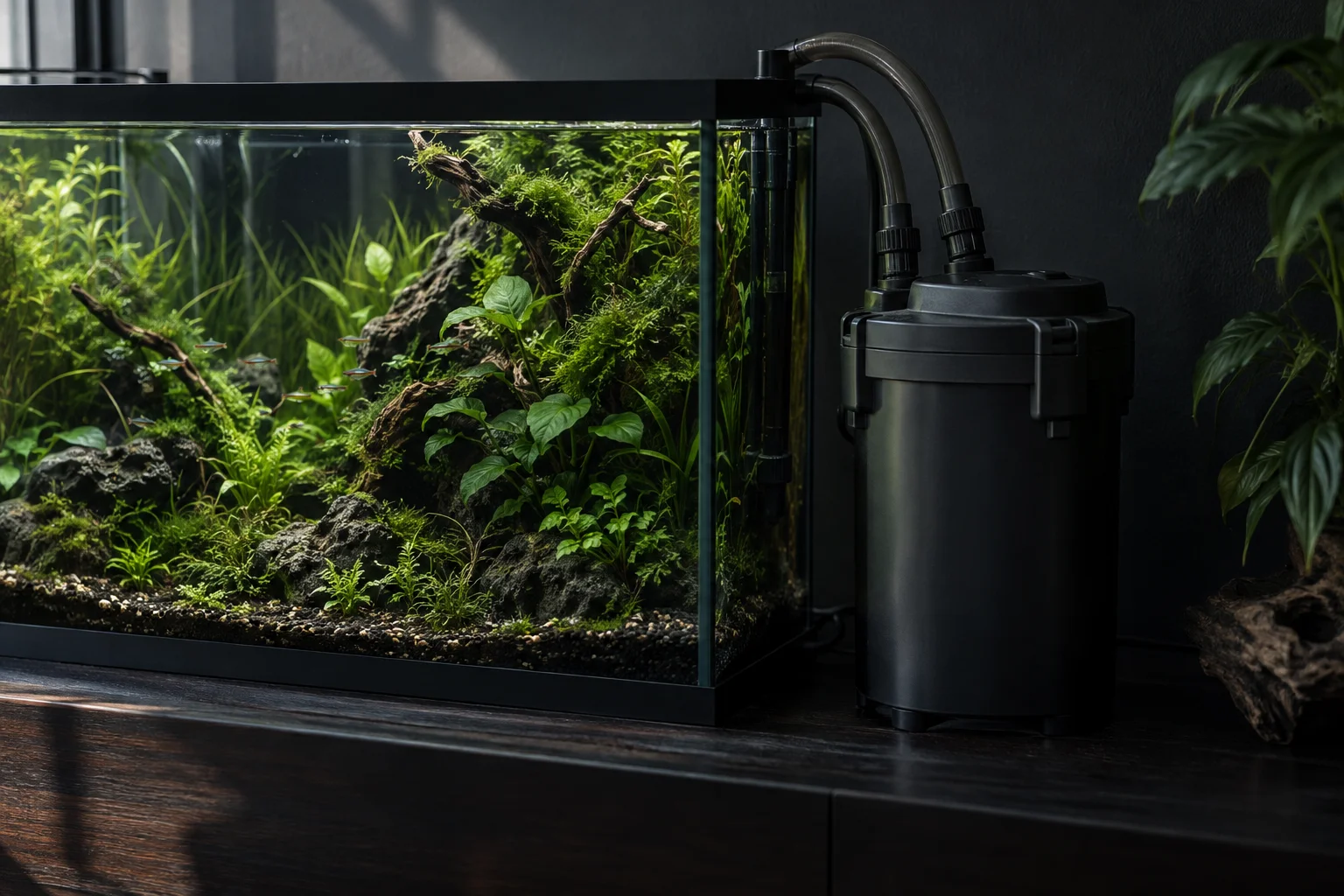
If a pair forms and starts spawning, they may chase everything away from one corner of the tank. In a 55 gallon tank this is usually manageable; in a 30 gallon it can be too much for a group of tetras. Remove the eggs, rearrange decor or rehome surplus angelfish if one fish is constantly harassed. A larger tank solves more aggression problems than any product. Our pick of the best 55 gallon aquarium and canister filters can help if you are planning one.
Frequently asked questions
Frequently asked questions
Can angelfish live with neon tetras?
It is risky. Juvenile angelfish usually ignore neon tetras, but adults often eat them, typically at night. Some keepers raise both together successfully, yet many lose their neons once the angelfish reach full size. Choose larger tetras instead, such as rummy nose, lemon or Congo tetras.
How many angelfish should be kept together?
Either one angelfish, one pair, or a group of five or more in at least 55 gallons (208 L). Groups of two or three unpaired angelfish often end with one fish being bullied. A group spreads aggression; once a pair forms, they may need to be separated from the others.
Can angelfish live with guppies?
Not reliably. Adult angelfish can eat small male guppies and will eat every fry, and guppies prefer harder water. In a very large tank with full-grown guppies it sometimes works, but it is better to choose peaceful, deeper-bodied fish like platies or lemon tetras.
What are the best bottom feeders for an angelfish tank?
Medium corydoras (bronze, sterbai, panda) in groups of six or more, a bristlenose pleco for algae and kuhli loaches for a natural, hidden presence. All are peaceful and share the same water. Avoid common plecos, which grow to over a foot long, and dwarf shrimp, which get eaten.
Can angelfish live with discus?
Yes, in a large tank with experienced care. Discus prefer warmer water, around 82–86 °F (28–30 °C), which angelfish tolerate. Angelfish are faster eaters and can outcompete discus, and they can carry diseases discus are sensitive to, so quarantine is essential.
Sources and references
Written and reviewed by the handsoffmyhobby editorial team according to our editorial policy.