Fact sheet
- Common names
- Rummy nose tetra, red-nose tetra, firehead tetra
- Similar species sold under the name
- Hemigrammus bleheri, Petitella georgiae
- Origin
- Amazon basin, South America (Brazil, Colombia, Venezuela, Peru)
- Adult size
- About 2 in (5 cm)
- Lifespan
- 5–8 years
- Minimum tank
- 20 gallons long (75 L), 30 gallons (115 L) for larger groups
- Group size
- 8 minimum, 10–15 recommended
- Temperature
- 75–82 °F (24–28 °C)
- pH
- 5.5–7.0 (tolerates up to about 7.5)
- Hardness
- GH 2–10 °dH, KH 1–5 °dH
- Temperament
- Peaceful, tight schooling, mid-water
- Care level
- Intermediate: needs a stable, mature tank
01
Rummy nose tetra care at a glance
The rummy nose tetra is a slim, silver tetra with a bright red head and a black-and-white striped tail. Its big selling point is behavior: few aquarium fish school as tightly, which is why aquascapers love it and why it ranks among the best schooling fish for planted community tanks.
It is not a beginner’s first fish, though. Rummy noses react badly to ammonia spikes and swings in temperature or pH, so they belong in a tank that has been fully cycled and running for a few months. In return, they act as a living water-quality alarm: a bright red nose means things are fine, a pale nose means something needs checking.
- Tank: 20 gallons long (75 L) minimum, 30 gallons or more for a big school
- Group: at least 8 fish, 10–15 for natural schooling
- Water: warm, soft, slightly acidic and very clean
- Decor: open swimming space in the middle, plants on the sides and back, dim areas
- Introduce them only to an established, stable tank
02
Origin and natural habitat
Three closely related fish are sold as rummy nose tetras. Hemigrammus rhodostomus comes from the lower Amazon in Brazil and from parts of Venezuela. Hemigrammus bleheri, probably the most common in stores, comes from the Rio Negro and Rio Meta basins in Brazil and Colombia. Petitella georgiae, the false rummy nose, lives in the upper Amazon in Peru. Some taxonomists now place the first two in the genus Petitella as well, but the hobby names remain the same.
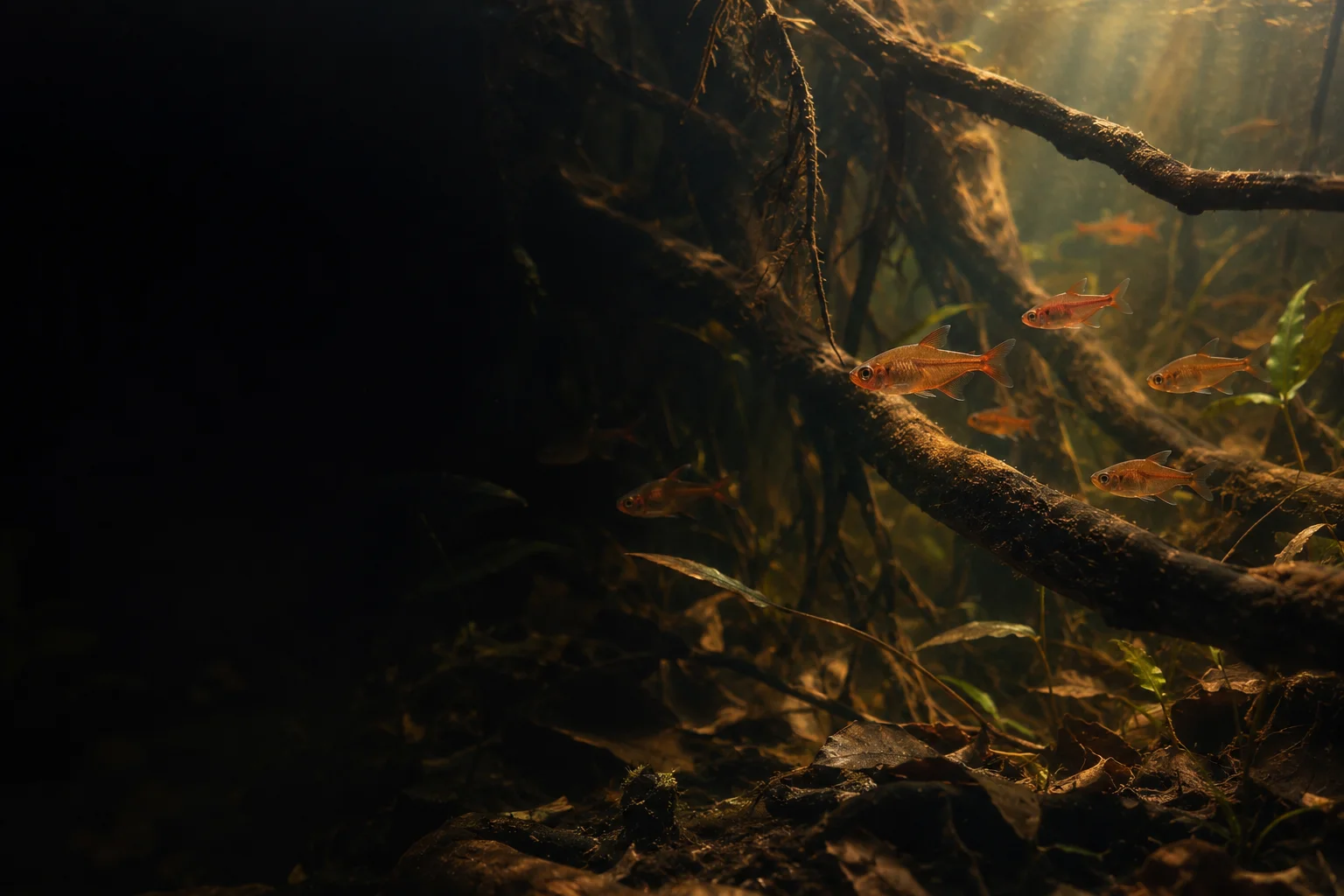
All three live in clear or blackwater streams under forest cover, with leaf litter, roots and very soft, acidic water. In the aquarium they look the same and need the same care. H. bleheri usually has the most extensive red, reaching behind the gill cover, while the false rummy nose shows less red and a fainter tail pattern.
03
Adult size and lifespan
Adult rummy nose tetras reach about 2 inches (5 cm), occasionally slightly more. Females are a little fuller in the belly when mature, but the sexes are otherwise very hard to tell apart.
With stable water and good food, they often live 5–8 years, which is long for a small tetra. Most of the fish that die young are lost in the first weeks, during shipping stress or after being added to an immature tank.
04
Rummy nose tetra tank size
Plan for at least a 20-gallon long tank (about 75 L, 30 in or 76 cm long) for a school of 8–10. Length matters more than volume: these are active mid-water swimmers that cruise from one end of the tank to the other. A 30-gallon (115 L) or larger tank lets you keep 12–15 fish, which is when their schooling really shows. Our list of the best fish for a 20-gallon tank shows how they fit into a mixed community.
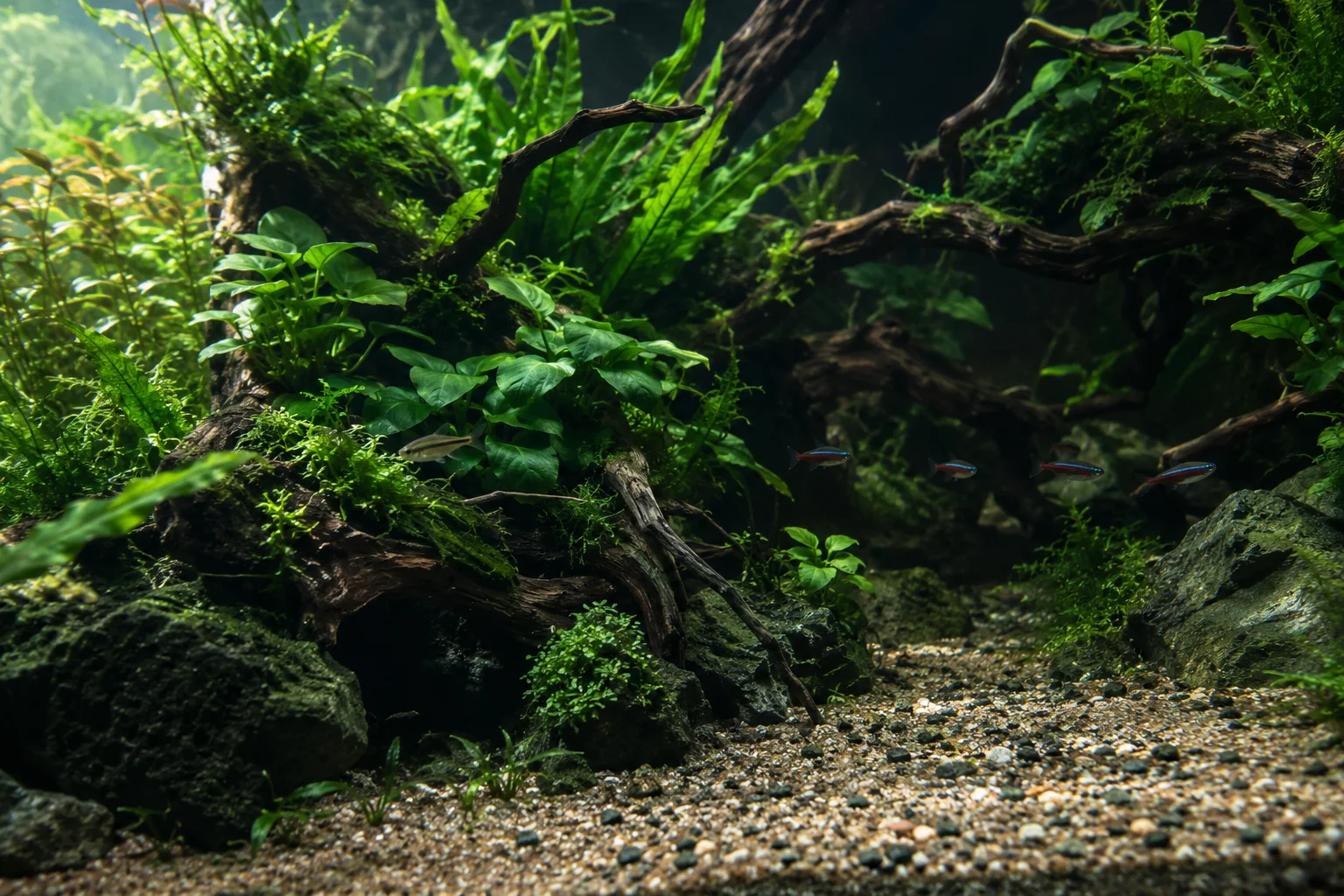
Aquascape with dense planting along the back and sides, some driftwood, and a clear swimming lane in front. Floating plants or a dimmer light help: rummy noses color up better and school more calmly when the tank is not glaring bright.
05
Water parameters
Rummy noses come from very soft, acidic water, but captive-bred fish adapt to moderately soft tap water. What they do not tolerate well is instability. Treat new water with a water conditioner, match the temperature during water changes, and keep nitrate low with regular changes of 20–30% a week. Our guide to aquarium water parameters explains what each value means.
If your tap water is hard and alkaline, you can soften it with RO water, peat or Indian almond leaves, or follow our guide on how to lower pH in an aquarium. Change things slowly: a stable pH of 7.2 is safer than a pH that swings between 6.0 and 7.0.
| Parameter | Target range |
|---|---|
| Temperature | 75–82 °F (24–28 °C) |
| pH | 5.5–7.0 (up to 7.5 for captive-bred fish) |
| GH (general hardness) | 2–10 °dH (35–180 ppm) |
| KH (carbonate hardness) | 1–5 °dH (18–90 ppm) |
| Ammonia / nitrite | 0 ppm |
| Nitrate | Below 20 ppm |
A pale nose is an early warning. When the red fades across the whole school, test ammonia, nitrite, nitrate and temperature before anything else.
06
Diet and feeding
In the wild, rummy noses pick small insects, larvae, worms and some plant matter from the water column. In the aquarium they are easy eaters. Use a quality micro pellet or flake as the base, and add frozen or live foods such as daphnia, brine shrimp, cyclops and chopped bloodworms a few times a week.
Feed small portions once or twice a day, only what the group eats in about two minutes. Their mouths are small, so crush larger flakes. Overfeeding mostly hurts them indirectly, by raising nitrate and fouling the water, so our guide on how often to feed aquarium fish is worth a read.
07
Behavior and rummy nose tetra tank mates
Rummy noses are peaceful and never bother other fish. In groups that are too small they become shy, lose color and stay hidden, so the group size is a welfare issue, not just a look. Startled schools may dash around the tank, which is another reason to keep them with calm companions.
Good rummy nose tetra tank mates share their taste for warm, soft water and gentle behavior. They are a classic dither fish for discus because they tolerate the same high temperatures; see our discus tank mates guide. Other strong choices include cardinal tetras, corydoras, otocinclus, small apistogramma and dwarf gouramis.
- Good matches: cardinal and neon tetras, ember tetras, harlequin rasboras, corydoras, otocinclus, bristlenose plecos, discus, German blue rams, apistogramma, kuhli loaches
- Usually fine with care: angelfish raised with them in a large tank (rummy noses are close to bite size for big adults)
- Avoid: fin nippers like tiger barbs, boisterous fish such as large barbs, and any predator big enough to swallow a 2 in fish
08
Breeding rummy nose tetras
Breeding rummy noses at home is possible but challenging. Sexing is difficult, and the eggs need very soft, acidic water to develop: think GH below 4 °dH and pH around 6. Most fish in stores today are farm-bred, mainly in Asia and Europe.
Condition a group with live and frozen food, then move a few plump females and active males into a dim breeding tank with fine-leaved plants or a spawning mop. They scatter eggs among the plants and will eat them, so remove the adults after spawning. Eggs hatch in roughly one to two days, and the fry need infusoria or liquid fry food before moving on to baby brine shrimp. Keep the eggs and fry in low light, since they are sensitive to it.
09
Common rummy nose tetra diseases
Most problems start with water quality or stress during transport. Quarantine new fish for 2–4 weeks when you can, and acclimate them slowly to your water. For serious or unexplained losses, an aquatic veterinarian is the best next step.
| Problem | Typical signs | Where to start |
|---|---|---|
| Stress or poor water | Pale nose, hiding, loose school | Test water, check temperature, review stocking |
| Ich | White salt-like spots, flashing | See ich in fish |
| Neon tetra disease | Patchy white muscle areas, curved spine, one fish lagging behind | Isolate quickly, see neon tetra disease |
| Ammonia burn | Gasping, red gills, sudden deaths in a new tank | Water changes, see ammonia poisoning |
| Fin rot | Frayed, whitish fin edges | Improve water, then fin rot treatment |
10
Recommended gear
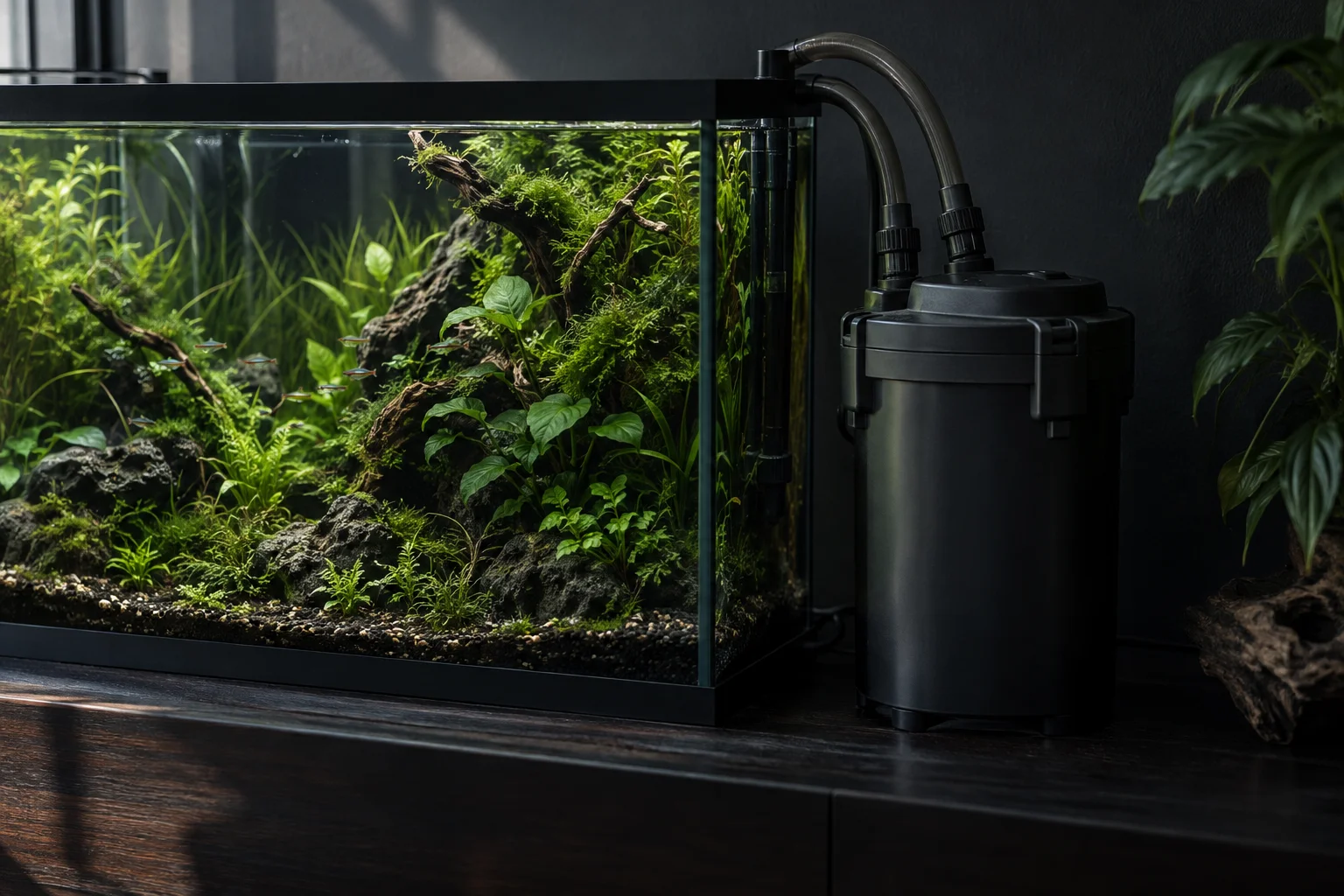
A reliable heater is essential, since rummy noses prefer the warm end of the tropical range; our best aquarium heater guide covers models with accurate thermostats. For a 20–40 gallon planted tank, a quiet canister filter gives strong biological filtration without blasting the fish, especially if you spread the outflow with a spray bar.
Add a liquid aquarium test kit for ammonia, nitrite, nitrate and pH, a lid, and dark substrate with plenty of plants. Dark backgrounds and soft light bring out the red of the head and the contrast of the tail.
Frequently asked questions
Frequently asked questions
How many rummy nose tetras should be kept together?
Keep at least 8 rummy nose tetras, and 10–15 if your tank allows. In smaller groups they become nervous, hide and lose color, and the tight schooling they are known for does not happen. A 20-gallon long tank suits about 8–10 fish; a 30-gallon tank or larger is better for a bigger school.
Why is my rummy nose tetra's nose pale?
A pale nose usually signals stress: ammonia or nitrite, high nitrate, a temperature drop, a recent move or bullying tank mates. Fish also look pale at night and right after arrival. If the whole school stays pale for more than a day, test the water, check the heater and do a partial water change.
Are rummy nose tetras good for beginners?
They are not ideal as a very first fish, because they are sensitive to unstable water and to new tanks. Once you have a cycled aquarium that has been running for a few months and you test regularly, they are easy to keep, peaceful and long-lived.
What are the best rummy nose tetra tank mates?
Choose peaceful fish that like warm, soft water: cardinal or neon tetras, harlequin rasboras, corydoras, otocinclus, bristlenose plecos, apistogramma, German blue rams and discus. Avoid fin nippers such as tiger barbs and any fish large enough to eat a 2-inch tetra.
Can rummy nose tetras live with discus?
Yes, they are one of the most popular discus tank mates because they tolerate 82–84 °F (28–29 °C) and soft water better than most tetras. Keep a large school so they act as calm dither fish, and make sure the tank is big enough for the discus first.
Sources and references
Written and reviewed by the handsoffmyhobby editorial team according to our editorial policy.