Our picks at a glance
- Best overallFluval 407
Large media capacity, push-button priming and a good balance of price, flow and ease of maintenance for 40–100 gallon tanks.
- Most reliableEheim Classic 2215
A simple design with very few parts to fail, quiet operation and a long track record in the hobby.
- Best for large tanksFluval FX4
High flow, a huge media volume and self-starting operation for 125–250 gallon tanks and messy fish.
- Best budget canisterPenn-Plax Cascade 1000
Affordable, comes with media and rated for tanks up to 100 gallons, a sensible first canister.
01
Why choose a canister filter
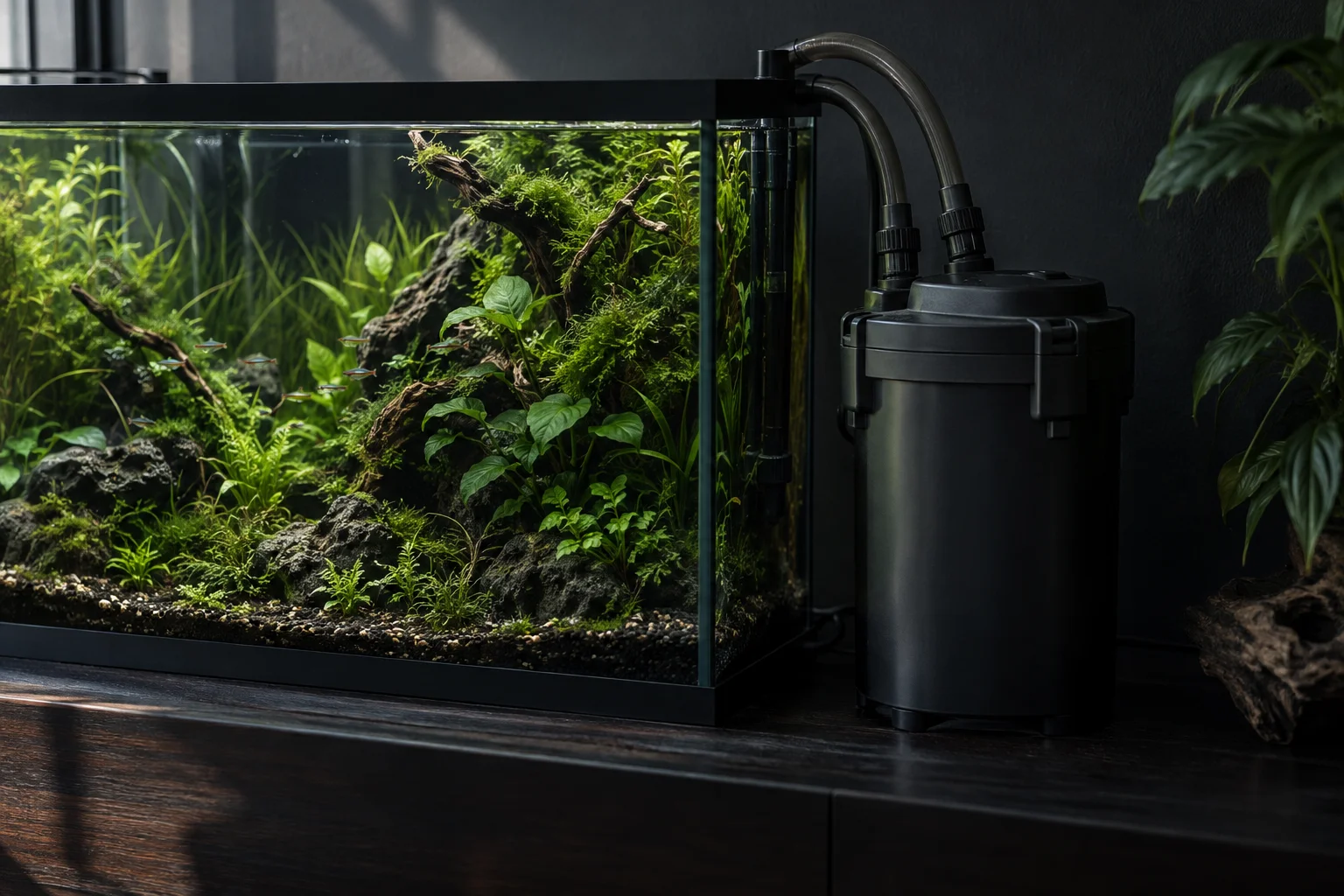
A canister filter is a sealed container placed below the tank. An intake tube draws water down through hoses, the water passes through mechanical, biological and optional chemical media, and a pump in the lid sends it back up through a spray bar or outflow. Because the canister can be large, it holds two to four times more media than a typical hang-on-back filter for the same tank size.
That extra media volume is what you are paying for. More biological media means a more stable nitrogen cycle, so ammonia and nitrite are processed reliably even with heavier stocking, and you can go longer between cleanings. Canisters also keep equipment out of sight, which is why aquascapers and owners of planted tanks like them, and they lose very little CO2 to surface agitation compared with filters that splash water back in.
They are not always the right answer. For tanks under about 20 gallons, a sponge filter or a small hang-on-back unit is cheaper, easier and perfectly effective. If you are still comparing filter types in general, start with our overview of the best aquarium filter for each tank size.
02
Comparison table
Tank ratings below are manufacturer figures. Real flow through a loaded canister is lower than the pump rating, so it is normal to size up.
| Filter | Rated tank size | Priming | Standout feature | Price |
|---|---|---|---|---|
| Fluval 407 | Up to 100 gal (380 L) | Push-button | Pre-filter + baskets | $$ |
| Eheim Classic 2215 | Up to ~92 gal (350 L) | Manual | Durability, silence | $$ |
| Fluval FX4 | Up to 250 gal (1,000 L) | Self-starting | Flow and media volume | $$$ |
| Oase BioMaster 350 | Up to ~90 gal (350 L) | Manual assist | Separate pre-filter | $$$ |
| Penn-Plax Cascade 1000 | Up to 100 gal (380 L) | Push-button | Price | $ |
| SunSun HW-304B | Size down from rating | Push-button | Built-in UV | $ |
Fluval · Multi-stage canister filter
Fluval 407
Best for: Community and planted tanks from 40 to 100 gallons
The 407 is the largest model in Fluval’s 07 series, which also includes the 107, 207 and 307 for smaller tanks. Fluval rates it for aquariums up to 100 US gallons (380 L). It uses stacked media baskets with a dedicated pre-filter stage, so coarse debris is trapped before it reaches the biological media. A push-button primer starts the siphon without sucking on hoses, and the lift-lock clamps and quick-disconnect valve make servicing straightforward. The pump head is quiet in normal use. The main complaints concern the quality of some hose fittings over the years, so check connections after each cleaning.
Pros
- Easy push-button priming
- Generous media volume with pre-filter stage
- Quick-disconnect valve for cleaning
- Comes with starter media
Cons
- Plastic fittings need care when tightening
- Tall canister may not fit low stands
- Baskets can be fiddly to reseat
- Tank size (maker)
- Up to 100 gal (380 L)
- Media stages
- Multiple stacked baskets + pre-filter
- Priming
- Push-button primer
- Series
- 107, 207, 307, 407
Eheim · Single-chamber canister filter
Eheim Classic 2215
Best for: Keepers who value durability and silence over features
The Eheim Classic line has been made in Germany for decades with almost the same design, and that is its strength: a single open canister filled with media, a simple pump head and a sealing ring. Eheim rates the 2215 for tanks up to about 92 gallons (350 L), with a pump output of about 164 gph (620 L/h). There are no trays or clips, so there is very little to break, and many units run for ten years or more with only a new sealing ring. The trade-offs are manual priming (you fill the canister and start the siphon yourself) and more work at cleaning time, since media is not in removable baskets.
Pros
- Very reliable and quiet
- Few moving parts
- Spare parts easy to find
- Low power use
Cons
- No built-in primer
- Media not in baskets, so cleaning is messier
- Modest flow for heavily stocked tanks
- Tank size (maker)
- Up to about 92 gal (350 L)
- Pump output
- About 164 gph (620 L/h)
- Design
- Single open chamber
- Other sizes
- 2213 (smaller), 2217 (larger)
Fluval · High-capacity canister filter
Fluval FX4
Best for: Large tanks, goldfish, oscars and big cichlids
The FX4 is the smaller sibling of the well-known FX6. Fluval rates it for tanks up to 250 US gallons (1,000 L) with a pump output of about 700 gph (2,650 L/h). Its main advantage is the Smart Pump: after the first fill it starts itself, and it periodically stops to let trapped air escape. The canister holds a very large volume of media in stacked baskets, and a drain valve at the base lets you empty it with a hose instead of carrying a heavy tub. It is overkill for a typical 55 gallon community tank, but a strong choice for big, messy fish.
Pros
- Very high flow and media volume
- Self-starting after initial fill
- Drain valve at the base
- Suitable for tanks up to 250 gal
Cons
- Large footprint under the stand
- Expensive
- Too much flow for small or delicate fish
- Tank size (maker)
- Up to 250 gal (1,000 L)
- Pump output
- About 700 gph (2,650 L/h)
- Priming
- Self-starting Smart Pump
- Bigger model
- FX6 (up to 400 gal)
Oase · Canister filter with external pre-filter
Oase BioMaster 350
Best for: Keepers who hate opening the main canister
Oase’s BioMaster series is designed around a pre-filter module at the top of the canister. Coarse dirt collects in that pre-filter, which you can open and rinse without disturbing the biological media below. That design stretches the interval between full cleanings, which is the job most people postpone. The BioMaster 350 is rated by Oase for aquariums up to about 90 gallons (350 L), and a Thermo version adds a built-in heater, freeing space in the tank. Build quality is high and parts are available, though the filter is less common in US stores than Fluval or Eheim.
Pros
- Separate, easy-to-clean pre-filter
- Thermo version includes a heater
- Solid build and quiet pump
- Large biological media volume
Cons
- Less common in US shops
- Higher price than similar-size Fluval models
- Tank size (maker)
- Up to about 90 gal (350 L)
- Key feature
- Pre-filter module cleaned separately
- Heater option
- BioMaster Thermo versions
- Other sizes
- 250, 600, 850
Penn-Plax · Budget multi-tray canister filter
Penn-Plax Cascade 1000
Best for: First canister on a 40–75 gallon tank on a budget
The Cascade line is one of the most widely sold budget canisters in the US. Penn-Plax rates the Cascade 1000 for tanks up to 100 gallons, though most keepers find it best on 40 to 75 gallon tanks. It uses stackable trays, comes with sponges, floss and bio-media, and has a push-button primer and flow-control valves on the hoses. Owners generally report that it does the job well for the price. The trade-offs are a louder pump than premium brands and gaskets that should be lubricated and checked at every cleaning to prevent slow leaks.
Pros
- Low price for a full canister
- Media included
- Push-button primer and flow valves
Cons
- Louder than Eheim or Oase
- Seals need regular checks
- Real-world flow drops quickly as media clogs
- Tank size (maker)
- Up to 100 gal (380 L)
- Media trays
- Stackable trays, media included
- Priming
- Push-button primer
- Line
- Cascade 500, 700, 1000, 1500
SunSun · Budget canister filter with UV lamp
SunSun HW-304B
Best for: Large tanks on a tight budget, or green water problems
SunSun canisters, sold on Amazon under SunSun and several other names, are popular because they offer a lot of media capacity for very little money. The HW-304B adds a built-in UV sterilizer that can clear free-floating algae (green water) when switched on. Manufacturer flow and tank ratings are generous, so treat them with caution and assume real-world flow is clearly lower. Quality control varies more than with big brands: check every hose connection and the lid seal carefully on setup, and keep spare O-rings. For keepers comfortable with a little tinkering, it is a good-value workhorse.
Pros
- Very low price for its size
- Built-in UV lamp
- Large media trays
Cons
- Inconsistent quality control
- Optimistic flow ratings
- Fewer official spare parts
- Tank size (maker)
- Follow manufacturer rating, size down in practice
- Extras
- Built-in UV sterilizer
- Media trays
- Multiple stacked trays
- Priming
- Push-button primer
03
How we selected these filters
This is an editorial selection based on research, not a lab test. Filters were chosen on manufacturer-declared specifications (tank rating, pump output, media capacity), ease of priming and cleaning, availability of spare parts such as seals and impellers in the US, and how consistently each model is recommended in long-running hobby communities. Brands that are hard to buy or support in the US were left out, and we flag known weaknesses rather than hiding them.
04
Buying guide: what matters in a canister filter
Flow numbers on the box are measured with an empty canister and no hoses. Once the canister is full of media and the water has to climb back up 3 to 4 feet, real flow can drop by a third or more. That is why most keepers aim for a rated flow of 4 to 6 times the tank volume per hour, and more for goldfish, oscars and other heavy waste producers.
- Media capacity: the single most important number. More media means more room for nitrifying bacteria and longer service intervals.
- Priming system: a push-button primer or self-starting pump saves a lot of frustration at every cleaning.
- Quick-disconnect valves: let you shut off and remove the canister without draining the hoses onto the floor.
- Seals and spare parts: O-rings and impellers wear out; a brand with easy-to-find parts lasts longer.
- Noise: canisters are usually quiet, but cheaper pumps can hum. Placement inside a closed cabinet helps.
- Footprint: measure the inside of your stand, including room above the canister to lift the lid.
05
How to choose by tank size and use
Match the filter to the tank and to the fish. Delicate species such as discus or long-finned fish prefer gentle, spread-out flow from a spray bar, while river fish and goldfish appreciate stronger current. If you are planning a 55 gallon aquarium, a filter rated for 70 to 100 gallons is the usual sweet spot.
| Setup | Recommended pick | Why |
|---|---|---|
| 20–40 gal (75–150 L) planted | Fluval 207 or 307, Eheim Classic 2213 | Quiet, low surface agitation, enough media |
| 55 gal (210 L) community | Fluval 407 or Eheim Classic 2215 | Best balance of media, flow and cost |
| 75 gal (285 L) goldfish or cichlids | Fluval 407 plus a second filter, or Fluval FX4 | Heavy bioload needs extra capacity |
| 125 gal+ (475 L+) | Fluval FX4 or FX6 | High flow, huge media volume |
| Tight budget, 40–75 gal | Penn-Plax Cascade 1000 | Full canister for a low price |
| Low-maintenance priority | Oase BioMaster 350 | Pre-filter cleaned without opening the canister |
On a stocked 55 gallon tank, many keepers run a canister plus a small sponge filter. If the canister ever fails or needs a deep clean, the sponge keeps a backup colony of bacteria alive.
06
Setting up and cleaning a canister without leaks
Most canister problems come from setup and maintenance, not from the filter itself. Follow these steps every time you install or service one.
- Rinse new mechanical media in tap water, but rinse used biological media only in old tank water to protect the bacteria.
- Give the main O-ring a thin film of silicone grease or the lubricant the maker recommends, and seat it without twists.
- Push hoses fully onto the fittings and tighten clamps by hand, never with tools.
- Fill the canister with tank water before priming, then use the primer or start the siphon.
- Tilt the canister gently once running to release trapped air, which causes rattling.
- Check every connection with a dry paper towel after 30 minutes and again the next day.
Never clean the filter and do a large gravel vacuum on the same day in a lightly established tank. Removing both bacteria sources at once can trigger an ammonia spike, the problem described in our guide to new tank syndrome.
07
Common mistakes with canister filters
If your water turns hazy after starting a new canister, it is usually a bacterial bloom or fine debris from new media, not a fault. Our guide to cloudy fish tank water explains how to tell the difference, and a new filter still needs time to establish: see how to cycle a fish tank.
- Buying for the box rating only. A filter rated exactly for your tank is usually undersized once media and head height are counted.
- Cleaning too often or too thoroughly. Rinsing bio-media under tap water or replacing it all at once resets the cycle. Clean mechanical media every 4 to 8 weeks, bio-media rarely.
- Waiting too long between cleanings. When flow drops by half, oxygen and filtration drop too. A rapid flow loss is your signal to service the pre-filter.
- Placing the canister above the tank level. Canisters must sit below the water line to stay primed.
- Skipping the intake guard. Fry and small shrimp such as cherry shrimp get sucked in; fit a pre-filter sponge on the intake.
08
Canister vs other filter types
A canister is the strongest option for medium and large tanks, but a hang-on-back filter is easier to service and often plenty for tanks up to 55 gallons with a moderate stock. Sponge filters are the best choice for fry, shrimp and betta fish tanks, where gentle flow matters more than capacity. Many experienced keepers combine types: a canister for capacity, a sponge filter for backup. Whatever you choose, regular water changes remain essential, since no filter removes nitrate on its own.
Frequently asked questions
Frequently asked questions
What is the best canister filter for a 55 gallon tank?
The Fluval 407 and the Eheim Classic 2215 are the two most common choices for a 55 gallon tank. Both are rated above 55 gallons, which compensates for flow lost to media and hoses. Choose the Fluval for easier priming and baskets, or the Eheim for simplicity and long-term reliability. With goldfish or large cichlids, step up to an FX4 or add a second filter.
How often should you clean a canister filter?
Most canisters need a service every 4 to 8 weeks, depending on stocking and feeding. Rinse sponges and floss in old tank water, and leave biological media mostly untouched. A clear drop in outflow is the best signal. Avoid cleaning the filter and deep-vacuuming the substrate on the same day.
Are canister filters better than hang-on-back filters?
Canisters hold more media, run quieter and hide out of sight, so they are better for tanks over about 55 gallons, planted tanks and heavy bioloads. Hang-on-back filters are cheaper, easier to install and to clean, and are often the better choice for 10 to 40 gallon tanks.
Why is my canister filter making noise?
Rattling or grinding usually means trapped air, a dirty impeller or a worn impeller shaft. Tilt the canister to release air, then clean the impeller well with a small brush. If the noise continues, the impeller or its rubber bushings may need replacement, which most brands sell as spare parts.
Can a canister filter be too strong for a tank?
Yes. Excess current stresses small or long-finned fish and blows food around. Use a spray bar, point the outflow at the glass, or reduce flow with the valve. A canister with a flow valve lets you oversize for media capacity while keeping current gentle.
Sources and references
Written and reviewed by the handsoffmyhobby editorial team according to our editorial policy.