01
Why is my fish tank cloudy? Identify it by color
The color of the haze and when it appeared tell you almost everything. Look at the tank against a white wall or with a flashlight, note how long ago you set it up or cleaned it, and compare with the table below before you change anything.
| What you see | When it appears | Most likely cause | Risk to fish |
|---|---|---|---|
| Milky white, uniform haze | Days 2–14 of a new tank, or after a big clean | Bacterial bloom | Low, unless ammonia is present |
| Grey or beige particles that drift and settle | Right after setup or rescaping | Substrate or decor dust | Very low |
| White haze after dosing a buffer or using very hard water | Within hours of the change | Mineral precipitate (calcium carbonate) | Low, but check pH swings |
| Cloudy after meals, food bits floating | Hours after feeding | Overfeeding and decaying food | Medium, ammonia builds up |
| Green, pea-soup color | Gradually over days | Free-floating algae | Low to medium |
| Yellow, amber or tea-colored but see-through | After adding driftwood or leaves | Tannins | None for most fish |
Green tint? That is a different problem with different fixes. Go straight to our guide on green water in a fish tank.
02
Bacterial bloom: the most common cause
A bacterial bloom is a population explosion of free-floating heterotrophic bacteria, the kind that feed on dissolved organic matter. It typically shows up a few days after a new tank is filled, after a large water change combined with a hard filter clean, after a big feeding, or when something dies and decays out of sight. The haze is milky and even, not grainy.
In a new tank, a bloom is part of the settling-in process while the beneficial nitrifying bacteria colonize the filter. It is a sign the tank is not yet mature, not a disease. Read our guide on how to cycle a fish tank to understand the timeline, and our page on new tank syndrome if fish were added on day one.
The bloom itself rarely harms fish, but it consumes oxygen and often travels with ammonia or nitrite. That is why testing matters more than the look of the water.
03
Other causes of cloudy aquarium water
If the haze is not milky white, or the tank is well established, one of these causes is more likely than a classic bloom.
- Unrinsed substrate and new decor: gravel, sand and some plant substrates release fine dust. It looks grey or beige and usually settles in 24–72 hours with the filter running.
- Mineral precipitate: very hard tap water, a pH buffer or a calcium supplement can make carbonate minerals fall out of solution as a fine white haze, especially when pH is high.
- Overfeeding: uneaten food breaks down, feeds bacteria and raises ammonia. It is the most common cause of repeated cloudiness in established tanks.
- Disturbed debris: digging fish, a rescape or a vigorous gravel clean can lift fine mulm into the water for a few hours.
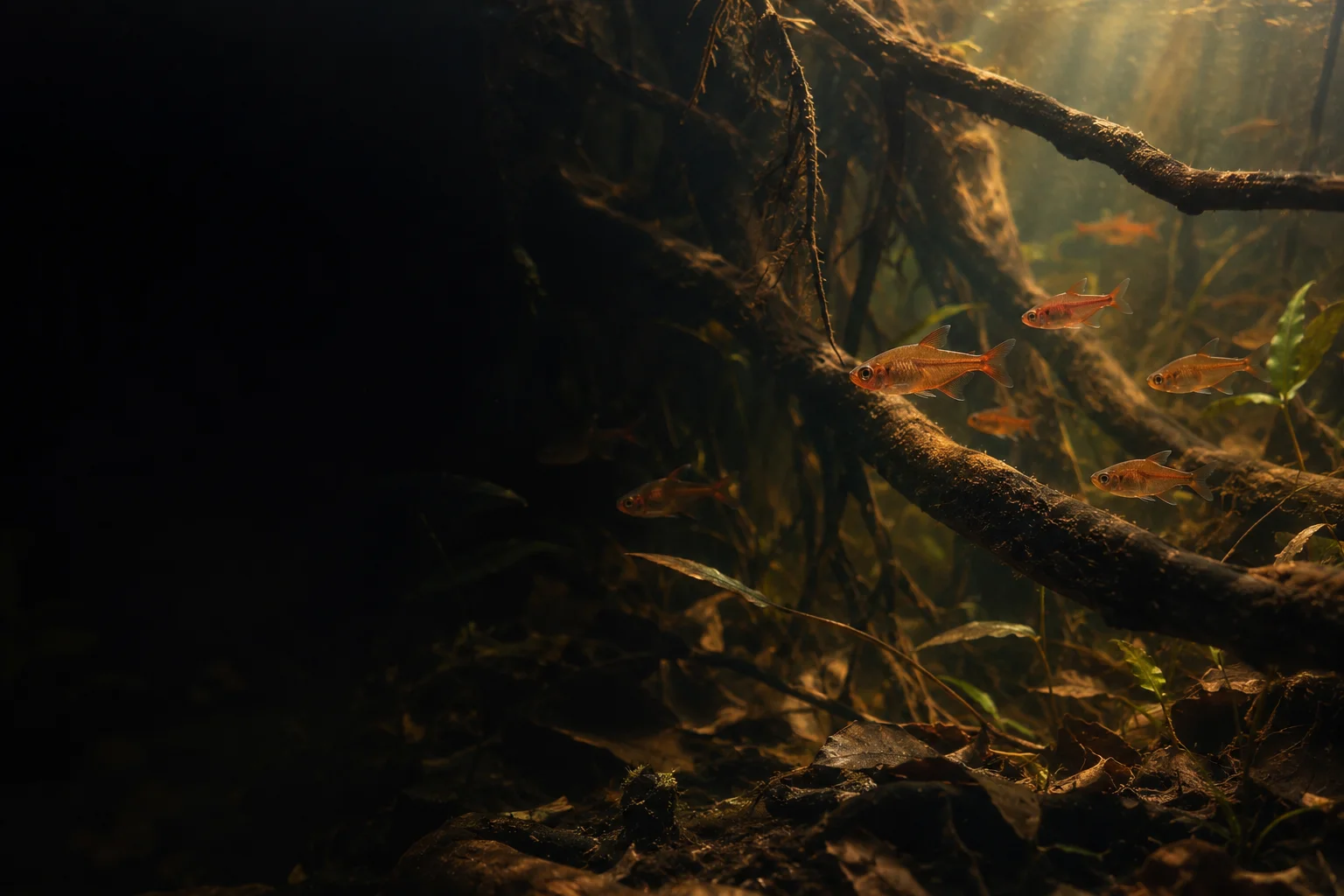
- Tannins: driftwood and botanicals such as Indian almond leaves release tannins that tint the water yellow to brown. The water is stained but clear, and many soft-water fish appreciate it.
- Dying bloom or dead animal: a sudden haze in a stable tank can mean a dead fish, snail or a rotting plant somewhere behind the decor.
04
How to fix cloudy fish tank water step by step
Work through these steps in order. The goal is to remove the cause while keeping the filter’s bacteria colony intact.
- Test the water. Measure ammonia, nitrite, nitrate and pH with a liquid aquarium test kit. Compare the results with our guide to aquarium water parameters.
- If ammonia or nitrite is above zero, change 25–30% of the water with dechlorinated water at the same temperature, using a water conditioner. Repeat every day or two until both read zero.
- Cut feeding. Feed a small amount every other day for a few days and remove anything not eaten within two minutes.
- Leave the filter alone. Do not replace cartridges or scrub media during a bloom. If flow drops, rinse the sponge gently in a bucket of tank water.
- Add aeration. An air stone or surface agitation offsets the extra oxygen demand of the bloom; see our aquarium air pump picks.
- For dust or debris, add fine filter floss to the filter and rinse or replace it every day or two until the water is clear.
- For tannins, use activated carbon or Seachem Purigen in the filter and keep up with water changes, or simply accept the tint if your fish come from blackwater habitats.
- Be patient. A bacterial bloom in a new tank usually clears within a few days to two weeks once the excess food and organics are gone.
05
Do water clarifiers work?
Water clarifiers are flocculants: they make tiny particles clump together so the filter can catch them. Products such as Seachem Clarity and API Accu-Clear can speed up clearing for dust and fine debris, and sometimes help with a bacterial haze. They do nothing about the cause, though, and overdosing can itself cloud the water. Use them as a finishing step, follow the label for the dose, and keep fine mechanical media in the filter so the clumps are removed.
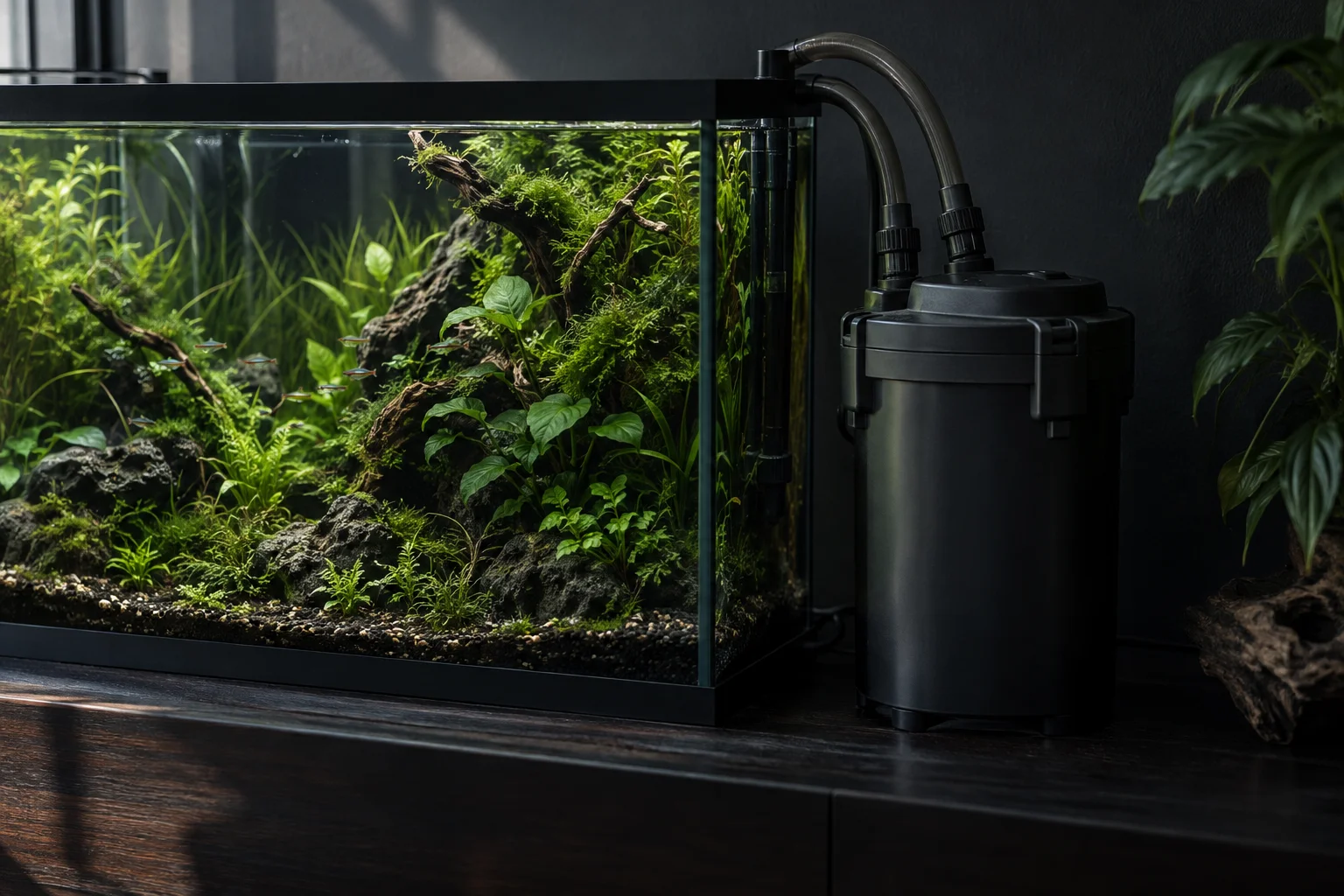
If cloudiness keeps coming back in an established tank, the filter may simply be too small or poorly maintained. Our guide to the best aquarium filter explains how to size one, and how to clean a fish tank shows a routine that does not crash the bacteria.
06
Common mistakes
Most persistent cloudiness is made worse by well-meant overreactions.
- Doing a 100% water change or tearing the tank down: the bloom returns and you restart the cycle.
- Replacing the filter cartridge every time the water clouds: it throws away the bacteria that would clear it.
- Adding several chemicals at once (clarifier, bacteria starter, pH buffer) without testing first.
- Adding more fish while the water is still cloudy in a new tank.
07
How to prevent cloudy water
Rinse new gravel or sand in a bucket until the water runs almost clear (nutrient-rich plant soils are an exception: follow the maker’s instructions, and see our aquarium substrate reviews). Cycle the tank before adding fish, stock gradually, and feed small portions.
Keep a steady routine of partial water changes and gravel vacuuming, and clean the filter in tank water, never under hot tap water. In very hard water areas, avoid stacking buffers and check pH and KH before adding anything new.
08
When to worry
Cloudy water is a warning to act fast when fish gasp at the surface, hang near the filter outlet, show red or inflamed gills, or when ammonia keeps rising despite water changes. In that case follow our guide to ammonia poisoning in fish, increase aeration and change water daily. If fish keep getting sick once the water is clear, contact an aquatic veterinarian.
Frequently asked questions
Frequently asked questions
Why is my fish tank cloudy after a water change?
Usually because the change disturbed fine debris or, combined with a hard filter clean, triggered a bacterial bloom. Very hard or high-pH tap water can also release a white mineral haze. Test ammonia, keep the filter running and avoid scrubbing media; most of these clear within one to a few days.
How long does a bacterial bloom last in a fish tank?
Most bacterial blooms clear within a few days to two weeks. In new tanks they fade as the beneficial bacteria colony establishes. Overfeeding, frequent deep cleaning or decaying matter can make them last longer, so reduce feeding and leave the filter undisturbed.
Is cloudy water bad for fish?
The haze itself is rarely harmful, but it often comes with ammonia or nitrite, which are. A bloom also uses oxygen. Test the water: if ammonia and nitrite are zero and fish behave normally, patience is enough. If not, do partial water changes with conditioned water.
Should I add fish to a cloudy new tank?
No. Cloudy water in a new tank means it is still settling. Wait until the water is clear and ammonia and nitrite have read zero for several days, then add a few fish at a time.
How do I clear yellow or brown aquarium water?
Yellow or brown but clear water comes from tannins in driftwood or leaves. Activated carbon or Seachem Purigen in the filter and regular water changes remove most of the color. Boiling or soaking new driftwood before use reduces it. Tannins are harmless to most fish.
Sources and references
Written and reviewed by the handsoffmyhobby editorial team according to our editorial policy.