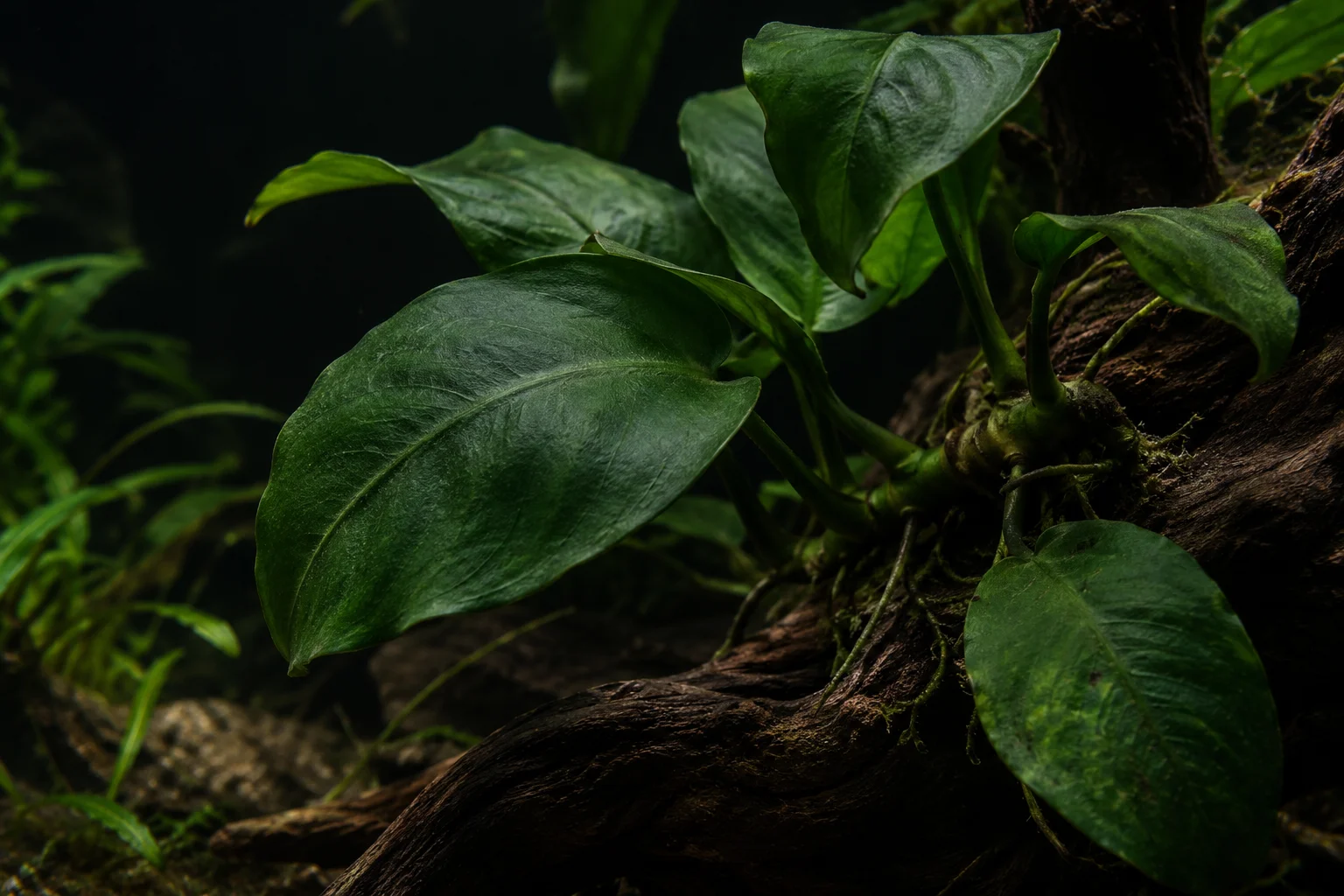
01
What makes an aquarium plant easy for beginners?
Easy aquarium plants share a few traits. They grow under low to medium light, take their carbon from the water without injected CO2, tolerate a wide pH and hardness range and recover from small mistakes such as a missed water change. Most are also unattractive to the fish that commonly nibble plants.
We selected the plants below using those criteria, along with the difficulty ratings published by large plant growers and what is widely available in US stores. None needs special substrate to survive, though root feeders do much better with root tabs. If you are still setting up the tank, read our beginner aquarium guide first, then plant before or during the nitrogen cycle: plants help absorb ammonia while bacteria establish.
- Light: grows under the stock LED of most kit tanks
- CO2: none needed, liquid carbon optional
- Growth: slow to moderate, so you are not trimming every week
- Hardiness: tolerates pH 6–7.5 and moderate hardness
- Availability: sold in most stores and online, often as tissue culture
02
The 15 best beginner aquarium plants compared
Plants are grouped by how they are planted, because that is where most beginners go wrong. Epiphytes such as Java fern and anubias attach to decor; root feeders go in the substrate; stem plants are pushed in as cuttings; floaters need nothing at all.
| Plant | Type | Placement | Light | Growth |
|---|---|---|---|---|
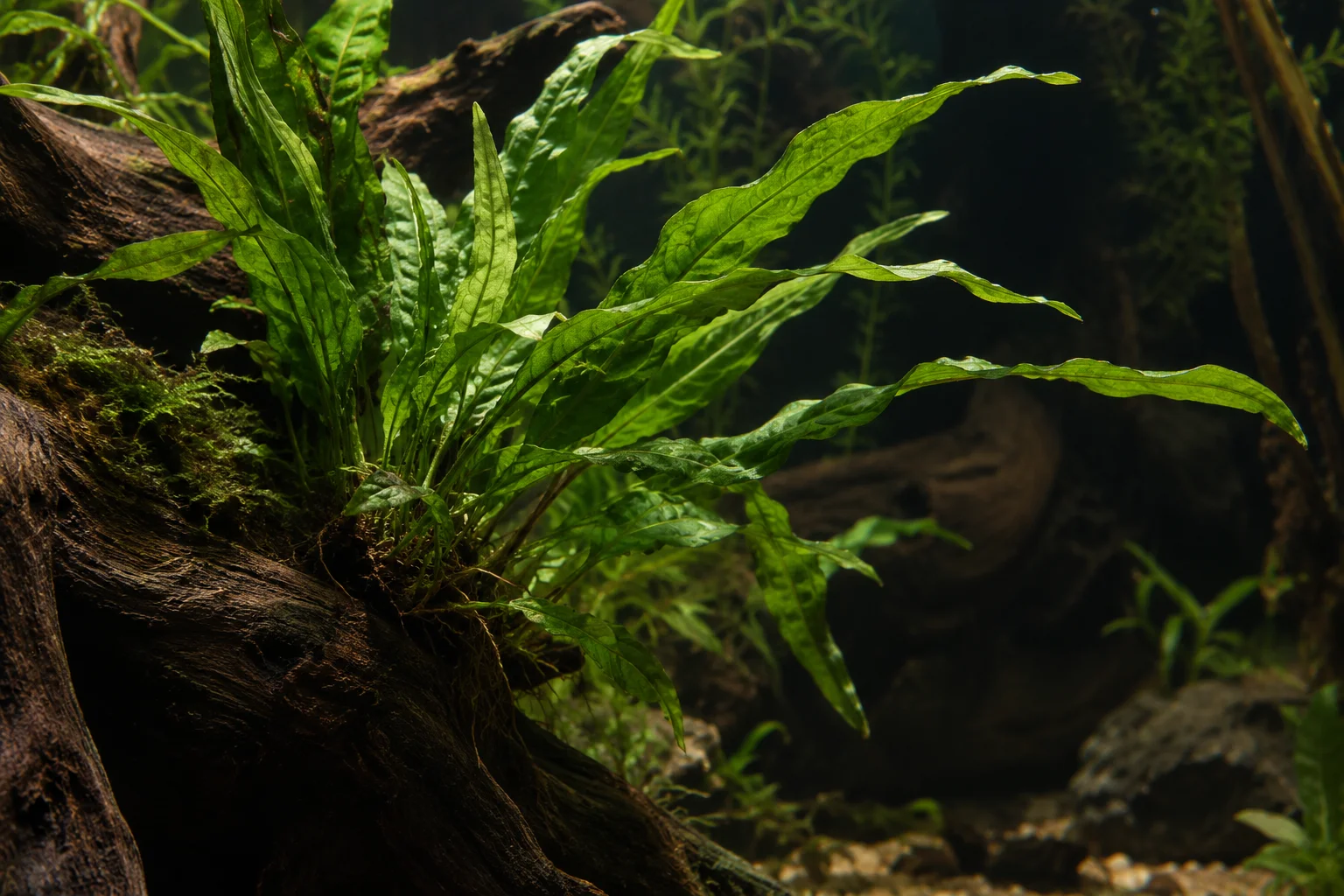
| Java fern (Microsorum pteropus) | Epiphyte | Midground, on wood or rock | Low | Slow |
| Anubias barteri var. nana | Epiphyte | Foreground to midground, on decor | Low | Very slow |
| Java moss (Taxiphyllum barbieri) | Moss | Anywhere, on wood or rock | Low | Moderate |
| Cryptocoryne wendtii | Rosette, root feeder | Foreground to midground | Low to medium | Slow |
| Cryptocoryne parva | Rosette, root feeder | Foreground | Medium | Very slow |
| Amazon sword (Echinodorus grisebachii) | Rosette, root feeder | Background, 30 gal and up | Medium | Moderate |
| Vallisneria (Vallisneria spiralis) | Grass-like, runners | Background | Low to medium | Fast |
| Dwarf sagittaria (Sagittaria subulata) | Grass-like, runners | Foreground | Medium | Moderate |
| Hornwort (Ceratophyllum demersum) | Stem, floating or planted | Background or floating | Low to medium | Fast |
| Water sprite (Ceratopteris thalictroides) | Stem or floating | Background or floating | Medium | Fast |
| Water wisteria (Hygrophila difformis) | Stem | Background | Medium | Fast |
| Ludwigia repens | Stem | Background | Medium | Moderate |
| Rotala rotundifolia | Stem | Background | Medium | Moderate to fast |
| Amazon frogbit (Limnobium laevigatum) | Floating | Surface | Any | Fast |
| Marimo moss ball (Aegagropila linnaei) | Algae ball | Foreground, loose | Low | Very slow |
Java fern care guide: planting, propagation and common problems
The number one beginner plant: low light, no CO2, ignored by most fish. Tie it to wood and never bury the rhizome.
PlantsAnubias care guide: types, planting, light and propagation
Nearly indestructible and slow-growing. Thick leaves survive plant-eating fish and goldfish.
PlantsAmazon sword plant care: planting, fertilizer and propagation
A large, fast-rooting centerpiece for 30 gallons and up. Feed it root tabs and it fills the background.
PlantsFloating aquarium plants: the 10 best floaters and how to keep them
Frogbit, salvinia and red root floaters soak up nitrate quickly and shade algae out.
PlantsLow light aquarium plants: 15 species that grow without CO2
If your tank has a weak hood light, start from this shorter list of shade-tolerant species.
03
How to plant each type
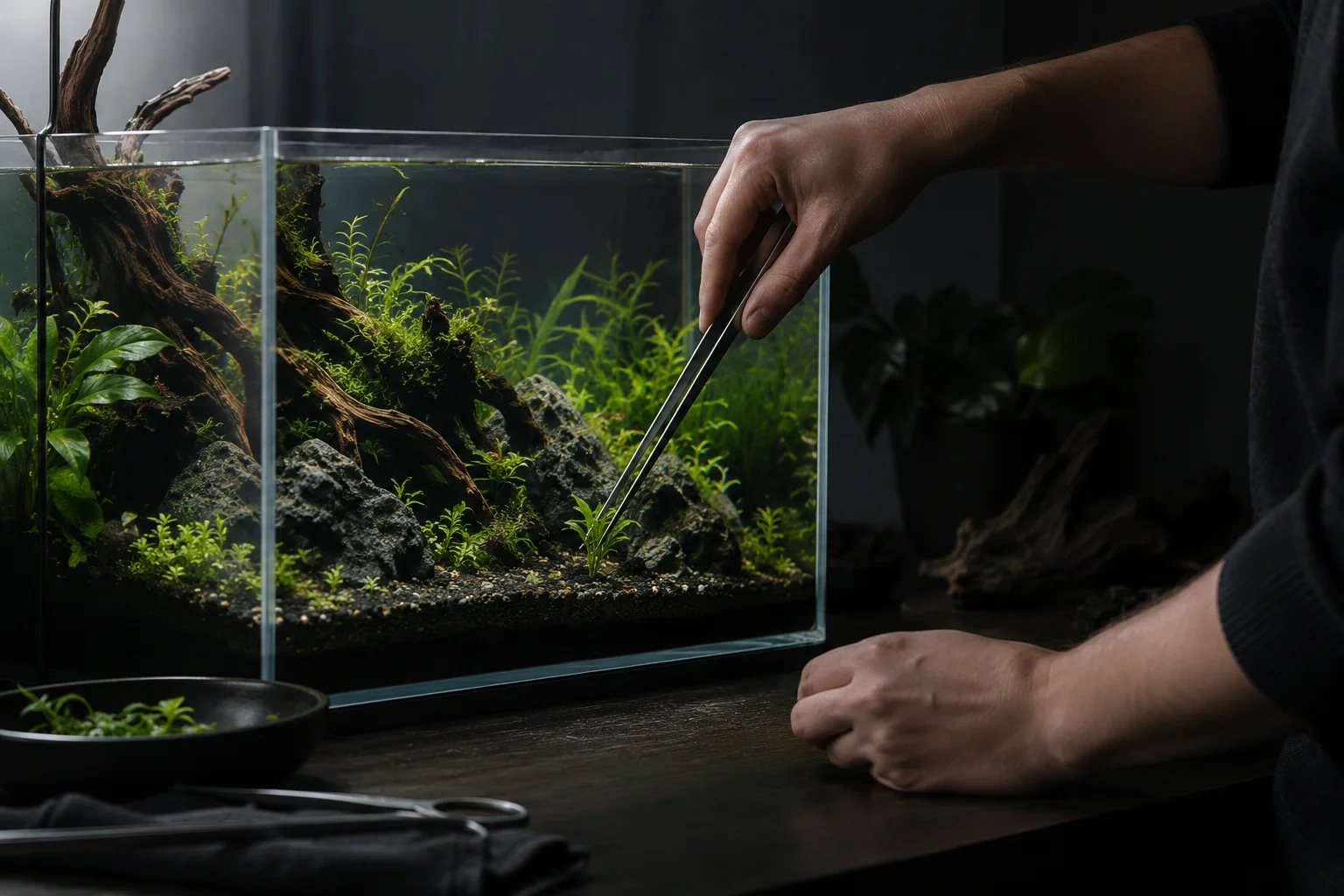
Getting the planting method right solves most early failures. The two classic mistakes are burying the rhizome of Java fern or anubias, which rots it, and leaving root feeders in a bare gravel bed with no nutrients.
- Epiphytes (Java fern, anubias, moss): tie with cotton thread or fishing line, or glue with gel superglue, to driftwood or rock. Keep the rhizome above the substrate.
- Root feeders (crypts, swords, vallisneria, sagittaria): remove the pot and rock wool, trim long roots to about 1 inch (2–3 cm), plant up to the crown and push a root tab nearby.
- Stem plants (wisteria, Ludwigia, Rotala, hornwort): plant stems individually, 1–2 inches (3–5 cm) deep and slightly apart, so the lower leaves still get light.
- Floaters (frogbit): drop them on the surface and keep them away from strong filter outflow. Thin them every week or two.
Cryptocorynes often "melt" (lose most of their leaves) a week or two after planting, because of the change from farm to aquarium conditions. Leave the roots in place: new leaves usually appear within a few weeks.
04
Light, fertilizer and CO2 for easy plants
Beginner plants are forgiving, not maintenance-free. Run the light for 6–8 hours a day on a timer; most kit LEDs are enough for the plants above. If you upgrade, our best aquarium light review explains which fixtures suit low-tech tanks without blasting them with algae-friendly intensity.
Dose an all-in-one liquid fertilizer at the label dose (or half dose in lightly stocked tanks) once a week after the water change, and push root tabs under swords and crypts every 2–3 months. Our aquarium fertilizer guide compares the main options. CO2 injection is not needed; if you want faster growth later, read the aquarium CO2 guide first.
05
Sample planted layouts by tank size
These are starting points with realistic plant counts. Buy a little more than you think you need: a densely planted tank resists algae better than a sparse one.
- 10 gallon (38 L): 1 Java fern on a piece of driftwood, 2 Anubias nana on rock, 3 Cryptocoryne wendtii in the midground, a small clump of Java moss and a handful of Amazon frogbit. Ideal for a betta or cherry shrimp.
- 20 gallon (75 L): 6–8 vallisneria in the back corners, 5 stems of water wisteria or Ludwigia, 4–5 crypts, 2 Java ferns and 2 anubias on hardscape, and a patch of dwarf sagittaria in front.
- 55 gallon (208 L): 1–2 Amazon swords as centerpieces, 10–15 vallisneria along the back, a bunch of hornwort, 6–8 crypts, several Java ferns and anubias on wood, and frogbit at one end for shade.
06
Plants beginners should avoid
Some popular plants are sold in beginner sections but need strong light, injected CO2 or a nutrient-rich soil. Others are not aquatic at all and rot within weeks.
- Carpet plants such as dwarf hairgrass, Monte Carlo and HC Cuba: they usually fade without CO2 and strong light.
- Red stem plants such as Rotala macrandra and Ludwigia 'Super Red': color and health depend on high light and CO2.
- Terrestrial plants sold as aquatic: mondo grass, purple waffle, peace lily (sometimes labeled 'Brazilian sword') and fully submerged lucky bamboo.
- Large swords in small tanks: an Amazon sword quickly overgrows a 10 gallon tank.
07
Fish and invertebrates that work with live plants
Most community fish leave plants alone. Tetras, rasboras, corydoras, bettas and shrimp are plant-safe. Goldfish, silver dollars and many large cichlids eat or uproot soft plants; with them, stick to anubias and Java fern attached to decor. If algae appears on the leaves, nerite snails and the species in our best snails for algae guide graze it without harming plants.
Frequently asked questions
Frequently asked questions
What are the easiest aquarium plants that do not need CO2?
Java fern, anubias, Java moss, Cryptocoryne wendtii, vallisneria, hornwort and Amazon frogbit all grow well without CO2. They take carbon from the water and from fish respiration. Growth is slower than in a CO2 tank, which actually makes them easier: less trimming, fewer nutrient swings and less algae.
Can I grow aquarium plants in gravel?
Yes. Epiphytes and floaters do not use the substrate, and root feeders such as swords, crypts and vallisneria grow well in fine to medium gravel if you add root tabs every 2–3 months. Avoid very coarse gravel, which leaves gaps that stems and fine roots struggle to anchor in.
Why are my new aquarium plants dying?
The most common causes are buried rhizomes on Java fern or anubias, crypt melt after planting, too little light for the species, or no nutrients for root feeders. Many store plants were also grown emersed and shed their old leaves while they adapt underwater. Give new plants 3–4 weeks before judging them.
How many plants should I put in my aquarium?
More than you think. Cover at least half of the substrate area from the start, using a mix of fast growers (hornwort, wisteria, floaters) and slow growers. Fast growers compete with algae while the slow plants establish. A sparsely planted tank is more prone to algae than a densely planted one.
Are live plants better than fake plants for beginners?
Live plants improve water quality, compete with algae and give fish natural cover, so the tank is usually more stable. Fake plants need no light or fertilizer but do none of that work. Many beginners mix both and replace the fake ones as their live plants grow.
Sources and references
Written and reviewed by the handsoffmyhobby editorial team according to our editorial policy.