Fact sheet
- Family
- Araceae (aroids)
- Origin
- Tropical West and Central Africa (riverbanks and streams)
- Height
- 1–2 in (3–5 cm) for Nana Petite, 2–4 in (5–10 cm) for nana, up to 12–16 in (30–40 cm) for barteri
- Light
- Low to medium
- CO2
- Not required
- Growth rate
- Very slow (about 1 leaf every 2–3 weeks)
- Difficulty
- Very easy
- Placement
- Epiphyte: on wood or rock, foreground to midground
- Temperature
- 72–82 °F (22–28 °C)
- pH
- 6.0–7.5 (tolerates up to about 8.0)
01
Anubias at a glance: why it suits almost any tank
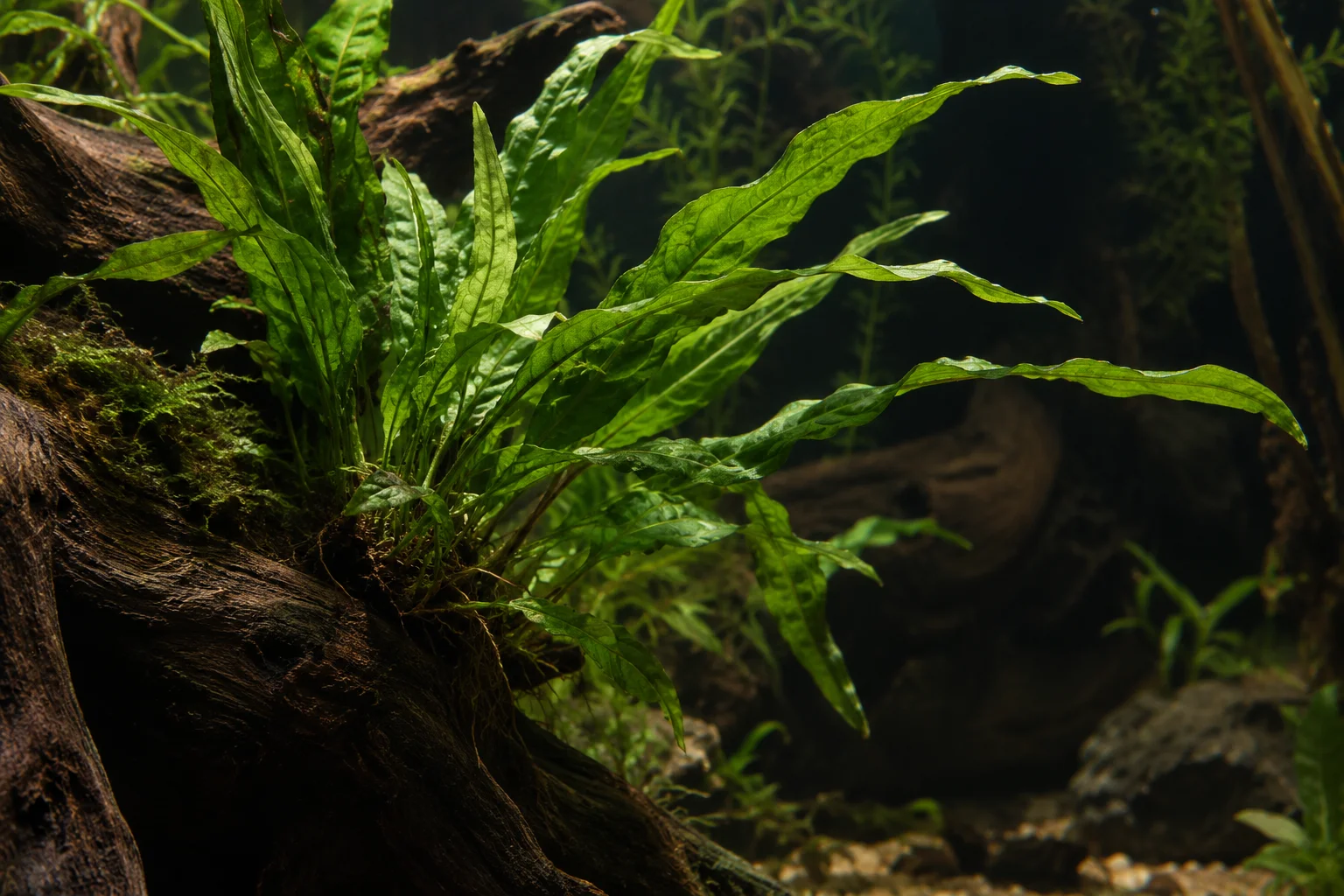
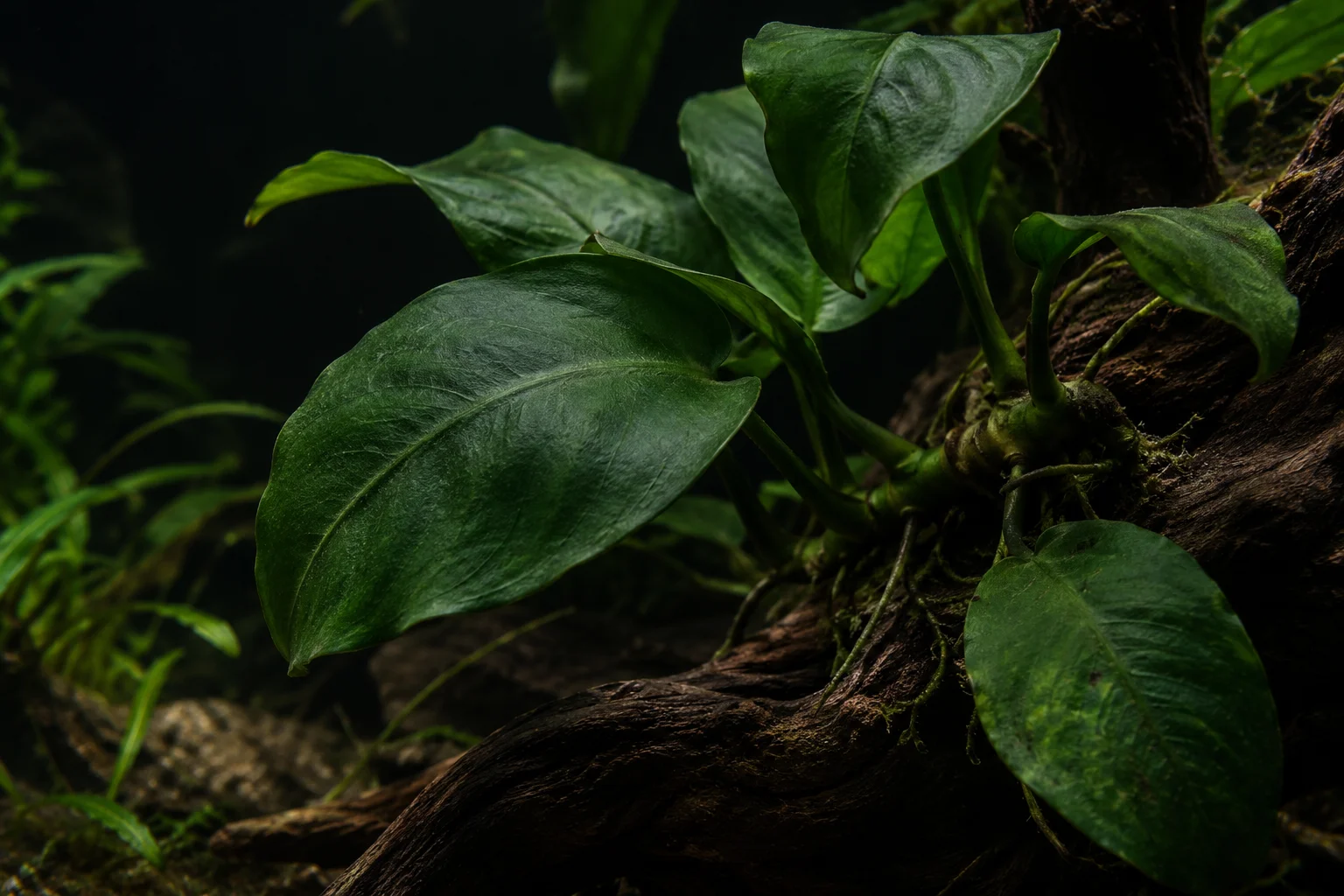
Anubias is a genus of rhizome plants from tropical Africa, sold in the hobby mostly as varieties of Anubias barteri. Its leaves are thick, dark green and leathery, which makes them unappealing to plant-eating fish. That is why anubias appears in goldfish tanks, cichlid tanks and low-tech setups where softer plants get eaten or fade away.
The trade-off is speed. Anubias grows very slowly, so it will not out-compete algae the way fast stem plants do, and a small pot stays small for months. If you want a forgiving plant for a new tank, pair it with Java fern and a few faster growers from our list of the best aquarium plants for beginners.
- Thrives under basic hood lights and in shaded corners
- Survives without fertilizer or CO2, though it grows better with some nutrients
- Ignored by most herbivorous fish, including goldfish and many cichlids
- Lives for years: a single rhizome can be divided again and again
02
Popular anubias types
Most anubias in stores are cultivated forms of Anubias barteri. Names vary by grower, but the following types are widely available in the US. Choose by final size first: a large barteri will shade a nano tank, while Nana Petite disappears in a 75-gallon layout.
| Type | Typical height | Leaf look | Best use |
|---|---|---|---|
| Anubias barteri var. nana | 2–4 in (5–10 cm) | Small, rounded, dark green | Foreground and midground, nano tanks |
| Anubias nana 'Petite' | 1–2 in (3–5 cm) | Tiny, compact leaves | Nano tanks, crevices in rock, shrimp tanks |
| Anubias barteri (species form) | 8–16 in (20–40 cm) | Large, broad, arrow-shaped | Midground to background on big wood |
| Anubias barteri 'Coffeefolia' | 4–8 in (10–20 cm) | Puckered leaves, reddish new growth | Midground accent |
| Anubias barteri var. caladiifolia | 8–14 in (20–35 cm) | Heart-shaped leaves | Larger tanks, background wood |
| Anubias heterophylla / gracilis | 8–16 in (20–40 cm) | Long or triangular leaves on tall stems | Background, open-top or riparium setups |
03
How to plant anubias
The rhizome, the thick horizontal stem that carries the leaves, must stay exposed to the water. Buried rhizomes cannot exchange gases properly and tend to rot within weeks. The roots, on the other hand, can go into the substrate or cling to hardscape.
- Remove the pot and all the rock wool with your fingers or tweezers; leftover wool traps debris and rots roots.
- Trim any brown, mushy roots and damaged leaves with sharp scissors.
- Choose a spot on driftwood or rock with some water flow around it.
- Attach the rhizome with cotton thread, fishing line, a zip tie or a drop of cyanoacrylate gel superglue (gel versions are aquarium-safe once cured).
- If you want it in the substrate, push only the roots in and leave the rhizome on top, or wedge it between two stones.
- Within 4–8 weeks the roots grip the surface and you can remove the thread.
Small anubias on wood or rock are easy to move. That makes them ideal for testing a layout before you commit to slower, rooted plants.
04
Anubias care: light, nutrients and water
Low to medium light is ideal. Strong light does not kill anubias, but it lets algae settle on the slow leaves before the plant can shed them. If your tank runs a powerful planted LED, put anubias in the shade of wood or taller plants. Our guide to the best aquarium light explains how intensity settings affect slow growers.
Anubias feeds mainly through its leaves and rhizome, so liquid fertilizer suits it better than root tabs. A weekly dose of an all-in-one liquid at the label rate is enough in most tanks; fish waste covers the rest in lightly planted setups. Pale new leaves usually point to a lack of nitrogen or iron. See our page on aquarium fertilizer for how to choose a balanced product.
CO2 is optional. In high-tech tanks it speeds growth slightly, but nobody adds CO2 to an aquarium for anubias alone. Water chemistry is rarely a problem: anubias accepts soft to fairly hard water, and temperatures from the low 70s to about 82 °F.
05
Propagation
Anubias spreads by extending its rhizome and occasionally sending up side shoots. Propagation is simple: once a rhizome carries 8–10 leaves, cut it into sections with a clean blade, leaving at least 3–4 leaves on each piece. Attach the cuttings like new plants. Side shoots that appear on their own can be snapped off once they have a few leaves and roots.
Anubias also flowers underwater fairly often, producing a cream-colored spathe typical of aroids. Flowering is a sign of a settled plant, not a problem, and you can trim the stalk or leave it.
06
Common anubias problems and fixes
Anubias has few real problems, and almost all of them come from planting or from its slow growth. Use the table to match what you see with a likely cause.
| Symptom | Likely cause | What to do |
|---|---|---|
| Leaves turn yellow, rhizome soft or smells | Rhizome rot, often from burial | Cut away soft tissue to firm green rhizome, replant above the substrate |
| Leaves melt or drop after purchase | Switch from emersed (farm) to submerged growth | Keep the rhizome healthy; new submerged leaves follow |
| Green spots or black tufts on leaves | Slow leaves give algae time to settle, light too strong | Shade the plant, remove worst leaves, see black beard algae |
| Pale or translucent new leaves | Nitrogen, iron or potassium shortage | Dose a complete liquid fertilizer |
| Holes in leaves | Potassium shortage or snails grazing old damage | Check fertilizer; healthy anubias is rarely eaten |
Algae on anubias is the most common complaint. Lower light intensity or photoperiod, keep nitrate stable, and let algae grazers such as Amano shrimp or nerite snails clean the leaves.
07
Tank ideas with anubias
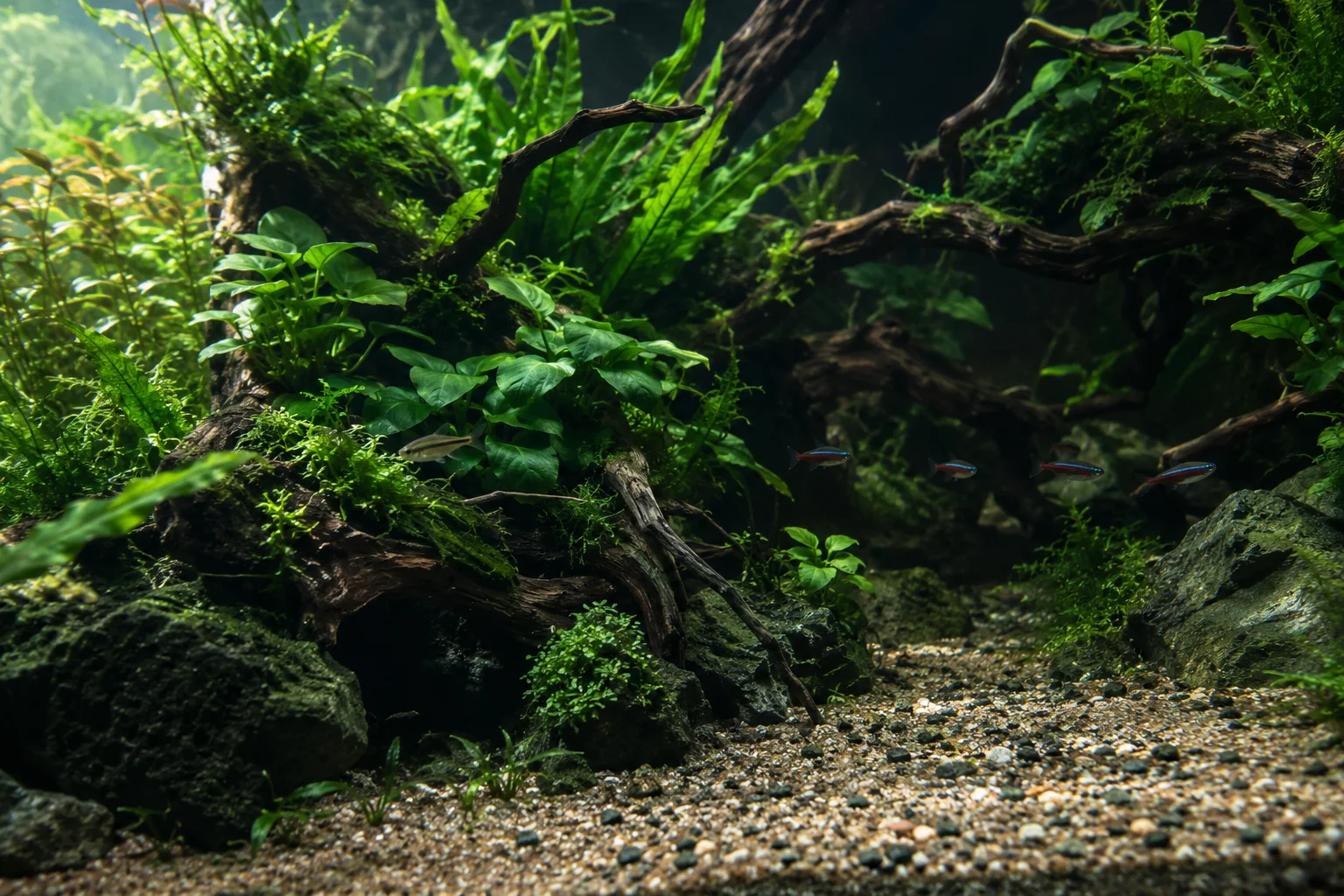
In a low-tech community tank, cover a piece of spiderwood with Anubias nana and Java fern, add a background of Amazon sword and floating plants, and you have a lush layout that needs little more than weekly water changes. The Walstad method uses the same idea of slow, hardy plants in a stable, lightly managed tank.
Anubias is also a strong choice where fish eat plants. In a goldfish tank or a cichlid setup, glue it firmly to rock so digging fish cannot uproot it. In nano and shrimp tanks, Nana Petite on small stones gives shelter and a surface for biofilm, which cherry shrimp graze constantly. For more ideas suited to dim tanks, browse our low-light aquarium plants.
Frequently asked questions
Frequently asked questions
Can you bury anubias nana in gravel?
You can bury the roots but not the rhizome. The rhizome is the thick green stem the leaves grow from, and when it is covered by gravel or sand it often rots. Plant the roots lightly in the substrate with the rhizome resting on top, or attach the plant to wood or rock with thread or gel superglue.
Does anubias need CO2 or fertilizer?
No CO2 is required, and anubias survives without fertilizer in many stocked tanks because fish waste supplies some nutrients. It grows better and keeps darker leaves with a weekly liquid fertilizer at the label dose. Root tabs are less useful than for rooted plants, because anubias absorbs most nutrients through its leaves and rhizome.
Why is my anubias melting?
New anubias is usually farm-grown with its leaves out of water. After planting, some of those emersed leaves can yellow and fall off while the plant adapts. As long as the rhizome stays firm and green, new submerged leaves will follow. A soft, brown or bad-smelling rhizome means rot, which must be cut away.
How fast does anubias barteri grow?
Very slowly. A healthy anubias barteri or nana produces about one new leaf every two to three weeks, a little faster with good light, fertilizer and CO2. Large specimens therefore take months to years to develop, which is why mature anubias plants are priced higher than small potted ones.
Is anubias safe with goldfish and cichlids?
Anubias is one of the best plants for these fish. Its tough, bitter leaves are rarely eaten, and attaching it to rock or wood keeps it safe from fish that dig. Make sure the attachment is firm, because large goldfish and cichlids can still pull loose plants out.
Sources and references
Written and reviewed by the handsoffmyhobby editorial team according to our editorial policy.