01
What makes freshwater fish colorful
Fish color comes from two sources. Pigments (red, orange, yellow and black) sit in skin cells and depend partly on diet, especially carotenoids. Structural color (the electric blue of a neon tetra or a ram) comes from reflective crystals that bend light, so it changes with viewing angle and lighting. The brightest freshwater fish combine both.
Three practical points matter when you shop. First, males are usually far more colorful than females, especially in livebearers, gouramis, killifish and dwarf cichlids. Second, juveniles in store tanks are often pale; many species color up only once they mature and settle. Third, stress kills color fast, so a fish that looks dull in the shop may simply be stressed, while a fish that stays dull in a good tank is often unwell.
If you are new to the hobby, start with hardy colorful species and only move to delicate ones like rams or discus once you are comfortable with testing and keeping stable water. Our list of the best beginner fish has several bright, forgiving options.
02
Most colorful freshwater fish compared
The table compares brightly colored aquarium fish, including several species without their own guide yet. Tank sizes are realistic minimums for a small group or pair, and temperature and pH ranges are comfortable ranges for captive-bred fish.
| Species | Main colors | Adult size | Min. tank | Temperature | pH | Difficulty |
|---|---|---|---|---|---|---|
| Betta (Betta splendens) | Every color, long fins | 2.4–2.8 in (6–7 cm) | 5 gal (19 L) | 76–82 °F (24–28 °C) | 6.5–7.5 | Easy |
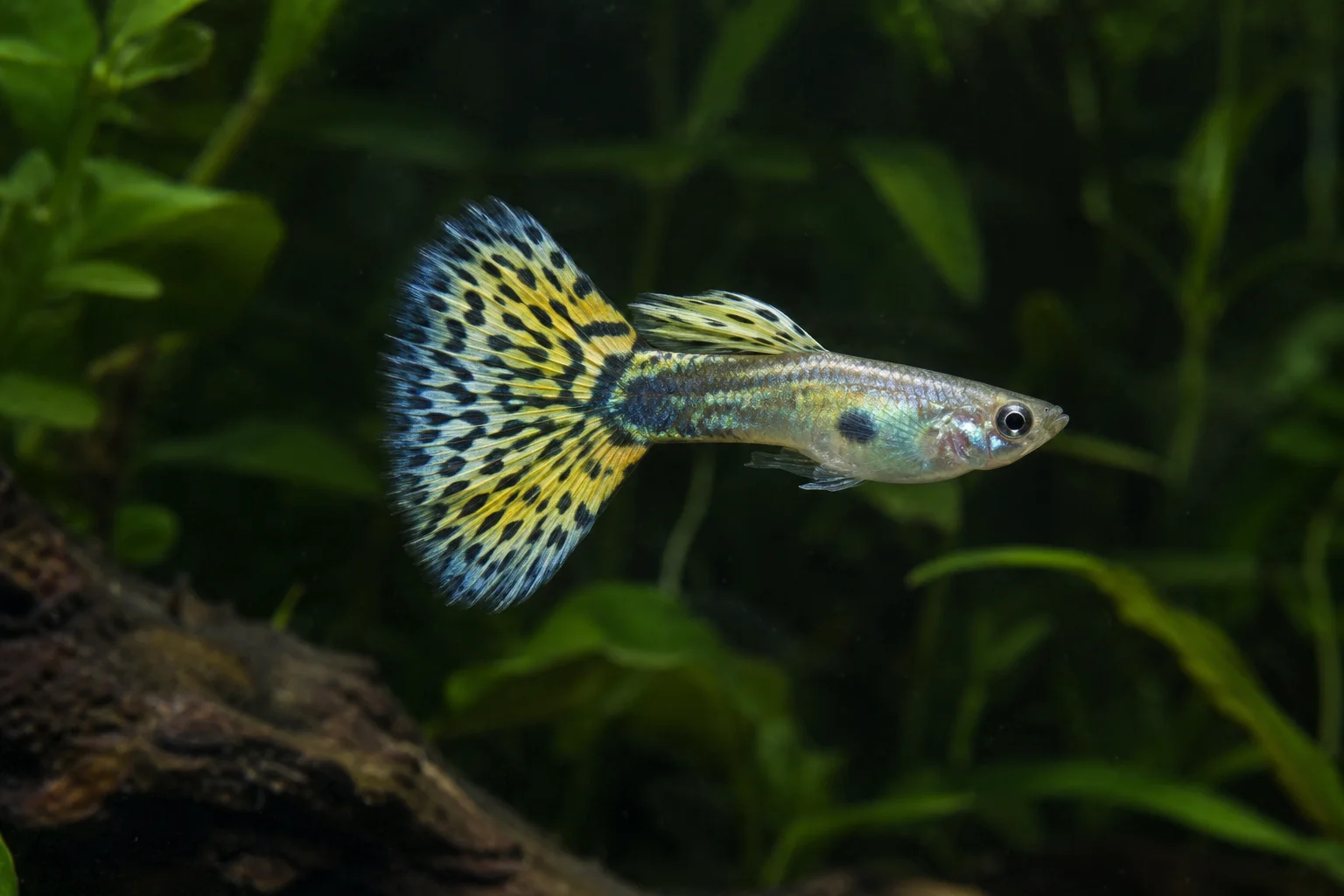
| Guppy (Poecilia reticulata) | Every color, males | 1.2–2.4 in (3–6 cm) | 10 gal (38 L) | 72–82 °F (22–28 °C) | 7.0–8.0 | Easy |
| Endler’s livebearer (Poecilia wingei) | Orange, green, black | 1–1.8 in (2.5–4.5 cm) | 10 gal (38 L) | 72–82 °F (22–28 °C) | 7.0–8.0 | Easy |
| Platy (Xiphophorus maculatus) | Red, orange, yellow, blue | 2–2.5 in (5–6 cm) | 20 gal (75 L) | 70–80 °F (21–27 °C) | 7.0–8.0 | Easy |
| Ember tetra (Hyphessobrycon amandae) | Orange-red | 0.8 in (2 cm) | 10 gal (38 L) | 73–82 °F (23–28 °C) | 5.5–7.0 | Easy |
| Cardinal tetra (Paracheirodon axelrodi) | Neon blue, red | 2 in (5 cm) | 20 gal (75 L) | 75–82 °F (24–28 °C) | 5.0–7.0 | Moderate |
| Celestial pearl danio (Danio margaritatus) | Blue, gold spots, orange fins | 1 in (2.5 cm) | 10 gal (38 L) | 72–78 °F (22–26 °C) | 6.5–7.5 | Easy to moderate |
| Cherry barb (Puntius titteya) | Cherry red (males) | 2 in (5 cm) | 20 gal (75 L) | 73–80 °F (23–27 °C) | 6.0–7.5 | Easy |
| Scarlet badis (Dario dario) | Scarlet and blue bars (males) | 0.8 in (2 cm) | 10 gal (38 L) | 72–79 °F (22–26 °C) | 6.5–7.5 | Moderate (live or frozen food) |
| Sparkling gourami (Trichopsis pumila) | Blue spangles, red edges | 1.5 in (4 cm) | 10 gal (38 L) | 76–82 °F (24–28 °C) | 6.0–7.5 | Easy to moderate |
| Dwarf gourami (Trichogaster lalius) | Red and blue | 3 in (7.5 cm) | 20 gal (75 L) | 77–82 °F (25–28 °C) | 6.0–7.5 | Moderate (health) |
| German blue ram (Mikrogeophagus ramirezi) | Yellow, blue, red | 2–3 in (5–7 cm) | 20 gal (75 L) | 78–85 °F (26–29 °C) | 5.0–7.0 | Moderate to hard |
| Boesemani rainbowfish (Melanotaenia boesemani) | Blue front, orange rear | 4 in (10 cm) | 55 gal (208 L) | 77–81 °F (25–27 °C) | 7.0–8.0 | Easy to moderate |
| Electric blue acara (Andinoacara pulcher) | Metallic blue | 5–6 in (13–15 cm) | 40 gal (150 L) | 74–80 °F (23–27 °C) | 6.5–7.5 | Moderate |
| Discus (Symphysodon spp.) | Red, blue, turquoise strains | 6–8 in (15–20 cm) | 75 gal (284 L) | 82–86 °F (28–30 °C) | 5.5–7.0 | Hard |
Betta fish care guide: tank size, water, diet and tank mates
Almost any color and fin shape you can imagine, in a fish that fits a 5–10 gallon tank.
Fish speciesGuppy care guide: tank, water, tank mates and breeding
Hardy livebearer with endless color strains, ideal for a bright, busy community in harder water.
Fish speciesCardinal tetra care guide: tank, water, tank mates and neon comparison
Neon blue and full red stripe; a large school is one of the most striking sights in the hobby.
Fish speciesEmber tetra care guide: tank, water, school and tank mates
Glowing orange micro tetra that lights up a planted nano tank.
Fish speciesCelestial pearl danio (galaxy rasbora) care: tank size, water and tank mates
Blue-gray body, gold spots and orange fins, a jewel for dense nano tanks.
Fish speciesDwarf gourami care guide: tank size, water, tank mates and disease
Red and electric blue stripes in a peaceful 20-gallon centerpiece.
Fish speciesGerman blue ram care guide: tank, water, tank mates and breeding
Yellow, blue and red in a small cichlid, at its best in warm, soft water.
Fish speciesElectric blue acara care guide: tank size, water, diet and tank mates
Solid, metallic blue in a calm, medium-sized cichlid.
Fish speciesDiscus fish care guide: water parameters, tank size and tank mates
The most colorful freshwater fish in many keepers' eyes, but strictly for experienced hobbyists.
03
Colorful fish for nano and 10-gallon tanks
Small tanks suit the tiny jewels of the hobby. A school of ember tetras turns a planted 10-gallon into a warm orange glow, while celestial pearl danios show their spots best against dark green plants. Endler’s livebearers are even more intense than most guppies, though they breed freely and a male-only group is the simple way to avoid overcrowding.
For a single showpiece, a betta is hard to beat, and the sparkling gourami is a quieter alternative that glitters blue under good light. Scarlet badis are among the most vivid fish of any size, but they are shy micro predators that usually refuse dry food, so plan on frozen or live foods. Browse our nano fish guide for more small species.
04
Brightly colored aquarium fish for 20 to 55 gallons
In mid-size tanks you can mix color on several levels. Guppies and platies bring constant movement and every shade imaginable, but they prefer harder, slightly alkaline water, so keep them with fish that like the same. A school of cardinal tetras is the softer-water alternative and gives the most intense blue-and-red band in the hobby.
For a focal fish, a male dwarf gourami or a pair of German blue rams adds a second color story. In 55 gallons, a group of Boesemani rainbowfish is a spectacle: males turn deep blue at the front and bright orange at the back, especially in the morning. If you want more ideas for a striking focal fish, see our guide to centerpiece fish.
05
How to bring out your fish’s best color
Most dull fish in home tanks are not "bad specimens" but fish in conditions that do not show them off. These changes make the biggest difference:
- Water quality first: keep ammonia and nitrite at zero and nitrate low with weekly water changes. Poor water fades color within days.
- Varied diet: a quality flake or pellet with natural carotenoids (krill, spirulina, astaxanthin), plus frozen foods a few times a week. See how often to feed aquarium fish.
- Dark substrate and background: fish often show deeper color over dark gravel or sand. Our aquarium substrate reviews cover dark options.
- Good lighting: a full-spectrum LED with some red and blue output makes reds and blues pop. Compare models in our aquarium light reviews.
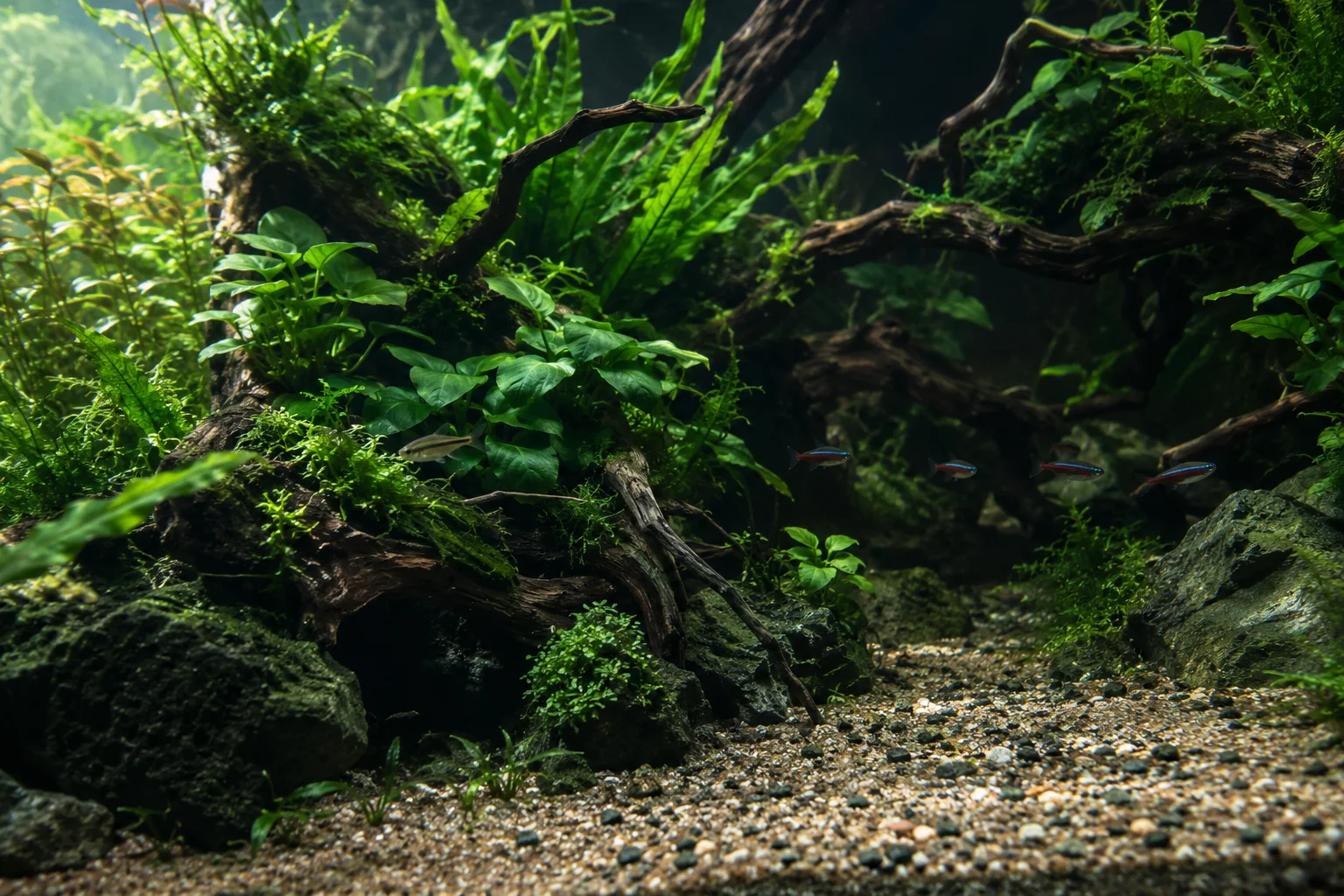
- Plants and cover: secure fish color up, nervous fish fade. Floating plants and dense planting help shy species.
- Compatible tank mates: one bully can keep a whole tank pale.
Color-enhancing foods can deepen reds and oranges, but they cannot fix stress, poor water or a fish that is sick. Treat them as a finishing touch, not a cure.
06
Colorful community examples for 10, 20 and 55 gallons
These sample communities assume a cycled, planted tank with suitable filtration and regular maintenance. Add fish in stages and check the volume guides for 10-gallon and 20-gallon tanks for more options.
- 10 gallons (38 L): 10 ember tetras, 1 male sparkling gourami or 1 male betta (not both), a few nerite snails
- 20 gallons long (75 L): 12 cardinal tetras, 1 pair of German blue rams, 6 sterbai corydoras (one of the few corydoras that handle warm water)
- 55 gallons (208 L): 8 Boesemani rainbowfish, 8 cherry barbs, 1 male dwarf gourami, 8 corydoras, 1 bristlenose pleco
07
Colorful fish to avoid
Some fish are sold for their color but come with a welfare cost. Dyed fish, such as painted glassfish (Parambassis ranga) or dyed "jellybean" parrot cichlids, are injected or soaked in dye. The color fades within months, and the process is stressful and often harmful, so avoid buying them and choose naturally colorful species instead.
GloFish are different: they are genetically modified zebra danios, tetras and barbs that are legal to sell in the US, and their color is permanent and does not involve dyeing. Care is the same as for the original species. Finally, be wary of extreme fancy strains with very long fins or deformed bodies, which tend to be weaker swimmers and more prone to fin rot.
Frequently asked questions
Frequently asked questions
What is the most colorful freshwater fish?
There is no single answer, but discus, German blue rams, bettas, guppies, cardinal tetras and Boesemani rainbowfish are usually named among the most colorful freshwater fish. For small tanks, scarlet badis, Endler’s livebearers and ember tetras are among the brightest. Male fish of most species are far more colorful than females.
What are the best colorful freshwater fish for beginners?
Guppies, platies, Endler’s livebearers, ember tetras, cherry barbs and a single betta are colorful and forgiving. They accept a wide range of conditions, eat standard foods and are captive-bred in large numbers. Wait until your tank is fully cycled, then add them in small batches.
Why has my fish lost its color?
The most common causes are stress, poor water quality, a recent move, a bully in the tank, bright bare surroundings or illness. Test ammonia, nitrite and nitrate first, then look at tank mates and decor. Many fish also look pale at night or right after lights come on, which is normal.
Do color-enhancing fish foods work?
Foods rich in carotenoids such as astaxanthin, krill or spirulina can intensify red, orange and yellow pigments over several weeks. They do not change blue or iridescent colors much, and they cannot compensate for poor water or stress. A varied diet of quality dry and frozen foods works best.
Are colorful fish harder to keep?
Not necessarily. Guppies, platies and ember tetras are both bright and hardy. Difficulty depends on the species: discus and German blue rams need warm, very clean, stable water, while many colorful livebearers and tetras are among the easiest fish in the hobby.
Sources and references
Written and reviewed by the handsoffmyhobby editorial team according to our editorial policy.