Our picks at a glance
- Best overallAquaClear Power Filter
Large, fully customizable media basket, adjustable flow and replacement media that costs little over the years.
- Best hang-on-back for convenienceSeachem Tidal
Self-priming, built-in surface skimmer and a removable media basket that makes cleaning quick.
- Best canister for mid-size tanksFluval 07 Series
Quiet, holds a lot of biological media and keeps equipment out of sight in 30 to 100 gallon tanks.
- Best for bettas, fry and shrimpHikari Bacto-Surge Foam Filter
Air-driven, gentle flow, no intake that can suck in tiny animals, and almost nothing to break.
01
What the best aquarium filter actually does
A filter does three jobs. Mechanical filtration traps floating debris in foam or floss. Biological filtration, the most important one, gives nitrifying bacteria a large surface to live on so they can convert ammonia into nitrite and then nitrate. Chemical filtration (activated carbon, resins) removes odors, tannins or medications, and is optional in most tanks.
That is why a new filter cannot keep fish safe on day one: the bacteria have to grow first, which is what cycling a fish tank is about. And it is why you should never replace all the media at once. Whatever type you choose, the best aquarium filter for your setup is the one with enough biological media for your stock and a flow your fish can live with.
Rinse filter media in old tank water, never under the tap. Chlorine or chloramine in tap water kills the bacteria your fish depend on.
02
Comparison table
The four main filter types differ in media capacity, noise, maintenance and the tank sizes they suit.
| Filter | Type | Tank size | Media capacity | Price |
|---|---|---|---|---|
| AquaClear Power Filter | Hang-on-back | 5–110 gal (19–416 L) | Medium-high | $ |
| Seachem Tidal | Hang-on-back | Up to 110 gal (416 L) | Medium-high | $$ |
| Marineland Penguin Bio-Wheel | Hang-on-back | Up to 70 gal (265 L) | Low (cartridge) | $ |
| Fluval 07 Series | Canister | About 30–100 gal (115–380 L) | High | $$$ |
| Fluval FX6 | Canister | 75 gal and up (285 L+) | Very high | $$$ |
| Fluval U Series | Internal | Small to medium tanks | Low-medium | $ |
| Hikari Bacto-Surge | Sponge | Nano to large, low flow | Medium (biological) | $ |
AquaClear (Fluval) · Hang-on-back filter
AquaClear Power Filter
Best for: Community tanks from 10 to 110 gallons, beginners and budget-minded keepers
The AquaClear has been a hobby standard for decades because it gets the basics right. Water rises through a deep basket that holds a foam block, activated carbon and BioMax ceramic rings, and you can swap the carbon for more biological media or a fine polishing pad. Flow is adjustable with a lever, which helps with slow swimmers. It comes in five sizes (20, 30, 50, 70 and 110), each rated for a range of tank volumes. Downsides: it must be primed by hand after a power cut, and the intake can need a sponge cover for shrimp or fry.
Pros
- Large, customizable media basket
- Adjustable flow
- Inexpensive replacement media
- Five sizes covering 5 to 110 gallons
Cons
- Must be refilled to restart after a power outage
- Impeller can rattle if not cleaned
- Intake needs a guard for shrimp and fry
- Type
- Hang-on-back
- Sizes
- 20, 30, 50, 70, 110
- Media
- Foam, carbon, BioMax (customizable)
- Flow control
- Yes, adjustable
Seachem · Hang-on-back filter
Seachem Tidal
Best for: Keepers who want an easy-maintenance hang-on-back for 35 to 110 gallons
Tidal is Seachem’s take on the hang-on-back filter, designed to fix the classic annoyances. The pump sits in the tank, so it self-primes after a power cut and keeps running even when the water level drops. A built-in surface skimmer pulls off oily film, the flow is adjustable, and the media basket lifts out in one piece. An indicator shows when the basket is clogging. It is offered in 35, 55, 75 and 110 gallon sizes. It takes a little more space at the back of the tank than an AquaClear, and the larger models are fairly tall for low-lid tanks.
Pros
- Self-priming
- Built-in surface skimmer
- Removable media basket with clog indicator
- Adjustable flow
Cons
- No size for nano tanks
- Bulkier than other hang-on-backs
- Larger models need lid clearance
- Type
- Hang-on-back
- Sizes
- 35, 55, 75, 110
- Self-priming
- Yes
- Surface skimmer
- Built in
Marineland · Hang-on-back filter with bio-wheel
Marineland Penguin Bio-Wheel Power Filter
Best for: Simple community tanks where cartridge convenience matters most
The Penguin is the familiar cartridge filter with a rotating Bio-Wheel that hosts beneficial bacteria in contact with air. It is easy to set up, widely sold and offered in several sizes (100, 150, 200 and 350). The trade-off is the cartridge system: many keepers throw away cartridges too often, which removes bacteria and can cause ammonia spikes. If you choose a Penguin, rinse the cartridge in tank water instead of replacing it monthly, and let the Bio-Wheel do the biological work. The wheel can also stop turning if it gets dirty, so check it during maintenance.
Pros
- Easy to set up
- Bio-Wheel adds biological capacity
- Widely available
- Several sizes
Cons
- Cartridge-based, with limited media space
- Bio-Wheel can stall and make noise
- Ongoing cartridge cost if replaced often
- Type
- Hang-on-back
- Sizes
- 100, 150, 200, 350
- Media
- Cartridge plus Bio-Wheel
- Flow control
- No
Fluval · Canister filter
Fluval 07 Series
Best for: Planted and community tanks from about 30 to 100 gallons
The 07 series (107, 207, 307 and 407) is one of the most popular canisters in the mid-size range. Fluval rates the 107 for tanks up to about 30 gallons and the 407 for up to about 100 gallons. Water passes through stacked trays you can fill with foam, ceramic rings and fine pads, so biological capacity is far higher than in a hang-on-back. The canister sits in the stand, which keeps the tank clean-looking and quiet. Priming is done with a built-in pump button. Like every canister, maintenance takes longer: plan to open it every one to three months and to check the hoses and seals.
Pros
- Large media capacity in stacked trays
- Quiet operation
- Built-in priming button
- Hidden in the stand
Cons
- Longer, messier maintenance
- Higher upfront cost
- Hoses and seals need regular checks
- Type
- Canister
- Models
- 107, 207, 307, 407
- Tank range (maker)
- Up to about 30 gal (107) to about 100 gal (407)
- Priming
- Push-button primer
Fluval · High-capacity canister filter
Fluval FX6
Best for: Large tanks, goldfish, cichlids and big messy fish
The FX6 is a high-output canister that Fluval rates for tanks up to about 400 gallons. Its Smart Pump self-primes, it has a large media volume and a drain valve at the bottom makes water changes on the canister itself easier. For a 75 to 125 gallon tank with large cichlids, plecos or a group of fancy goldfish, it can handle the bioload a hang-on-back cannot. The smaller FX4 follows the same design for medium-large tanks. It is big, heavy when full and too powerful for most tanks under 55 gallons unless you diffuse the outflow.
Pros
- Very large media capacity
- Self-priming pump
- Bottom drain valve
- Handles heavy bioloads
Cons
- Bulky, needs a deep stand
- Too strong for small tanks
- Expensive
- Type
- Canister
- Tank range (maker)
- Up to about 400 gal
- Priming
- Self-priming
- Smaller sibling
- Fluval FX4
Fluval · Internal filter
Fluval U Series
Best for: Small and medium tanks, low-water setups and rimless tanks where a hang-on-back will not fit
The U series (U1 to U4) sits inside the tank against the glass with suction cups. It uses removable foam and Poly/Carbon cartridges plus a biological stage, has adjustable flow and can be installed horizontally for very shallow water such as turtle or paludarium setups. Internal filters are handy when the lid or the wall leaves no room at the back. The obvious downside is that it takes up space in the tank and is visible unless hidden behind plants or decor, and its media volume is smaller than a canister of the same price.
Pros
- Fits where a hang-on-back cannot
- Adjustable flow
- Works in shallow water
- Easy to remove for cleaning
Cons
- Visible inside the tank
- Smaller media volume
- Suction cups age and slip
- Type
- Internal
- Models
- U1, U2, U3, U4
- Flow control
- Yes
- Mounting
- Vertical or horizontal
Hikari · Air-driven sponge filter
Hikari Bacto-Surge Foam Filter
Best for: Bettas, fry, shrimp tanks, quarantine and hospital tanks
A sponge filter is the simplest biological filter there is: an air pump pushes bubbles up a tube, which draws water through a large foam block where bacteria colonize. The Bacto-Surge is a well-built version with a weighted base and coarse foam that clogs slowly. Flow is gentle, so it suits long-finned fish, and there is no intake to trap baby shrimp or fry. It needs a separate aquarium air pump and airline, and it does little mechanical polishing, so the water may look less crystal-clear than with a power filter.
Pros
- Very gentle flow
- Safe for fry and shrimp
- Almost nothing to break
- Easy to seed a new tank with
Cons
- Needs a separate air pump
- Takes up space in the tank
- Limited mechanical filtration
- Type
- Sponge (air-driven)
- Sizes
- Mini to extra large
- Power
- External air pump required
- Flow
- Gentle, set by air valve
03
How we selected these filters
This list is an editorial selection based on manufacturer specifications and long-standing hobby consensus, not a laboratory test. We looked at four things: biological media capacity for the rated tank size, how easy and safe routine maintenance is, the cost and availability of replacement media and parts in the US, and how consistently each model is recommended by experienced keepers. Ratings on the box are the maker’s figures and tend to be optimistic, which is why we suggest sizing up below.
04
Buying guide: filter types explained
Hang-on-back (HOB) filters hang on the rear rim and return water like a waterfall. They are cheap, easy to service and fine for most tanks up to about 75 gallons. Compare models in our guide to the best hang-on-back filter.
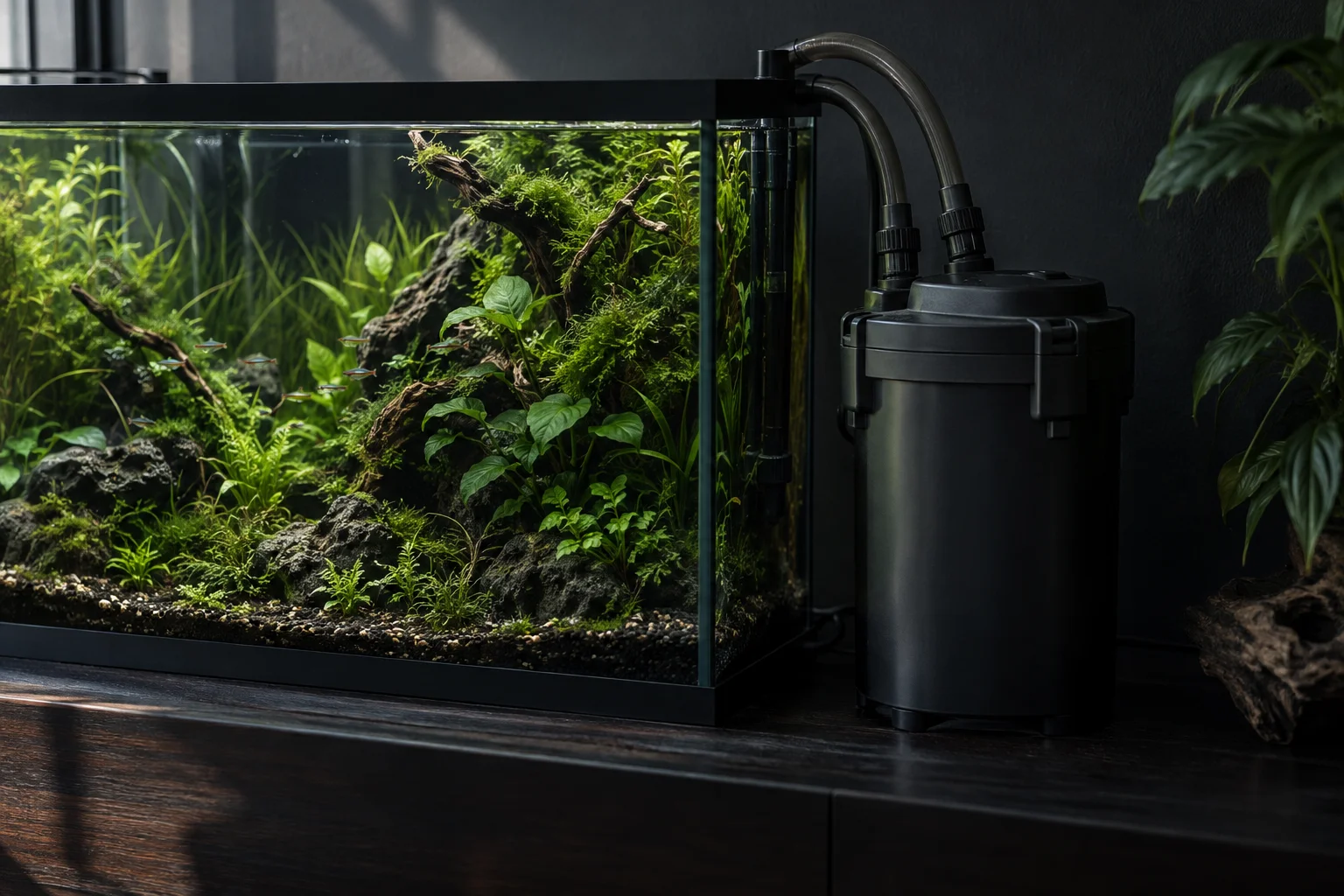
Canister filters sit under the tank and connect with hoses. They hold the most media, run quietly and suit planted tanks, large tanks and heavy bioloads. See the best canister filter for more options.
Sponge filters run on air, are nearly indestructible and give the gentlest flow. They are the default for breeding, shrimp and hospital tanks; our best sponge filter page compares the main models.
Internal filters sit inside the tank. They are useful when there is no room behind the tank, but they are visible and hold less media.
- Media capacity: more biological media means a more stable tank.
- Adjustable flow: essential for bettas, gouramis and long-finned fish.
- Maintenance access: a basket or tray you can lift out saves time and mess.
- Noise: canisters are quietest; hang-on-backs make a light trickle when the water level drops.
- Running cost: reusable foam and ceramic beat disposable cartridges over time.
05
How to choose by tank size and fish
A common rule of thumb is a filter that turns over the tank 4 to 6 times per hour for a typical community tank, and closer to 8 to 10 times for heavy waste producers. Because box ratings are generous, many keepers pick a filter rated for a larger tank than the one they own.
| Setup | Recommended type | Example |
|---|---|---|
| Betta or nano tank (2.5–10 gal / 10–40 L) | Sponge or small HOB with flow turned down | Hikari Bacto-Surge, AquaClear 20 |
| Community tank (20–40 gal / 75–150 L) | Hang-on-back | AquaClear 50, Seachem Tidal 35 or 55 |
| Planted tank (40–75 gal / 150–285 L) | Canister | Fluval 307 or 407 |
| Goldfish tank (40 gal+ / 150 L+) | Large HOB or canister, high turnover | AquaClear 110, Fluval FX4 or FX6 |
| Large cichlids, plecos (75 gal+ / 285 L+) | High-capacity canister | Fluval FX6 |
| Shrimp, fry, quarantine | Sponge | Hikari Bacto-Surge |
Goldfish produce far more waste than tropical fish of the same size. Plan for about double the turnover you would use for a community tank, and add a gravel vacuum to your routine.
06
Flow and sensitive fish
Strong current exhausts fish that evolved in still water. A betta fish with long fins should never be pushed around the tank; use a sponge filter or turn a hang-on-back down and baffle the outflow with a piece of foam. For cherry shrimp and fry, cover any intake with a pre-filter sponge so babies are not sucked in. Fish from fast rivers, such as hillstream loaches, are the exception and appreciate more flow.
07
Common mistakes with aquarium filters
If the water turns milky after maintenance, read our guide to cloudy fish tank water; a bacterial bloom after over-cleaning is a frequent cause. For a full maintenance routine, see how to clean a fish tank.
- Replacing all the media at once. This throws away most of your bacteria and can trigger an ammonia spike. Replace or rinse only part of the media at a time.
- Cleaning media under tap water. Use water from a water change instead.
- Buying the minimum rating. A filter rated exactly for your tank size is often undersized in practice.
- Switching off the filter for long periods. Bacteria start dying after a few hours without oxygen-rich flow.
- Running carbon forever. Exhausted carbon does nothing; in most tanks you can replace it with more biological media.
08
Setting up a new filter
Rinse new foam and ceramic media in dechlorinated water to remove dust, fill the hang-on-back box or canister before you plug it in, and never run an impeller dry. Pair the filter with a reliable aquarium heater placed near the outflow for even temperature. If you are buying your first tank, our beginner aquarium guide walks through the complete setup order.
Frequently asked questions
Frequently asked questions
What is the best aquarium filter for beginners?
For most beginners, a hang-on-back filter such as the AquaClear Power Filter is the best choice. It is affordable, easy to install and maintain, and uses reusable media instead of disposable cartridges. Pick a size rated for a slightly larger tank than yours, and keep the media in the filter for at least a few weeks while the tank cycles.
How often should I clean my aquarium filter?
Most hang-on-back and internal filters need a light rinse every two to four weeks, and canisters every one to three months, depending on stock. Clean when flow drops noticeably. Squeeze foam in old tank water, leave ceramic media mostly alone, and never clean the filter on the same day as a big gravel vacuum.
Is a canister filter better than a hang-on-back?
A canister holds more media, runs quieter and stays hidden, so it is better for large, planted or heavily stocked tanks. A hang-on-back is cheaper, quicker to service and perfectly adequate for most tanks up to about 75 gallons. Neither is better in every case; the right one depends on tank size, stock and how much maintenance you want.
How many gallons per hour should my filter be?
A typical community tank does well with a flow of 4 to 6 times the tank volume per hour, so about 80 to 120 gallons per hour for a 20 gallon tank. Goldfish and large cichlids benefit from 8 to 10 times. Bettas and shrimp need gentle flow, so a sponge filter or an adjustable model turned down is better.
Can I turn off my aquarium filter at night?
No. The filter keeps oxygen-rich water moving through the bacterial colony. Without flow, bacteria begin to die within hours and the tank can lose oxygen. If noise is the problem, choose a quieter canister or sponge filter, or adjust the water level to reduce the splash from a hang-on-back.
Sources and references
Written and reviewed by the handsoffmyhobby editorial team according to our editorial policy.