Where to start
Best aquarium plants for beginners: 15 easy live plants
Fifteen forgiving species compared by light, placement and growth, with sample layouts for 10, 20 and 55 gallon tanks.
PlantsLow light aquarium plants: 15 species that grow without CO2
Plants that grow under a stock hood light with no CO2, and how to place them so they stay healthy.
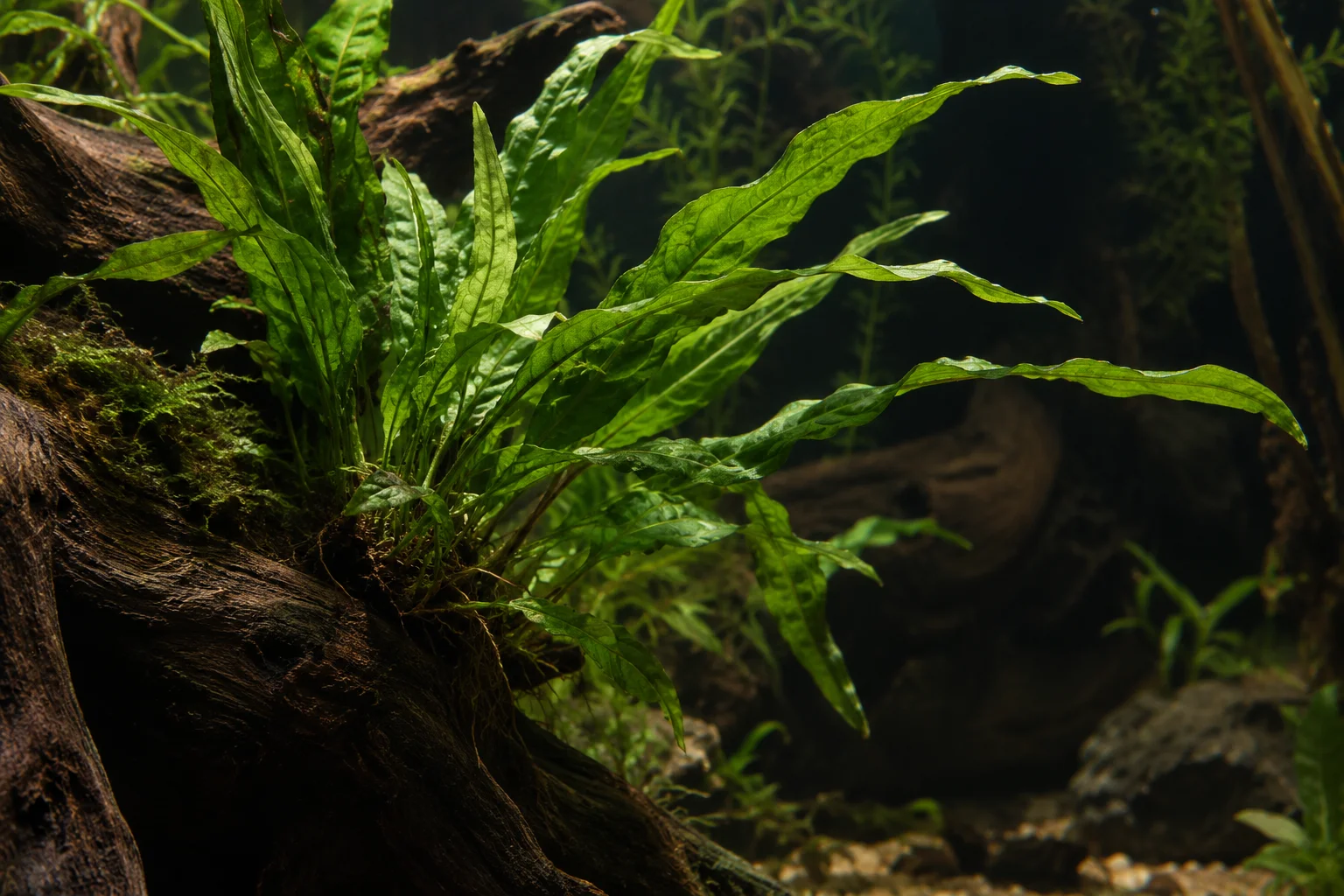
PlantsJava fern care guide: planting, propagation and common problems
The plant that is almost impossible to kill, as long as you do not bury its rhizome.
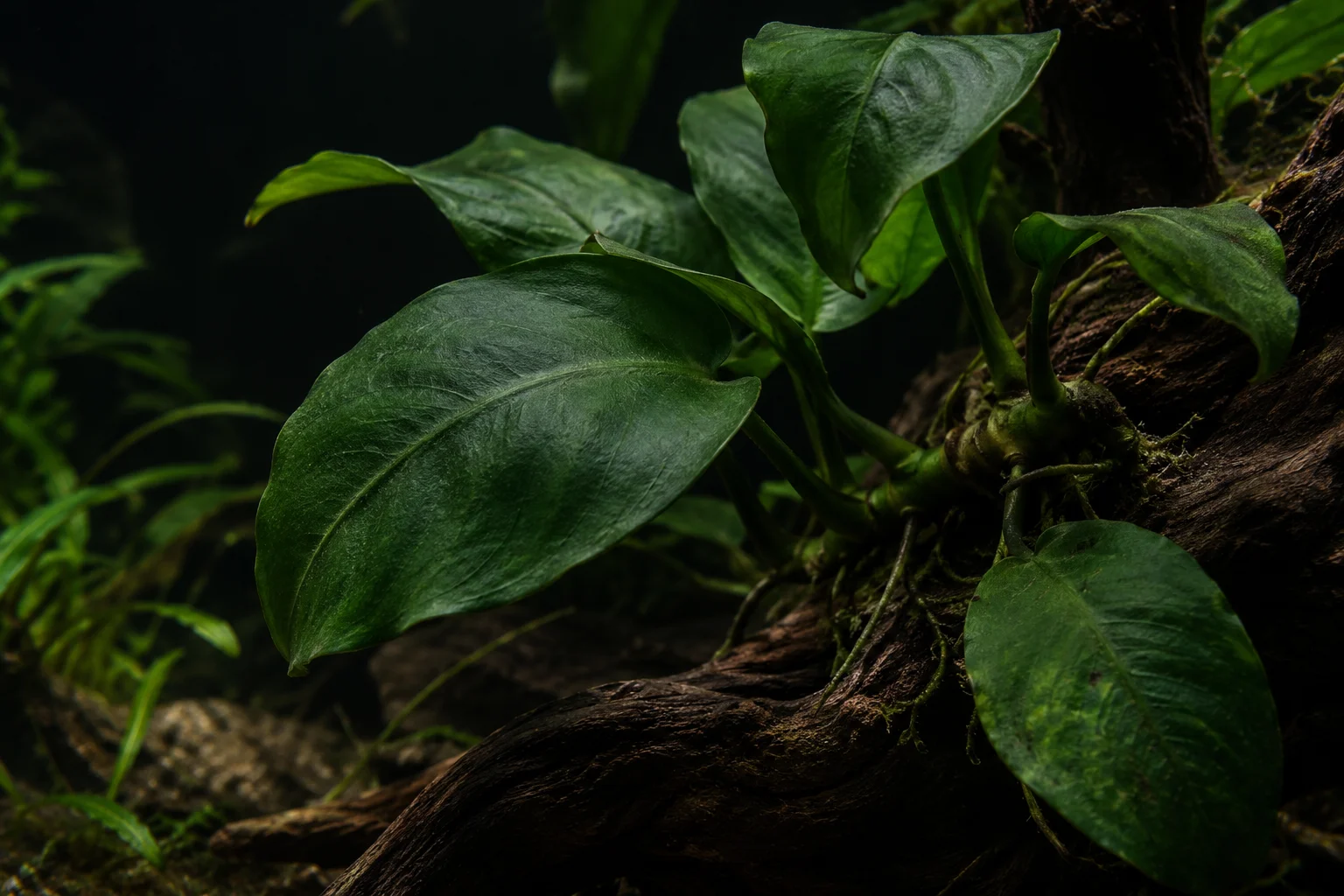
PlantsAnubias care guide: types, planting, light and propagation
Tough, slow-growing epiphytes for wood and rock, safe with cichlids and goldfish that uproot everything else.
PlantsFloating aquarium plants: the 10 best floaters and how to keep them
Frogbit, salvinia and red root floaters: shade, nitrate control and resting spots for bettas.
PlantsCarpet aquarium plants: 12 ground cover plants, from easy to expert
Dwarf hairgrass, Monte Carlo and other ground covers, and the light and CO2 a lawn really needs.
01
Why keep live aquarium plants?
A planted aquarium is more stable than a bare one. Fast-growing plants take up ammonia and nitrate as nutrients, so they act as a second filter between water changes. They shade the water, compete with algae for the same nutrients and give shy fish, fry and shrimp places to hide. Many keepers also find that fish color up and behave more naturally among real plants than among plastic ones.
Live plants are not a replacement for a cycled tank or regular water changes, though. They help most when the basics are already in place, and a heavily planted tank with good light can still grow algae if nutrients and light are out of balance.
- Water quality: plants absorb nitrate and phosphate between water changes
- Algae control: healthy, growing plants compete with algae for light and nutrients
- Shelter: cover for fry, shrimp and timid fish
- Oxygen: plants release oxygen while the light is on
- Natural look: the foundation of every aquascape
02
Where to start with a planted tank
If this is your first planted tank, start with our list of the best aquarium plants for beginners. Most of those species grow under the light that came with your tank, need no CO2 and forgive irregular fertilizing. If your hood light is weak or the tank sits in a dim room, go straight to the low light aquarium plants guide.
Two plants deserve a special mention because they survive almost any setup: Java fern and anubias. Both attach to rock or driftwood instead of growing in the substrate, which makes them ideal for gravel tanks and for fish that dig. For a large background plant in a 30 gallon tank or bigger, the Amazon sword is the classic choice.
03
Light, substrate, CO2 and fertilizer
Every plant guide on handsoffmyhobby rates each species against the same four factors. Light is the engine: it sets how fast plants grow and how much of everything else they need. A decent aquarium light with adjustable intensity makes the jump from easy plants to stem plants much simpler. Substrate matters for root feeders like swords and crypts; an aquarium substrate made for plants helps, but plain gravel works with root tabs.
CO2 injection is optional for most beginner plants and close to mandatory for carpets like dwarf hairgrass and Monte Carlo. Our aquarium CO2 guide explains when it is worth it, and the aquarium fertilizer guide covers liquid ferts and root tabs.
| Setup | Light | CO2 | Fertilizer | Typical plants |
|---|---|---|---|---|
| Low-tech | Low to medium | None | Light liquid dose, root tabs | Java fern, anubias, crypts, mosses, floaters |
| Medium-tech | Medium | Optional (liquid carbon or low CO2) | Weekly all-in-one | Swords, vallisneria, Ludwigia, Rotala |
| High-tech | High | Injected, 20–30 ppm | Regular, measured dosing | Carpets, red stem plants, demanding species |
04
Plants and aquascaping
Once your plants are growing, the next step is arranging them. Our aquascaping section covers the main styles: the stone-led Iwagumi, the dense, colorful Dutch aquascape and the low-maintenance, soil-based Walstad method. Each style guide lists the plants that fit it and the equipment it needs.
05
When plants struggle
Melting leaves, holes, yellowing and algae on the leaves almost always point to an imbalance between light, CO2 and nutrients. Algae is the most common sign: black beard algae often follows unstable CO2, while brown algae is normal in a new tank and usually fades as plants take hold.
Quarantine or rinse new plants before adding them. Snails, snail eggs and pest algae often arrive on plants, and pesticide residue on some farmed plants can harm shrimp. Tissue-culture (in-vitro) cups avoid both problems.
Every guide in this section
- 01Best aquarium plants for beginners: 15 easy live plants
- 02Low light aquarium plants: 15 species that grow without CO2
- 03Floating aquarium plants: the 10 best floaters and how to keep them
- 04Carpet aquarium plants: 12 ground cover plants, from easy to expert
- 05Java fern care guide: planting, propagation and common problems
- 06Anubias care guide: types, planting, light and propagation
- 07Amazon sword plant care: planting, fertilizer and propagation
- 08Dwarf hairgrass guide: how to grow a dense carpet
- 09Monte Carlo aquarium plant care: how to grow a dense carpet
- 10Aquarium CO2 guide: when you need it and how to set it up safely
- 11Aquarium fertilizer guide: liquids, root tabs and how to dose
Frequently asked questions
Frequently asked questions
What are the easiest live plants for an aquarium?
Java fern, anubias, Java moss, Cryptocoryne wendtii, Amazon sword, hornwort and floating plants like Amazon frogbit are the easiest. They grow under basic lighting without CO2 and tolerate a wide range of water. Java fern and anubias are the most forgiving because they attach to decor and are rarely eaten by fish.
Do aquarium plants need special substrate?
Not always. Plants that attach to wood or rock, mosses and floating plants need no substrate at all. Root feeders such as swords, crypts and vallisneria grow well in plain sand or gravel if you push root tabs near their roots every few months. A nutrient-rich aquasoil mostly pays off for carpets and high-tech tanks.
Do I need CO2 for a planted tank?
No, not for most beginner and low-light plants. CO2 injection speeds up growth and makes carpets and many red stem plants possible, but it also demands stronger light and more fertilizer. Start low-tech, and add CO2 only when you want plants that clearly need it.
How long should the aquarium light be on for plants?
Around 6 to 8 hours a day suits most planted tanks. Longer photoperiods rarely help plants much but often feed algae. Use a simple timer so the schedule stays the same every day, and only lengthen it gradually if plants are clearly healthy and algae-free.
Sources and references
Written and reviewed by the handsoffmyhobby editorial team according to our editorial policy.