01
Do you really need to lower your aquarium pH?
Before reaching for a bottle, ask whether a high reading is actually a problem. Most commonly kept fish, including guppies, platies, mollies, most barbs and many livebearers, live happily anywhere between pH 6.8 and 8.0. Even many "soft water" species sold today are farm-bred and adapt to pH 7.0–7.6 without trouble. A stable pH matters far more than hitting a textbook number.
You have good reasons to reduce aquarium pH when you keep or breed species that genuinely need soft, acidic water, such as discus, cardinal tetras, German blue rams or wild-caught Apistogramma, or when your tap water comes out above pH 8 and the fish show stress. Our overview of aquarium water parameters gives target ranges for the most popular species.
Test your tap water after letting a glass sit for 24 hours. Tap water often carries dissolved CO2 that makes the first reading look lower (or higher) than it will be once the water settles.
02
Why pH and KH go together
pH measures how acidic or alkaline the water is. KH (carbonate hardness, or alkalinity) measures the carbonates and bicarbonates that neutralize acid. KH acts like a sponge: as long as there is plenty of it, any acid you add is soaked up and pH springs back. That is why pH Down drops seem to stop working after a day in hard water, and why the same few drops can crash pH in very soft water.
In practice, lasting pH changes come from changing KH. Water with a KH of 6–10 °dH (about 107–179 ppm) will sit around pH 7.5–8 almost no matter what you do. Bring KH down to 2–4 °dH (36–71 ppm) and gentle methods like driftwood or peat can hold pH in the 6.5–7.0 range. Going below 1–2 °dH is risky, because the buffer is too weak to stop the nitrogen cycle from acidifying the water.
| KH | Typical pH behavior | What it means for you |
|---|---|---|
| Above 8 °dH (143 ppm) | Locked at 7.8–8.4 | Only diluting with soft water will lower pH |
| 4–8 °dH (71–143 ppm) | Stable around 7.2–7.8 | Natural methods give small changes |
| 2–4 °dH (36–71 ppm) | Easy to hold at 6.5–7.2 | Ideal zone for most soft-water fish |
| Below 2 °dH (36 ppm) | Can drift fast below 6 | Test often; risk of pH crash |
03
Common causes of high pH in a fish tank
Check the hardscape first. Drop a little vinegar on a dry rock: if it fizzes, it releases carbonates and will keep pushing pH up as long as it stays in the tank.
- Hard, alkaline tap water, often treated by the water utility to protect pipes
- Calcareous rock or decor: limestone, Texas holey rock, seiryu stone, ocean rock, shells
- Crushed coral, aragonite sand or some colored gravels that contain carbonates
- Strong surface agitation that drives off CO2 (a mild, normal effect)
- Leftover buffer products or salts added for livebearers or cichlids
04
How to lower pH in an aquarium step by step
Follow these steps in order. Each one is gentle on its own, and together they produce a durable, natural drop rather than a swing.
- Measure pH, KH and GH with a liquid test kit and write the numbers down. Measure your tap water too, so you know your starting point.
- Remove any rock, gravel or decor that fizzes with vinegar, and replace it with inert stone or sand.
- Prepare softer water for changes: mix reverse osmosis (RO), distilled or filtered rain water with tap water. Start with 25% RO and adjust the ratio until the mix reaches your target KH.
- Do your normal water change with the mixed water, no more than 20–25% at a time, so pH moves by only 0.2–0.3 units per day.
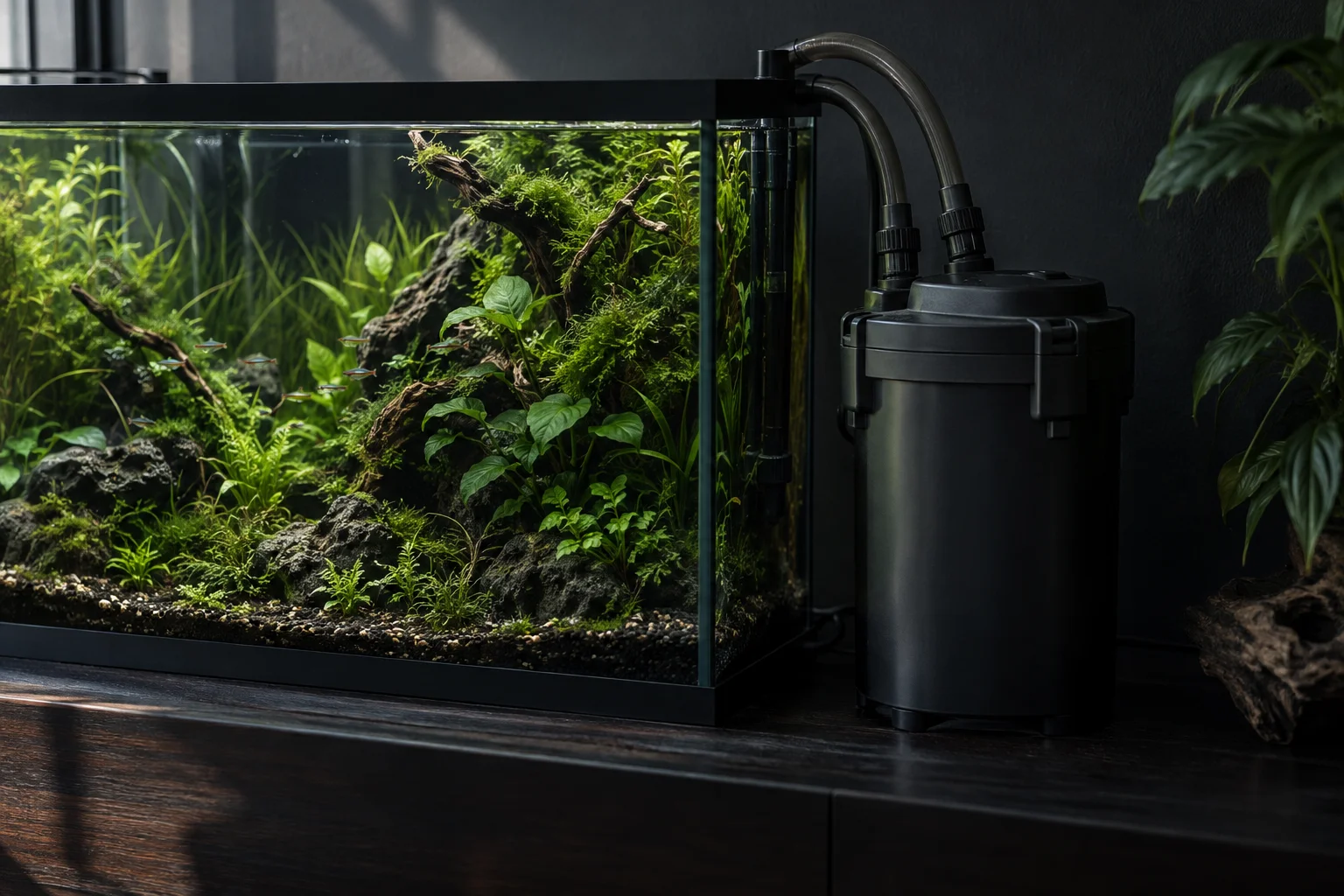
- Add natural acidifiers: one or two pieces of boiled or soaked driftwood, a few Indian almond leaves or catappa, and a filter bag of aquarium peat in the filter flow.
- Re-test pH and KH every 1–2 days. Increase the RO share or the peat only if the readings stay above target after a week.
- Once pH sits where you want it, keep every water change at the same RO-to-tap ratio so the chemistry stays steady.
Never use pure RO or distilled water alone. It has no minerals and no buffer, so pH can collapse. Always remineralize or blend it with tap water.
05
Natural ways to lower pH
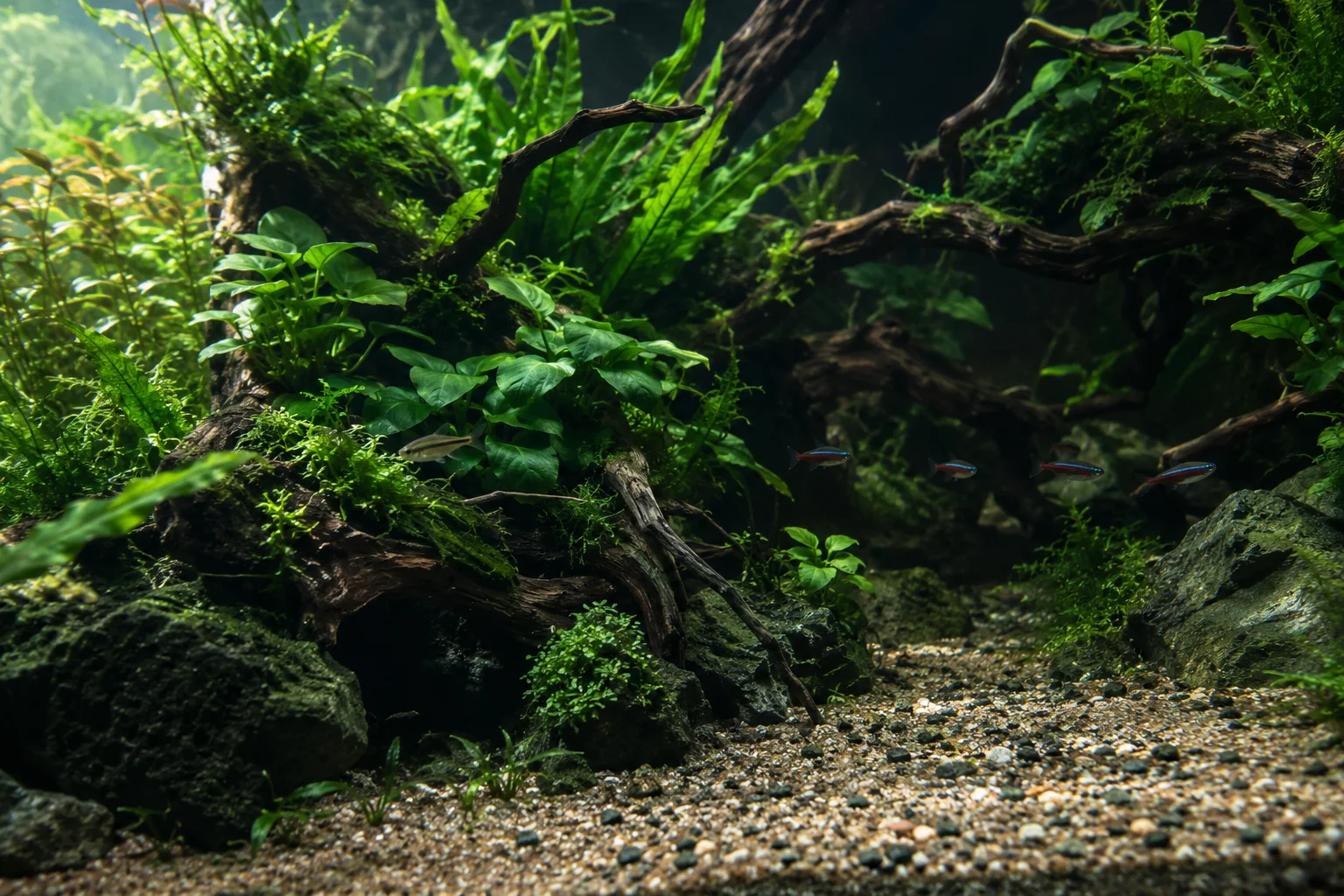
Driftwood releases humic and tannic acids. The effect is mild, typically a few tenths of a pH unit in soft water, and it tints the water a light tea color, which many blackwater species appreciate. Mopani, Malaysian driftwood and spiderwood all work.
Indian almond leaves (catappa) do the same in a smaller dose and are easy to replace as they break down. Our dedicated page on Indian almond leaves covers dosing per gallon and how to prepare them.
Aquarium peat is the strongest natural option. Put it in a mesh bag in the filter, after mechanical media, and replace it every 3–4 weeks as it gets used up. Use only peat sold for aquariums, since garden peat may contain fertilizers. Peat also softens water slightly.
CO2 injection in planted tanks lowers pH while it runs, often by 0.5–1 unit. It reverses when the CO2 turns off at night, which plants and fish tolerate well, but it is a tool for plants rather than a way to set pH. See our guide to aquarium CO2 before trying it.
06
Using pH-lowering products
Products such as API pH Down, Seachem Acid Buffer or Seachem Neutral Regulator do lower pH, but in water with a KH above about 4 °dH the effect fades within a day or two as carbonates absorb the acid. Re-dosing every day causes the very swings that stress fish. If you use one, measure KH first, follow the label exactly, dose into the water you are adding rather than directly into the tank, and combine it with softer water so the change sticks.
Phosphate-based pH products can also feed algae, so watch for growth after using them. In most tanks, blending RO water is cheaper and more predictable than chemicals.
07
Common mistakes when lowering pH
Remember that nitrifying bacteria slow down below about pH 6.5. If you are still cycling a fish tank, keep pH near 7 until the cycle is complete.
- Chasing a number when the fish are healthy and the pH is stable
- Dropping pH by a full unit in one day, which can shock fish and stall the biofilter
- Daily pH Down doses in hard water, causing a sawtooth pattern of swings
- Using pure RO water with no minerals, leading to a pH crash
- Leaving limestone or crushed coral in the tank while adding acids
- Testing only pH and never KH
08
When to stop and what to buy
Stop lowering pH and do a 25% water change with plain conditioned tap water if fish gasp, darken, clamp their fins or lie on the bottom, or if pH falls below 6.0 unexpectedly. In soft water, ammonia is less toxic but bacteria work slower, so watch for signs of ammonia poisoning. If you went too far, our guide on how to raise pH explains how to rebuild KH gently.
The one essential purchase is a reliable liquid kit that includes KH and GH; compare options in our best aquarium test kit guide. A conditioner that handles chloramine matters when you mix tap water, see our best water conditioner picks. For blackwater looks, choose an inert aquarium substrate or an active soil, which naturally buffers pH down to around 6.5.
Frequently asked questions
Frequently asked questions
How can I lower pH in my aquarium naturally?
Add driftwood, Indian almond leaves or a bag of aquarium peat in the filter, remove any limestone or shell-based decor, and blend RO or distilled water into your water changes to reduce KH. These methods act slowly, usually over one to two weeks, which is exactly what you want: a gradual, stable change that fish adapt to without stress.
What pH is too high for aquarium fish?
For most community fish, a stable pH up to about 8.0 is fine. Above 8.2–8.5, soft-water species such as tetras, rasboras, discus and dwarf cichlids often show stress, and ammonia becomes more toxic. Livebearers, goldfish and African rift lake cichlids, on the other hand, are comfortable at 7.5–8.5.
How fast can I lower pH without hurting my fish?
Aim for no more than 0.2–0.3 pH units per 24 hours. Bigger, faster drops stress gills and can stall the beneficial bacteria. If you need to move a full unit, spread the change over a week or more of small water changes with softer water, testing pH and KH every one or two days.
Does driftwood lower pH a lot?
Usually not. In soft water with low KH, driftwood can drop pH by a few tenths. In hard, well-buffered water, the effect may be barely measurable. It works best alongside RO water or peat. Its tannins also soften light and tint the water amber, which suits blackwater species.
Why does my pH keep going back up after using pH Down?
Because your KH is high. Carbonates in the water neutralize the acid, and pH returns to its buffered level within a day or two. Lower KH first by mixing RO or distilled water into your water changes and removing carbonate rocks, then the pH will stay down.
Sources and references
Written and reviewed by the handsoffmyhobby editorial team according to our editorial policy.