01
How to clean a fish tank without hurting your fish
A healthy aquarium is a living system. Millions of nitrifying bacteria live in the filter media, the gravel and on every surface, turning toxic ammonia into nitrate. If you scrub everything, replace the filter cartridge and change all the water at once, you wipe out that colony and the tank behaves like a new one, with ammonia and nitrite spikes a few days later. If your tank is not yet established, start with our guide on how to cycle a fish tank.
The goal of an aquarium cleaning routine is the opposite: remove what you can see (algae, uneaten food, fish waste, dead leaves) and dilute what you cannot see (nitrate, dissolved organics), while leaving the biology alone. Done this way, cleaning takes 20–40 minutes a week for most tanks under 55 gallons (210 L).
- Fish never need to be removed for routine cleaning
- Soap, detergents and household cleaners must never touch anything that goes in the tank
- Tap water must always be treated with a water conditioner before it goes back in
02
Why regular cleaning matters
Even in a cycled tank, nitrate keeps rising between water changes, and organic waste trapped in the gravel and the filter slowly lowers oxygen and feeds algae. Nitrate above 40 ppm stresses most fish and fuels green water and hair algae. Our page on how to lower nitrates explains how to bring them back under control.
Old water also loses its buffering capacity over time, which can let the pH slide. Small, regular cleanings keep all of this stable. Big, rare cleanings do the opposite: they swing temperature, pH and hardness all at once, which is more stressful than the dirt they remove.
03
What you need
Keep the bucket, sponges and brushes separate from household cleaning tools, so no trace of soap or chemicals ever reaches the tank.
- A gravel vacuum (siphon) sized for your tank; see our best gravel vacuum picks
- A bucket used only for the aquarium
- An algae scraper or magnetic glass cleaner, with a plastic blade for acrylic tanks
- An old toothbrush for decor and tubing, and a filter brush for hoses
- Water conditioner and a thermometer to match the new water’s temperature
- Paper towels and white vinegar for the outside of the glass and the lid
04
Step-by-step fish tank cleaning routine
Follow this order every week. Working from top to bottom means the debris you knock loose from the glass and decor ends up in the gravel, where the vacuum picks it up.
- Turn off and unplug the heater, filter and any pumps. Give the heater 10–15 minutes to cool before the water level drops below it.
- Clean the glass inside with a scraper or magnet. Start at the front, then the sides. Keep the magnet free of gravel to avoid scratches.
- Wipe or brush any decor that has algae. Remove pieces only if they need a scrub; rinse them in old tank water.
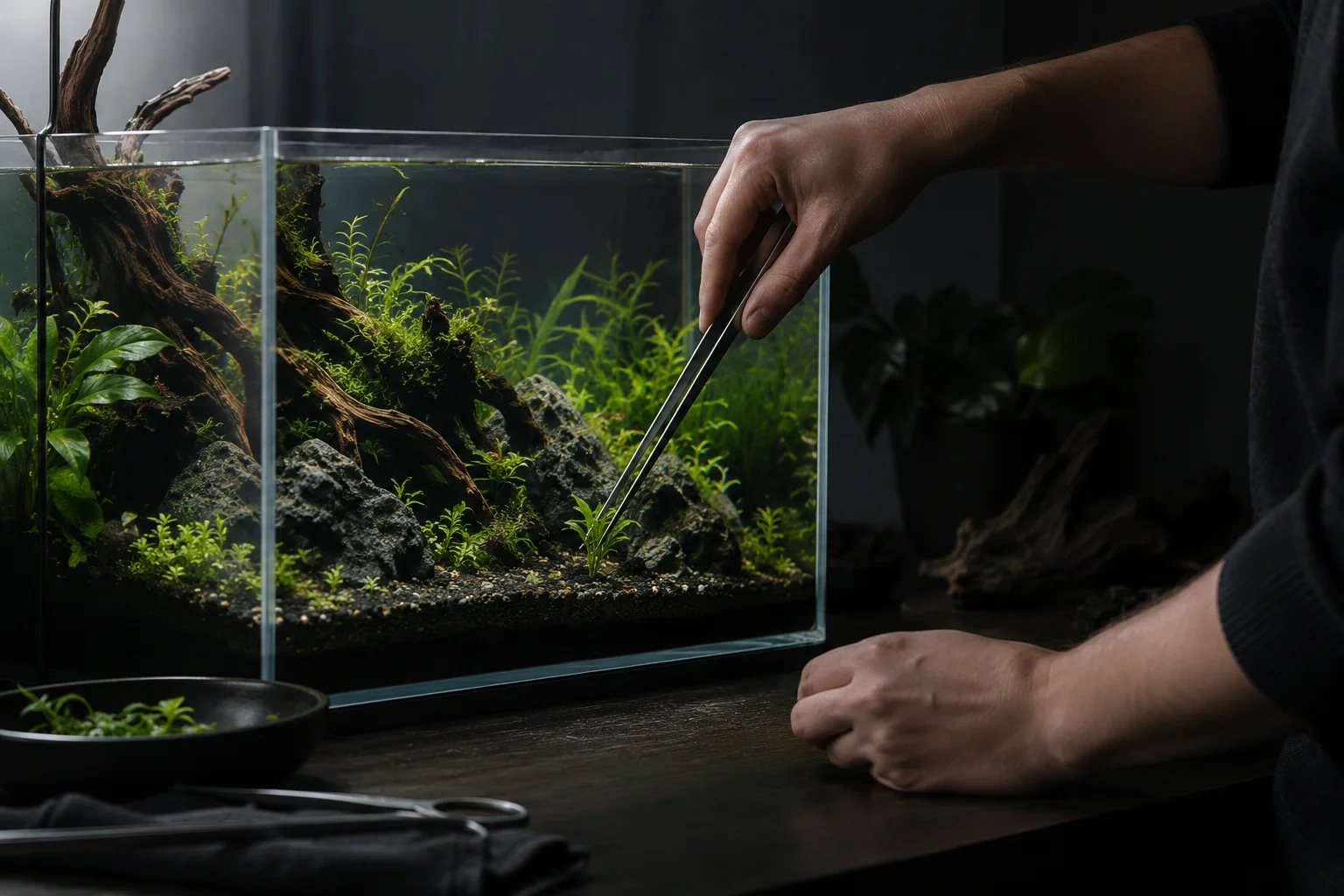
- Trim dead or melting plant leaves and remove them.
- Vacuum the gravel: push the siphon into the substrate, let it lift the debris, then move on before the gravel is sucked up. In planted tanks, only hover over the surface around the plants.
- Stop when you have removed 20–30% of the water. Keep some of it in the bucket if you plan to rinse filter media today.
- Prepare the new water: treat it with conditioner for the full tank volume and match the temperature within about 2 °F (1 °C).
- Refill slowly, pouring onto a plate, a rock or your hand so the substrate is not stirred up.
- Plug the filter and heater back in once the heater is fully submerged. Check that the filter primes and runs.
- Clean the outside glass and the lid with a damp cloth or a little vinegar, never a glass spray near the open tank.
Never run a heater out of water, and never plug a hot heater back in before it is submerged. Thermal shock can crack the glass tube.
05
How to clean a fish tank filter
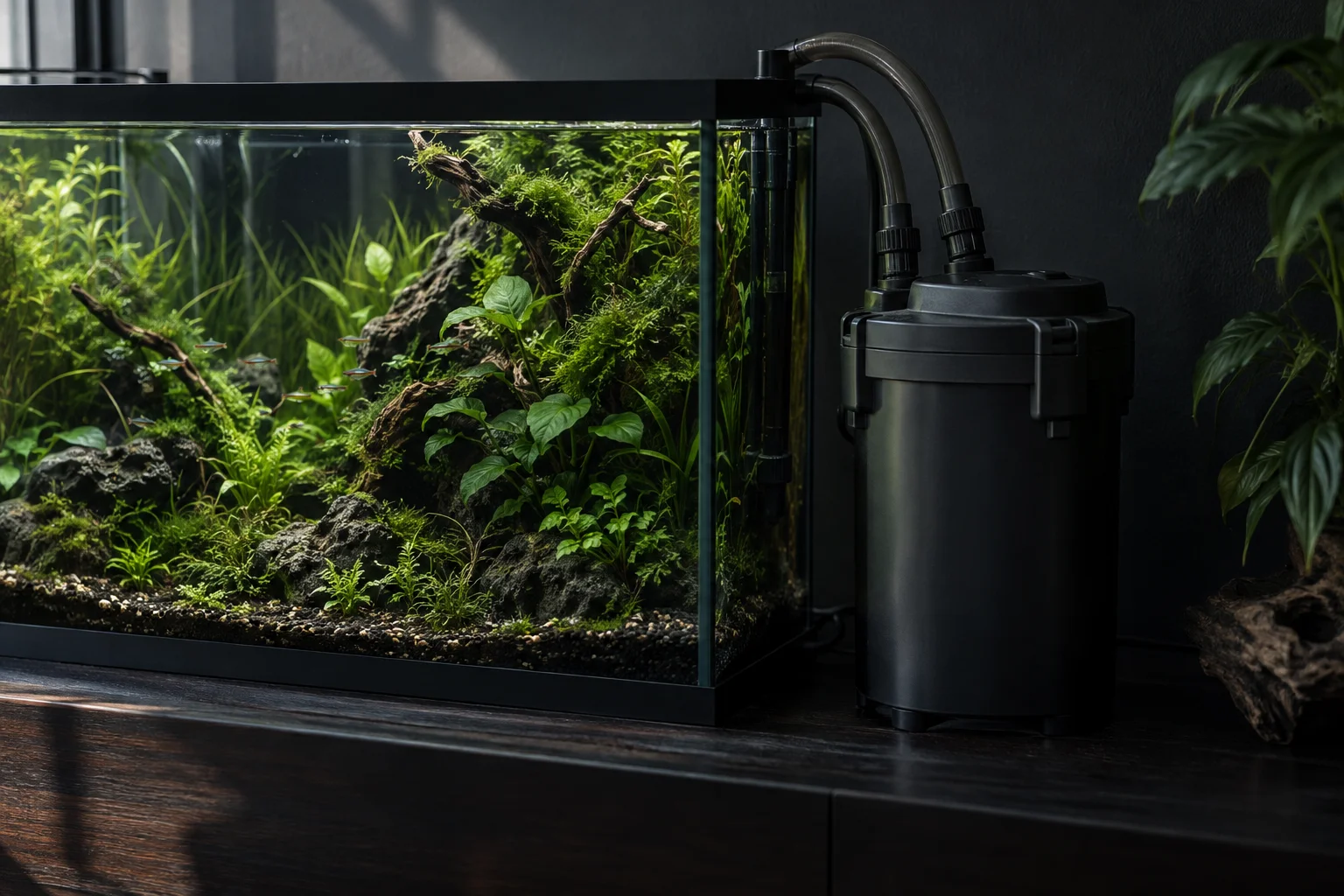
The filter is where most of your bacteria live, so it needs the gentlest treatment. Clean it only when the flow drops noticeably, usually every 2–4 weeks for hang-on-back and sponge filters and every 1–3 months for canister filters. Clean the filter and the substrate on different weeks so the bacteria in one can cover for the other.
Always rinse media in water you removed from the tank. Chlorine and chloramine in tap water kill nitrifying bacteria, and a sudden temperature change does not help either. Squeeze sponges a few times until they release most of the sludge; they do not need to look new. Brown water in the bucket is normal.
Replace media only when it falls apart, and never all at once. Mechanical floss and fine pads can be swapped when they are clogged; biological media such as ceramic rings or bio-balls should be kept for years and only swished in tank water. If your filter uses cartridges, cut the new one in, or keep the old sponge next to it for a few weeks. Comparing models in our best aquarium filter and best canister filter guides can help if your current filter is hard to maintain.
| Filter type | How often | How to clean |
|---|---|---|
| Sponge filter | Every 2–4 weeks | Squeeze the sponge in tank water, check the air line |
| Hang-on-back (HOB) | Every 2–4 weeks | Rinse sponge or cartridge in tank water, wipe the intake |
| Canister filter | Every 1–3 months | Rinse pads in tank water, swish bio media, clean hoses |
| Internal filter | Every 2–4 weeks | Rinse sponges in tank water, clean the impeller |
| Impeller and tubing (all) | Every 2–3 months | Brush out slime; reduced flow is often a dirty impeller |
06
Aquarium cleaning schedule
A routine you can actually keep is better than a perfect one you skip. This schedule fits most community tanks with a moderate stocking level.
| When | Task |
|---|---|
| Daily | Check fish, temperature and filter flow; remove uneaten food |
| Weekly | 20–30% water change with gravel vacuum, clean the glass, test nitrate |
| Every 2–4 weeks | Rinse filter media in tank water, trim plants |
| Monthly | Test pH, KH and GH; clean decor and the lid |
| Every 2–3 months | Clean the impeller, hoses and intake; check the heater |
| Only when needed | Deep-clean decor, replace worn media, rescape |
Our dedicated guide to aquarium water changes explains how to adapt the percentage and frequency to your stocking and nitrate readings.
07
Cleaning decor, plants and algae
Hard decor (rocks, resin ornaments, artificial plants) can be scrubbed with a toothbrush in old tank water. For stubborn algae on a removed piece, rinse it in hot tap water and scrub; for white mineral deposits, soak it in a 50/50 mix of white vinegar and water, then rinse very well and let it dry before it goes back in.
Live plants should not be bleached or scrubbed in place. Trim damaged leaves and wipe algae off slow growers such as anubias and java fern with your fingers. If algae keep coming back, the cause is light, nutrients or waste, not a lack of scrubbing: see brown algae for new tanks and consider an algae-eating crew from our list of the best snails for algae.
08
Common cleaning mistakes
If your water turns milky a day or two after cleaning, it is often a bacterial bloom after too much was disturbed; our guide to cloudy fish tank water explains how to handle it.
- Rinsing filter media under the tap, which kills the bacteria
- Replacing every cartridge and sponge on the same day
- Deep-cleaning the filter and the gravel in the same session
- Changing more than 50% of the water in an established tank without testing first, which can swing pH and hardness
- Forgetting the conditioner, or dosing it only for the new water when the label says to treat the full volume
- Using soap, glass spray or household cleaners on anything that touches the water
- Breaking the tank down and washing the gravel: this almost guarantees a mini-cycle
09
When to stop and test
If fish gasp at the surface, hide with clamped fins or lose color after a cleaning, test ammonia and nitrite immediately. A reading above 0.25 ppm means the bacterial colony was disturbed: change 25–50% of the water, dose a conditioner that binds ammonia, and avoid any further cleaning until the readings are back at zero. A liquid kit from our best aquarium test kit guide gives clear answers. If fish still decline with good water, check our troubleshooting hub and contact an aquatic veterinarian for serious cases.
Frequently asked questions
Frequently asked questions
How often should you clean a fish tank?
Do a light cleaning every week: a 20–30% water change with a gravel vacuum and a quick glass wipe. Rinse the filter media every 2–4 weeks, or every 1–3 months for a canister filter. Heavily stocked tanks or goldfish tanks may need two water changes a week. Let your nitrate readings, ideally under 20–40 ppm, guide you.
How do you clean a fish tank filter without killing bacteria?
Unplug the filter, take out the sponge or media and rinse it in a bucket of water removed from the tank during the water change. Squeeze it a few times until most of the sludge is gone, but do not aim for spotless. Never use tap water or soap, and never replace all the media at once.
Do I need to take the fish out to clean the tank?
No. Removing fish causes more stress than the cleaning itself and risks injury. Routine cleaning with a gravel vacuum and a partial water change is done with the fish in place. The only time to move them is when the tank must be completely emptied, for example to fix a leak or relocate it.
Can I clean a fish tank with vinegar?
Yes, for mineral deposits. A 50/50 mix of white vinegar and water removes white limescale from the glass of an empty tank, the lid or removed decor. Rinse thoroughly afterwards. Do not pour vinegar into a tank with fish, and avoid it on marble or limestone decor, which it dissolves.
Why is my tank cloudy after cleaning?
Short-lived cloudiness right after vacuuming is fine particles and clears in a few hours. Milky water that appears one or two days later is usually a bacterial bloom, often after cleaning too much at once. Test ammonia and nitrite, avoid overfeeding, and let the filter work; it typically clears within a few days.
Sources and references
Written and reviewed by the handsoffmyhobby editorial team according to our editorial policy.