01
What is the Iwagumi style?
Iwagumi means roughly "rock formation" in Japanese. The term comes from traditional Japanese garden design, and the aquascape style was popularized by Takashi Amano, the founder of Aqua Design Amano (ADA), as part of his Nature Aquarium approach. An Iwagumi tank recreates a grassland or mountain landscape with stones as the only hardscape and a low, uniform carpet of plants.
The principles are restraint and balance. One rock type, one main carpet species, open space, and one school of fish that moves through the layout without competing with it. Because the composition is so sparse, every angle and gap matters, which is why Iwagumi is often called the hardest style to master.
02
Iwagumi layout rules
Iwagumi stones have traditional names and roles. You do not need to follow them like law, but they explain why the classic layouts work.
- Use an odd number of stones: 3 is the classic triad, 5 or 7 work in larger tanks
- Use one rock type with matching color and texture
- Keep the strata (grain lines) of all stones pointing the same way, like one broken outcrop
- Slope the substrate up toward the back for depth
- Leave open carpet: negative space is part of the design
| Stone | Role | Placement tips |
|---|---|---|
| Oyaishi (main stone) | The largest, most striking rock and the focal point | Off-center, roughly at one third or the golden ratio (about 38/62) of the tank length, leaning slightly |
| Fukuishi (secondary stone) | Balances the main stone | Same side or opposite third, smaller, angled in the same direction |
| Soeishi (accent stones) | Support and connect the main stones | Placed around the oyaishi to strengthen its lines |
| Suteishi (sacrificial stones) | Small stones that add depth | Partly buried, often toward the back or sides |
03
Iwagumi rocks and carpet plants
The most used Iwagumi rocks are Seiryu stone (gray with white veins), Ryuoh stone, dragon stone (ohko) and lava rock. Seiryu is calcareous and slowly raises KH and GH, so test your water parameters if you keep soft-water fish or shrimp. Dragon stone and lava rock are largely inert. Buy 20–30% more rock than you think you need so you can choose the best faces.
The carpet is the second half of the picture. Classic choices are dwarf hairgrass (Eleocharis species) for a grass look, Monte Carlo (Micranthemum tweediei) for a rounded leafy lawn, Glossostigma elatinoides and HC Cuba (Hemianthus callitrichoides) for the finest texture. Our guide to carpet aquarium plants compares their light and CO2 needs. Most Iwagumi layouts use one carpet species, sometimes with a second low plant around the stones.
04
Equipment for an Iwagumi tank
A rimless tank shows the layout best. A standard 60 cm tank (about 24 x 12 x 14 in, 17 gallons / 65 L) is a classic first size. The gear matters more than in almost any other style because carpets need intense light and plenty of CO2 to grow dense and low.
- Light: a strong planted-tank LED with good spread across the whole front; see our best aquarium light picks
- CO2: a pressurized CO2 system with a regulator, solenoid and drop checker reading lime green (about 30 ppm)
- Substrate: an active aqua soil (ADA Aqua Soil Amazonia, Fluval Stratum, Tropica Aquarium Soil) from our aquarium substrate guide
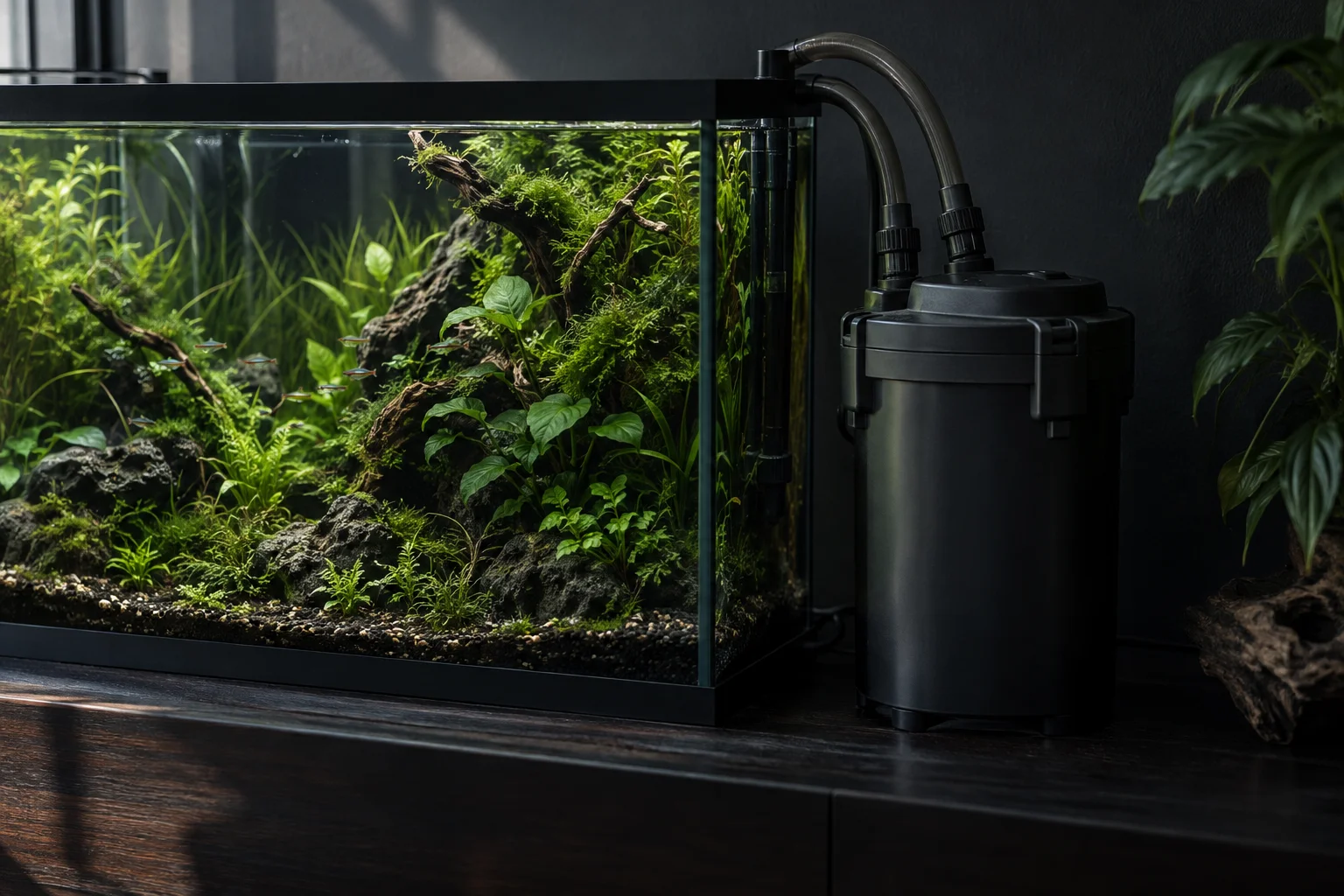
- Filtration: a canister filter turning the volume over about 5–10 times per hour, with glass lily pipes
- Fertilizer: a comprehensive liquid fertilizer once the carpet is established; see aquarium fertilizer
05
How to set up an Iwagumi step by step
Plan the layout dry, then build, plant and flood in that order. Many keepers use the dry start method for the carpet: the plants grow emersed in moist soil under plastic wrap for 4–6 weeks before the tank is filled, which gives a rooted carpet with almost no algae risk.
- Rinse the rocks and place them on the empty, dry glass to test compositions; photograph each option
- Add a thin layer of base substrate or lava grit if you want, then aqua soil, about 1–2 in (3–5 cm) at the front rising to 3–4 in (8–10 cm) at the back
- Set the stones into the soil, burying about one third of each so they look rooted
- Plant the carpet in small tufts with tweezers, about 1 in (2–3 cm) apart, densely
- Either flood slowly over a plate or plastic sheet, or keep the soil moist and covered for a dry start
- Run CO2 and lights from day one, with a 6 hour photoperiod rising to 7–8 hours over a month
- Do 50% water changes every 2–3 days for the first two weeks, then weekly, while new aqua soil releases ammonia
- Add fish only after the tank has finished cycling and ammonia and nitrite read zero
06
Fish and shrimp for an Iwagumi
Traditionally, an Iwagumi has a single school of one small species so the fish read as part of the landscape. Good choices are harlequin rasboras, ember tetras, celestial pearl danios or a group of rummy-nose tetras in larger tanks. Add a cleanup crew of Amano shrimp and a few otocinclus to keep film algae off the carpet and stones. Avoid diggers such as large loaches, goldfish and most cichlids, which uproot carpets.
07
Maintenance and trimming
Trim the carpet with curved scissors once it grows thicker than about 1–1.5 in (3–4 cm), otherwise the lower layer rots and lifts off the soil. Siphon the clippings out immediately. Keep weekly 30–50% water changes, wipe the glass and check the drop checker every day: CO2 that drifts low is the most common trigger for algae in Iwagumi tanks.
08
Common Iwagumi mistakes
Most of these come from impatience. An Iwagumi rewards a slow, controlled start more than any other style.
- Too many stones or mixed rock types, which turns minimalism into clutter
- Main stone in the dead center of the tank
- Sparse planting at the start, leaving bare soil for algae
- Full-length photoperiod from day one, a classic cause of brown diatoms and green spot algae
- Unstable or insufficient CO2, which leads to black beard algae on the stones
- Adding fish before the aqua soil has stopped leaching ammonia
Never inject CO2 without a drop checker and close observation of the fish. Gasping at the surface means CO2 is too high: switch it off and increase surface agitation at once.
Frequently asked questions
Frequently asked questions
How many rocks should an Iwagumi have?
An odd number, most often three, five or seven. Three stones (main, secondary and accent) is the classic triad and works well in tanks up to about 20 gallons (75 L). Larger tanks can take five or seven, plus small sacrificial stones. What matters most is one dominant stone and a single rock type.
Can you make an Iwagumi without CO2?
It is possible but slow and risky. Without CO2, the classic carpets grow thin and patchy, and the open soil invites algae. If you want a low-tech Iwagumi, use moderate light, slow but tolerant carpet plants such as Sagittaria subulata or Monte Carlo, liquid carbon, and accept that it will take months to fill in.
What is the best rock for an Iwagumi tank?
Seiryu stone is the classic Iwagumi rock for its sharp shapes and gray color, but it raises KH and GH. Dragon stone (ohko) and lava rock are near-inert and suit soft-water fish and shrimp. Choose one type and buy extra so you can pick the best faces.
What fish go in an Iwagumi tank?
One school of a small, peaceful species, typically 10 to 20 harlequin rasboras, ember tetras or celestial pearl danios in a 17–20 gallon (65–75 L) tank. Add Amano shrimp and otocinclus for algae control. Avoid fish that dig or uproot plants.
Sources and references
Written and reviewed by the handsoffmyhobby editorial team according to our editorial policy.