01
What aquarium fertilizer does
Plants need about 15 nutrients. Carbon comes from CO2, the rest from the water and the substrate. Macronutrients are used in large amounts: nitrogen (N), phosphorus (P) and potassium (K), plus calcium, magnesium and sulfur. Micronutrients or trace elements are needed in tiny amounts: iron, manganese, boron, zinc, copper, molybdenum and others.
Fish waste and food supply some nitrogen and phosphorus, but almost no potassium and too little iron. That is why plants in a well-stocked tank can still turn pale. An aquarium fertilizer fills those gaps. The goal is not to push as much as possible into the water but to keep nothing in short supply, so plants grow steadily and outcompete algae.
02
Why the right dose matters
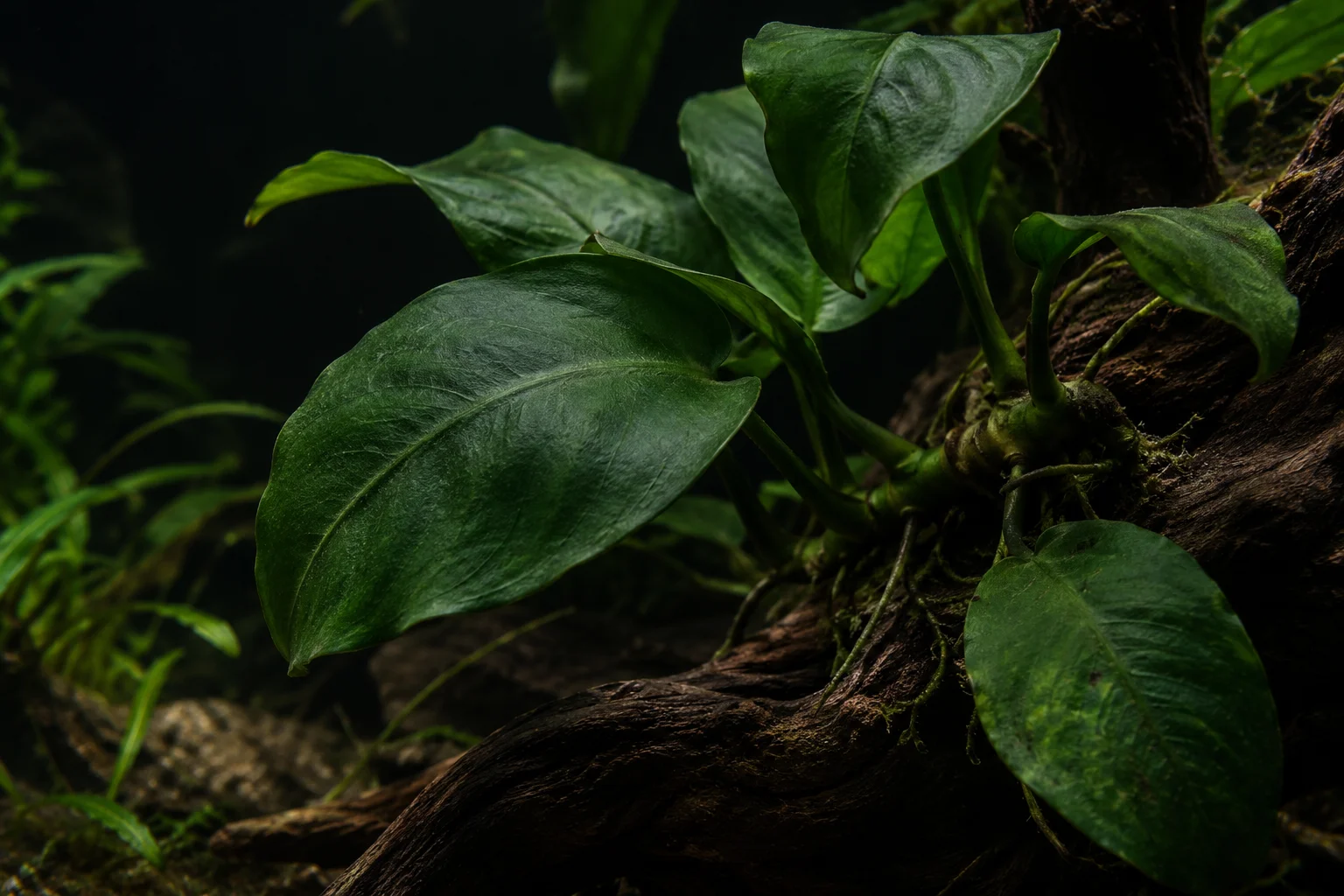
Fertilizer demand depends on how fast plants grow, which depends on light and carbon. A low-light tank with java fern and anubias may need only a small weekly dose. A tank with strong light and injected CO2, as described in our aquarium CO2 guide, can use several times more.
Underdosing causes stunted, pale or holed leaves, and stressed plants leak organics that feed algae. Overdosing in a tank with few plants mainly feeds algae and can harm shrimp. The sweet spot is a dose that matches plant mass and growth speed, adjusted over a few weeks.
03
Types of aquarium fertilizer
Fertilizers come in four main forms. Most tanks use a combination of a liquid and a substrate source.
| Type | Feeds | Pros | Cons |
|---|---|---|---|
| All-in-one liquid | Water column, all plants | Simple, one bottle, easy to adjust | Fixed ratio, can run short of N or P in high-tech tanks |
| Micro-only liquid (e.g. Seachem Flourish) | Trace elements and iron | Good base for low-tech tanks with fish load | No nitrate or phosphate, may need extra macros |
| Root tabs | Roots of substrate feeders | Targeted, lasts weeks | Needs re-inserting, can leak if placed shallow |
| Nutrient substrate (aqua soil) | Roots, for months | Strong start for carpets and stems | Depletes after 6–12 months, some leach ammonia at first |
| Dry salts (EI or custom) | Everything, very cheap | Full control of each nutrient | Requires measuring and large water changes |
04
Liquid fertilizer vs root tabs
Liquid fertilizers feed plants that take nutrients mostly through their leaves: stem plants, mosses, epiphytes such as ferns and anubias, and floating plants. Popular choices in the US include Seachem Flourish (a micronutrient and iron supplement), complete all-in-ones such as Aquarium Co-Op Easy Green, NilocG Thrive or Tropica Premium Nutrition, and separate Seachem products for nitrogen, phosphorus and potassium.
Root tabs are capsules or tablets pushed into the substrate near the roots of heavy feeders such as Amazon swords, cryptocorynes and crinum. Seachem Flourish Tabs and API Root Tabs are widely available. They matter most in inert gravel or sand, and in aqua soil once it is older than about a year.
Osmocote Plus is a slow-release garden fertilizer that some hobbyists pack into gel capsules as home-made root tabs. It is cheap and effective, but it contains ammonium-based nitrogen. If capsules break or sit too close to the surface, they can release ammonia and feed algae. Bury them deep, keep them away from shrimp tanks and fresh setups, and choose a commercial root tab if you are unsure.
05
How to start a fertilizer routine step by step
A simple routine beats a perfect one you cannot keep up. Start low, observe, then adjust.
- Test nitrate, phosphate and, if possible, KH and GH with a reliable aquarium test kit to know your starting point.
- Pick a complete liquid fertilizer and start at half the label dose in low-tech tanks, full dose in tanks with CO2.
- Add root tabs under heavy root feeders, 1–2 in (3–5 cm) from the plant and deep in the substrate, following the label spacing.
- Dose on a fixed schedule, ideally after your weekly water change, or split into daily doses.
- Retest after 2–3 weeks. If nitrate drops to zero, add nitrogen; if it climbs above about 25 ppm, reduce the dose or feed less.
- Watch new and old leaves for 3–4 weeks and adjust one variable at a time.
Common targets in a planted tank: nitrate 10–20 ppm, phosphate 0.5–1 ppm, potassium 10–20 ppm and iron about 0.05–0.1 ppm. High-tech tanks dosing the Estimative Index run higher levels and reset them with a 50% weekly water change.
06
Reading deficiency symptoms
Leaves show shortages fairly reliably. A useful rule: mobile nutrients (N, P, K, Mg) show on old leaves first, because the plant moves them to new growth; immobile ones (Fe, Ca, micros) show on new leaves.
| Nutrient | Typical symptom | Where it shows |
|---|---|---|
| Nitrogen | Uniform yellowing, slow growth, red plants turn pale | Old leaves |
| Phosphorus | Stunted growth, dark leaves, green spot algae on glass | Old leaves, whole plant |
| Potassium | Pinholes and yellow or brown leaf edges | Old leaves |
| Magnesium | Yellow between green veins | Old leaves |
| Iron | Pale or yellow new leaves with green veins | New leaves and tips |
| Calcium | Twisted, stunted or deformed new leaves | Growing tips |
Symptoms overlap and light or CO2 shortage can look similar. Change one thing at a time and give plants 2–3 weeks to show new growth before judging.
07
Common mistakes
Most fertilizer problems come from mismatched doses rather than the wrong brand.
- Dosing high-tech amounts in a low-light tank, then fighting green water and hair algae.
- Using only an iron supplement and wondering why plants stay pale: they may be short of nitrogen or potassium.
- Adding fertilizer to a tank with very few plants. Plant first, fertilize second.
- Placing root tabs too shallow, where they dissolve into the water column.
- Chasing black beard algae with more fertilizer, when the cause is unstable CO2 or old organic waste.
- Trying to cut nitrate to zero in a planted tank. Plants need some; for fish-only tanks see how to lower nitrates.
08
Shrimp, snails and safety
Most plant fertilizers contain small amounts of copper as a trace element. At label doses, well-known brands are widely used with cherry shrimp and snails, but sensitive species and overdoses are a risk. Choose products labelled safe for invertebrates, start at half dose in shrimp tanks and never double up to catch up after a missed dose.
If fish or shrimp act strangely after dosing, do a 30–50% water change with conditioned water and pause fertilizing until you find the cause. A sudden ammonia reading after adding Osmocote capsules or a fresh soil also calls for water changes.
09
Recommended products and next steps
For a first planted tank, an all-in-one liquid plus root tabs under swords and crypts covers almost every need. A nutrient-rich soil from our aquarium substrate reviews helps carpets such as Monte Carlo and other carpet plants get established. If you prefer a no-dosing approach, the soil-based Walstad method relies on a dirt layer and fish waste instead of bottled fertilizer.
Frequently asked questions
Frequently asked questions
Do I need aquarium fertilizer if I have fish?
Usually yes, if you want plants to thrive rather than survive. Fish waste provides some nitrogen and phosphorus but very little potassium and iron. Slow plants like java fern may cope on fish waste alone; most stem plants, carpets and swords need at least a light dose of a complete fertilizer or root tabs.
How often should I use root tabs?
Most root tabs last about 2–3 months, so replace them on that schedule near heavy root feeders such as Amazon swords and cryptocorynes. Push them deep into the substrate, an inch or two from the plant. In a fresh aqua soil you can usually wait several months before adding the first tabs.
Is Seachem Flourish a complete fertilizer?
Seachem Flourish is mainly a micronutrient and trace element supplement with iron. It contains little or no nitrate and phosphate, so it works well in low-tech tanks where fish waste supplies those. In faster-growing or CO2 tanks, pair it with nitrogen, phosphorus and potassium sources or use an all-in-one instead.
Can I use Osmocote Plus as root tabs?
Many hobbyists do, by packing Osmocote Plus into gel capsules and burying them deep. It is cheap and effective, but it contains ammonium-based nitrogen that can leak into the water if capsules break or sit shallow. Avoid it in new tanks and shrimp tanks, and use commercial root tabs if unsure.
Does aquarium fertilizer cause algae?
Not by itself. Algae grow when light, CO2 and nutrients are out of balance, or when there are too few plants to use the nutrients. Underdosing also causes algae, because weak plants cannot compete. Match the dose to plant mass and light, and change water regularly.
Sources and references
Written and reviewed by the handsoffmyhobby editorial team according to our editorial policy.